


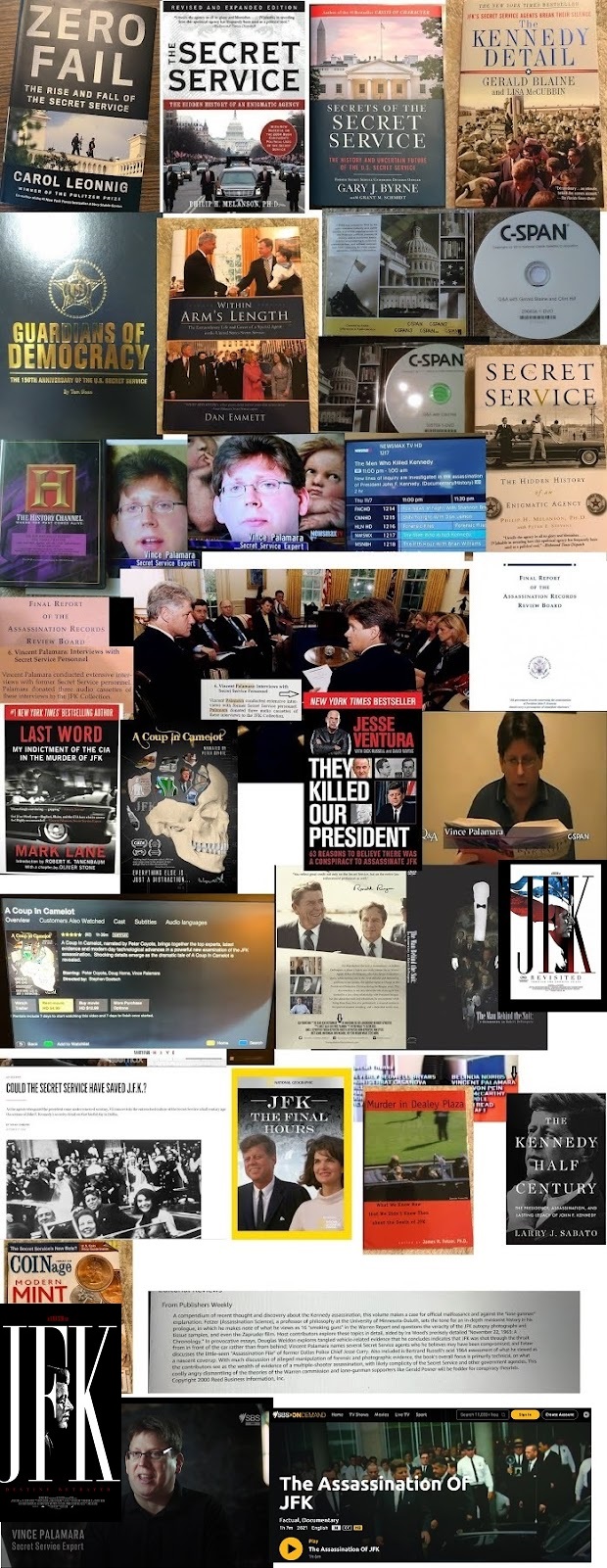

My book selling much better than Clint Hill's new book (and Gerald Blaine's at this same time three years ago)
Holy $@+!!! My book on Amazon right now (not released until 9/1/13)- Dan Emmett confirmed these are outstanding numbers for pre-sales only and are better than a lot of released books: Amazon Best Sellers Rank: #19,796 in Books (See Top 100 in Books)
#53 in Books > Politics & Social Sciences > Social Sciences > Communication & Media Studies...Clint Hill's new book? 412,000-yik! Amazing
Later in the day:
Amazon Best Sellers Rank: #30,491 in Books (See Top 100 in Books)
#79 in Books > Politics & Social Sciences > Social Sciences > Communication & Media Studies
Monday, May 13, 2013


Monday, May 6, 2013
Noted Law Professor gives negative review to "The Kennedy Detail"
Noted Law Professor gives negative review to "The Kennedy Detail"
Pay No Attention
The Kennedy Detail, the other book I want to discuss, whitewashes
the Secret Service. It attempts to continue the earlier coverup of the
major errors the Secret Service committed. It is defensive in tone
and pretends that the Secret Service did not let down President
Kennedy. It omits or misstates key facts in order to make the
performance of the Secret Service agents look better than it was.
Nastily, the book even suggests that JFK was partially responsible
for his own assassination because allegedly he forbade agents from
standing on the back of the limousine where they might have
shielded him from shooters. (The claim that JFK barred agents from
riding on the back of the limousine is almost certainly false.) The
Kennedy Detail could appropriately have been subtitled Pay No
Attention to the Secret Service’s Major Malfunction.
Perhaps unintentionally, however, The Kennedy Detail sets forth facts which are confirmatory of
the consensus critical of the Secret Service.
• Jerry Behn, the Special Agent in Charge of the White House Detail (and the most senior agent
on the Detail) was on vacation and did not accompany JFK on the trips to Florida or Texas. “He
took his first vacation in four years the week JFK was assassinated.” Oddly, however, Jerry Behn
was in his office in Washington, D.C. when the assassination occurred. “He was supposed to be
on vacation, but he’d come into the office for just a couple of hours.” As the most senior Secret
Service agent on the Detail, Behn usually was at the president’s side whenever Kennedy was
away from the White House, and on trips he occupied the right front seat of the presidential
limousine. (This means, of course, that despite the known threats to JFK’s safety posed by
gunmen, and despite the fact that he was traveling to a dangerous place, JFK was, on his visit to
Dallas, not accompanied by the experienced, supervisory agent who ordinarily was in close
personal attendance when the president appeared in public or traveled. With President Kennedy
in such apparent danger on his trip, Jerry Behn had chosen a most inopportune time to take a
vacation.)
• When the Special Agent in Charge was unavailable, an Assistant Special Agent in Charge
would closely accompany the president on trips and sit in the right front seat of the limousine.
Contrary to usual practice, however, Jerry Behn’s deputy, Floyd Boring, an Assistant Special
Agent in Charge of the White House Detail, was at home on an unusual day off on Nov. 22,
1963. “Agent Floyd Boring was relaxing at home on a rare day off when he got the call [telling
him of the assassination].” (This means that Boring had picked a peculiar time to take the day
off, since he knew about the dangers of the Dallas visit and also knew that Jerry Behn was not
traveling to Dallas. It also means that while on his hazardous visit to Dallas JFK unusually was
not accompanied by either of the experienced agents who usually were in close proximity to him
while traveling.)
• Because of the absence of Behn and Boring, another Assistant Special Agent in Charge of the
White House Detail, Roy H. Kellerman, sat in the right front seat of the limousine as it
motorcaded through Dallas. Kellerman was an experienced agent. (The Dallas visit appears to
have been Kellerman’s first major trip as the supervisory agent.) It was Kellerman who
scandalously remained in his seat and made no effort to get to or shield the president when the
shooting began.
• At the time of the assassination, the White House Detail was in a weakened condition due to
recent resignations and transfers. Nearly one-third of the 34 agents on the White House Detail
assigned to protect JFK, including a number of experienced agents, had recently resigned or been
transferred. “In the past two months alone, eleven of the most experienced agents on the
Kennedy Detail had been replaced. It had been a purely personal choice by the agents–they’d
requested, and had been granted, transfers to field offices… [N]early a third of the agents had
decided they just couldn’t do it any more. Too many missed birthdays and anniversaries, too
many holidays away from home.” (This means that despite several known plots to assassinate the
president, the Secret Service nonetheless was permitting numbers of its experienced agents to
leave the Detail. Shouldn’t it have been obvious under the circumstances that allowing so many
experienced agents to depart was unwise?)
• Perhaps because of the recent departures from the Detail, some of the agents in Dallas were
working their first motorcade.
Ironically, therefore, despite The Kennedy Detail’s efforts to divert blame away from the security
men who dismally failed to prevent the assassination, some of the information in the book tends
to support the consensus that the Secret Service did not do its job on Nov. 22, 1963.
Donald E. Wilkes, Jr., is Professor of Law Emeritus in the UGA School of Law
Pay No Attention
The Kennedy Detail, the other book I want to discuss, whitewashes
the Secret Service. It attempts to continue the earlier coverup of the
major errors the Secret Service committed. It is defensive in tone
and pretends that the Secret Service did not let down President
Kennedy. It omits or misstates key facts in order to make the
performance of the Secret Service agents look better than it was.
Nastily, the book even suggests that JFK was partially responsible
for his own assassination because allegedly he forbade agents from
standing on the back of the limousine where they might have
shielded him from shooters. (The claim that JFK barred agents from
riding on the back of the limousine is almost certainly false.) The
Kennedy Detail could appropriately have been subtitled Pay No
Attention to the Secret Service’s Major Malfunction.
Perhaps unintentionally, however, The Kennedy Detail sets forth facts which are confirmatory of
the consensus critical of the Secret Service.
• Jerry Behn, the Special Agent in Charge of the White House Detail (and the most senior agent
on the Detail) was on vacation and did not accompany JFK on the trips to Florida or Texas. “He
took his first vacation in four years the week JFK was assassinated.” Oddly, however, Jerry Behn
was in his office in Washington, D.C. when the assassination occurred. “He was supposed to be
on vacation, but he’d come into the office for just a couple of hours.” As the most senior Secret
Service agent on the Detail, Behn usually was at the president’s side whenever Kennedy was
away from the White House, and on trips he occupied the right front seat of the presidential
limousine. (This means, of course, that despite the known threats to JFK’s safety posed by
gunmen, and despite the fact that he was traveling to a dangerous place, JFK was, on his visit to
Dallas, not accompanied by the experienced, supervisory agent who ordinarily was in close
personal attendance when the president appeared in public or traveled. With President Kennedy
in such apparent danger on his trip, Jerry Behn had chosen a most inopportune time to take a
vacation.)
• When the Special Agent in Charge was unavailable, an Assistant Special Agent in Charge
would closely accompany the president on trips and sit in the right front seat of the limousine.
Contrary to usual practice, however, Jerry Behn’s deputy, Floyd Boring, an Assistant Special
Agent in Charge of the White House Detail, was at home on an unusual day off on Nov. 22,
1963. “Agent Floyd Boring was relaxing at home on a rare day off when he got the call [telling
him of the assassination].” (This means that Boring had picked a peculiar time to take the day
off, since he knew about the dangers of the Dallas visit and also knew that Jerry Behn was not
traveling to Dallas. It also means that while on his hazardous visit to Dallas JFK unusually was
not accompanied by either of the experienced agents who usually were in close proximity to him
while traveling.)
• Because of the absence of Behn and Boring, another Assistant Special Agent in Charge of the
White House Detail, Roy H. Kellerman, sat in the right front seat of the limousine as it
motorcaded through Dallas. Kellerman was an experienced agent. (The Dallas visit appears to
have been Kellerman’s first major trip as the supervisory agent.) It was Kellerman who
scandalously remained in his seat and made no effort to get to or shield the president when the
shooting began.
• At the time of the assassination, the White House Detail was in a weakened condition due to
recent resignations and transfers. Nearly one-third of the 34 agents on the White House Detail
assigned to protect JFK, including a number of experienced agents, had recently resigned or been
transferred. “In the past two months alone, eleven of the most experienced agents on the
Kennedy Detail had been replaced. It had been a purely personal choice by the agents–they’d
requested, and had been granted, transfers to field offices… [N]early a third of the agents had
decided they just couldn’t do it any more. Too many missed birthdays and anniversaries, too
many holidays away from home.” (This means that despite several known plots to assassinate the
president, the Secret Service nonetheless was permitting numbers of its experienced agents to
leave the Detail. Shouldn’t it have been obvious under the circumstances that allowing so many
experienced agents to depart was unwise?)
• Perhaps because of the recent departures from the Detail, some of the agents in Dallas were
working their first motorcade.
Ironically, therefore, despite The Kennedy Detail’s efforts to divert blame away from the security
men who dismally failed to prevent the assassination, some of the information in the book tends
to support the consensus that the Secret Service did not do its job on Nov. 22, 1963.
Donald E. Wilkes, Jr., is Professor of Law Emeritus in the UGA School of Law
11/18/63 JFK Tampa
Then-deputy recalls Kennedy’s visit to Tampa
HOWARD ALTMAN/STAFF
Published: May 4, 2013
TAMPA - Daryl May, a rookie deputy with the Pinellas County Sheriff’s Office, stood with his back to a swelling and anxious crowd, locking arms with other law enforcement officers to keep the throng at bay.
As people pushed forward against the officers, May had a troubling thought.
“I can’t reach my gun,” he recalled Saturday afternoon, seated at a table on the first floor of the Tampa Bay History Center. “Someone could have grabbed it from me and used it.”
The day was Nov. 18, 1963.
May, 27 years old at the time, was on the most historic detail of his life as part of the team providing security for President Kennedy, the first sitting president ever to visit Tampa. Kennedy spent five hours in the city, one of the longest stops of his presidency.
It was a day of triumph for the city, a glow that would last another four days, until Kennedy was gunned down while his motorcade passed through Dealey Plaza in Dallas.
Now 70, May was one of many area residents who came to the history center Saturday to share their memories, and memorabilia, of the Kennedy visit, with a crew shooting a documentary for WUSF-TV. JFK In Tampa: the 50th Anniversary, will be a multimedia “celebration,” said Lynn Marvin Dingfelder, the former Tampa television reporter who is producing the documentary.
Scheduled to debut with a showing at the Tampa Theater on Nov. 14, and on WUSF-TV three days later, the project “is not about the grassy knoll or assassination theories,” said Dingfelder, in between interviews. “This is about our place in the sun. JFK in Tampa is about joy. It is not a downer.”
As Kennedy took the bandstand at Al Lopez Field, May had no idea that three weeks earlier, the 35th president of the United States had received death threats while in Chicago.
All he knew was the Secret Service and Tampa police were extremely attentive to his security.
“They told us not to take our eyes off the crowd,” said May. “During the prayer, we were not to take our hats off or salute during the National Anthem.”
The speech, said May, was moving.
“He had a lot of charisma,” said May. “The crowd fed off the energy. You could feel his aura.”
After the speech Kennedy got back into his Lincoln convertible, which slowly rolled toward the crowd.
“People were trying to touch him, shake hands,” said May. “The Secret Service was very uncomfortable.”
That’s when May and the others locked arms, facing Kennedy.
“I was close enough to be able to smell the cigar smoke off his jacket,” May said.
May, who left the force in 1970 and went on to become an entertainer, said he was relieved when the president left town safely.
“It was a big deal,” he said. “I found it very pleasant and exciting. Something I could tell the grandkids.”
Four days later, Kennedy was dead.
May said he was taking out the trash before heading to work when a neighbor asked him if he’d heard the terrible news about the assassination.
“All of us felt like we lost a family member,” he said.
For Dingfelder, the hardest part about making the documentary will be winnowing all the stories down to an hour.
She said there will be about 45 interviews from which to choose.
In addition to the documentary, there will be DVDs with all the outtakes, as well as a book containing stories people submitted by mail and email.
“People’s eyes light up when they talk about their memories,” she said.
To learn more, go to jfkintampa.org
HOWARD ALTMAN/STAFF
Published: May 4, 2013
TAMPA - Daryl May, a rookie deputy with the Pinellas County Sheriff’s Office, stood with his back to a swelling and anxious crowd, locking arms with other law enforcement officers to keep the throng at bay.
As people pushed forward against the officers, May had a troubling thought.
“I can’t reach my gun,” he recalled Saturday afternoon, seated at a table on the first floor of the Tampa Bay History Center. “Someone could have grabbed it from me and used it.”
The day was Nov. 18, 1963.
May, 27 years old at the time, was on the most historic detail of his life as part of the team providing security for President Kennedy, the first sitting president ever to visit Tampa. Kennedy spent five hours in the city, one of the longest stops of his presidency.
It was a day of triumph for the city, a glow that would last another four days, until Kennedy was gunned down while his motorcade passed through Dealey Plaza in Dallas.
Now 70, May was one of many area residents who came to the history center Saturday to share their memories, and memorabilia, of the Kennedy visit, with a crew shooting a documentary for WUSF-TV. JFK In Tampa: the 50th Anniversary, will be a multimedia “celebration,” said Lynn Marvin Dingfelder, the former Tampa television reporter who is producing the documentary.
Scheduled to debut with a showing at the Tampa Theater on Nov. 14, and on WUSF-TV three days later, the project “is not about the grassy knoll or assassination theories,” said Dingfelder, in between interviews. “This is about our place in the sun. JFK in Tampa is about joy. It is not a downer.”
As Kennedy took the bandstand at Al Lopez Field, May had no idea that three weeks earlier, the 35th president of the United States had received death threats while in Chicago.
All he knew was the Secret Service and Tampa police were extremely attentive to his security.
“They told us not to take our eyes off the crowd,” said May. “During the prayer, we were not to take our hats off or salute during the National Anthem.”
The speech, said May, was moving.
“He had a lot of charisma,” said May. “The crowd fed off the energy. You could feel his aura.”
After the speech Kennedy got back into his Lincoln convertible, which slowly rolled toward the crowd.
“People were trying to touch him, shake hands,” said May. “The Secret Service was very uncomfortable.”
That’s when May and the others locked arms, facing Kennedy.
“I was close enough to be able to smell the cigar smoke off his jacket,” May said.
May, who left the force in 1970 and went on to become an entertainer, said he was relieved when the president left town safely.
“It was a big deal,” he said. “I found it very pleasant and exciting. Something I could tell the grandkids.”
Four days later, Kennedy was dead.
May said he was taking out the trash before heading to work when a neighbor asked him if he’d heard the terrible news about the assassination.
“All of us felt like we lost a family member,” he said.
For Dingfelder, the hardest part about making the documentary will be winnowing all the stories down to an hour.
She said there will be about 45 interviews from which to choose.
In addition to the documentary, there will be DVDs with all the outtakes, as well as a book containing stories people submitted by mail and email.
“People’s eyes light up when they talk about their memories,” she said.
To learn more, go to jfkintampa.org
Thursday, May 2, 2013


Missing Gerald Blaine transcript/ William Manchester papers+ Behn and Roberts, etc
Missing Gerald Blaine transcript/ William Manchester papers+ Behn and Roberts, etc
"Vince,
"Vince,
I don’t know why there is no transcript of the Blaine interview, but I’m not sure you can make much out of this. Everything that is in the Manchester papers is listed in the finding aid. As you can see from the finding aid, the transcripts are arranged chronologically. It appears that Manchester did the bulk of his interviews in 1964 and then did additional interviews in 1965. The 1964 transcripts seem to have been created much more systematically than those in 1965. As far as I can tell, Manchester appears to have saved everything related to his projects. If there is no transcript for a particular interview, it would seem that it either somehow got lost or misplaced (for example, over the course of his career, Manchester repeatedly consulted his Death of a President papers and it wouldn’t surprise me if a document did not find its way back to the collection) or there was no transcript created in the first place. I read the acknowledgements in One Brief Shining Moment and took a look at the papers listed in the finding aid for this book. It does not appear to me that he contacted (again) all of these people for OBSM, but rather, he was acknowledging people who had previously helped him at one time or another that may have contributed to his thinking about the new book.
The transcripts relating to Gerald Behn and Emory Roberts are restricted until 2067.
Best,
Leith
Leith Johnson
University Archivist
Special Collections & Archives
Olin Library
Wesleyan University"
----
FROM
| 1-2 | Interviews and sources, 1964 | ||||||||||||||||||||||||||||||||||||||||||||||||||||||||||||||||||||||||||||||||||||||||||||||||||||||||||||||||||||||||||||||||||||||||||||
| 3-4 | Index of interviews (alphabetical), 1965 | ||||||||||||||||||||||||||||||||||||||||||||||||||||||||||||||||||||||||||||||||||||||||||||||||||||||||||||||||||||||||||||||||||||||||||||
| 5-6 | Index of interviews (chronological), 1965 | ||||||||||||||||||||||||||||||||||||||||||||||||||||||||||||||||||||||||||||||||||||||||||||||||||||||||||||||||||||||||||||||||||||||||||||
| Alphabetical and chronological indexes are not comprehensive of all interviews conducted. | |||||||||||||||||||||||||||||||||||||||||||||||||||||||||||||||||||||||||||||||||||||||||||||||||||||||||||||||||||||||||||||||||||||||||||||
| Interview transcripts, numbered set 1 | |||||||||||||||||||||||||||||||||||||||||||||||||||||||||||||||||||||||||||||||||||||||||||||||||||||||||||||||||||||||||||||||||||||||||||||
| These files consist primarily of transcripts of interviews. Other files contain document transcriptions or summaries and the personal observations of WM. Restricted materials have been removed. ------------- **Foster, Bob, p. 835-39 [restricted], 1964 Nov 18 ; **Hill, Clinton, p. 840-48 [restricted], 1964 Nov 11; **Jack Warner; **Greer, Bill, p. 850-52 [restricted], 1964 Nov 19 ; **Johns, Lem, p. 853-58 [restricted], 1964 Nov 19; **Behn, Gerald, p. 869-871 [restricted], 1964 Dec 18 ; **Wells, Thomas, p. 872-79 [restricted], 1964 Dec 18 ; **Roberts, Emory, p. 881-84 [restricted], 1964 Dec 4 ; **Kinney, Sam, 1965 Feb 19 ; **George McNally [former Secret Service agent; head of WHCA]; **Wilson, Frank [former Chief of Secret Service];
| |||||||||||||||||||||||||||||||||||||||||||||||||||||||||||||||||||||||||||||||||||||||||||||||||||||||||||||||||||||||||||||||||||||||||||||

A good review of Blaine's book
A good review of Blaine's book
2.0 out of 5 stars **, May 1, 2013
By Lance Moore (AL) - See all my reviews
(REAL NAME) This review is from: The Kennedy Detail: JFK's Secret Service Agents Break Their Silence (Hardcover)
Interesting, and told in a likable style. However, the book is downright deceptive, according to written statements by a dozen other Secret Service agents. It attempts to blame Kennedy for his own death, rather than face the failures of the agents. Secret Service agents are, in general, brave and dedicated and risk their lives to protect our democracy. But on November 22, 1963, they failed. This book runs from that fact and defends some things for which an apology, not a defense, is due. On this topic, read the work of Vince Palamara (author of "Survivors Guilt") for example. Or my upcoming book, "50 Years, 50 Lies: From the Warren Commission to Bill O'Reilly, A History of Deceit in the JFK Assassination." Until it is released next month, read: "Class Crucifixion: Money, Power, Religion and the Death of the Middle Class
2.0 out of 5 stars **, May 1, 2013
By Lance Moore (AL) - See all my reviews
(REAL NAME) This review is from: The Kennedy Detail: JFK's Secret Service Agents Break Their Silence (Hardcover)
Interesting, and told in a likable style. However, the book is downright deceptive, according to written statements by a dozen other Secret Service agents. It attempts to blame Kennedy for his own death, rather than face the failures of the agents. Secret Service agents are, in general, brave and dedicated and risk their lives to protect our democracy. But on November 22, 1963, they failed. This book runs from that fact and defends some things for which an apology, not a defense, is due. On this topic, read the work of Vince Palamara (author of "Survivors Guilt") for example. Or my upcoming book, "50 Years, 50 Lies: From the Warren Commission to Bill O'Reilly, A History of Deceit in the JFK Assassination." Until it is released next month, read: "Class Crucifixion: Money, Power, Religion and the Death of the Middle Class
Subscribe to:
Posts (Atom)






![VINCE PALAMARA [remember to scroll all the way down!]](https://blogger.googleusercontent.com/img/b/R29vZ2xl/AVvXsEjSZ-Z_puqnjl3UgdiJxBenMyIMaFhmBD-PYQUsxCtFS4UF7dJQB6n32rt9a0ZqFRPmuBoukhrMZxv6LOD9GoUGPiaShO3wj_8xL98obRAsUbIf0mXutzbq7jKDrCp8Y-Y0k9rnS5ARjQQ/s1600/11.jpg)


![CHAPTER 8 OF ARRB FINAL REPORT [I AM IN THIS REPORT, AS WELL]...HMMM---THE SECRET SERVICE DESTROYS](https://blogger.googleusercontent.com/img/b/R29vZ2xl/AVvXsEimGbOuG69gW-cgAbsfjd8p8PD-subznIjcsQXUSFq560o_kiXunf9TcH0fkOqmWuK73id6m5TyVMhWcfBrPUEee6JLbvqNZKdIVQa5Drcz568Ue6GZdf_PUtLuLwPDcucv3gOn5KGBZPw/s1600/DSCF0462.JPG)


