


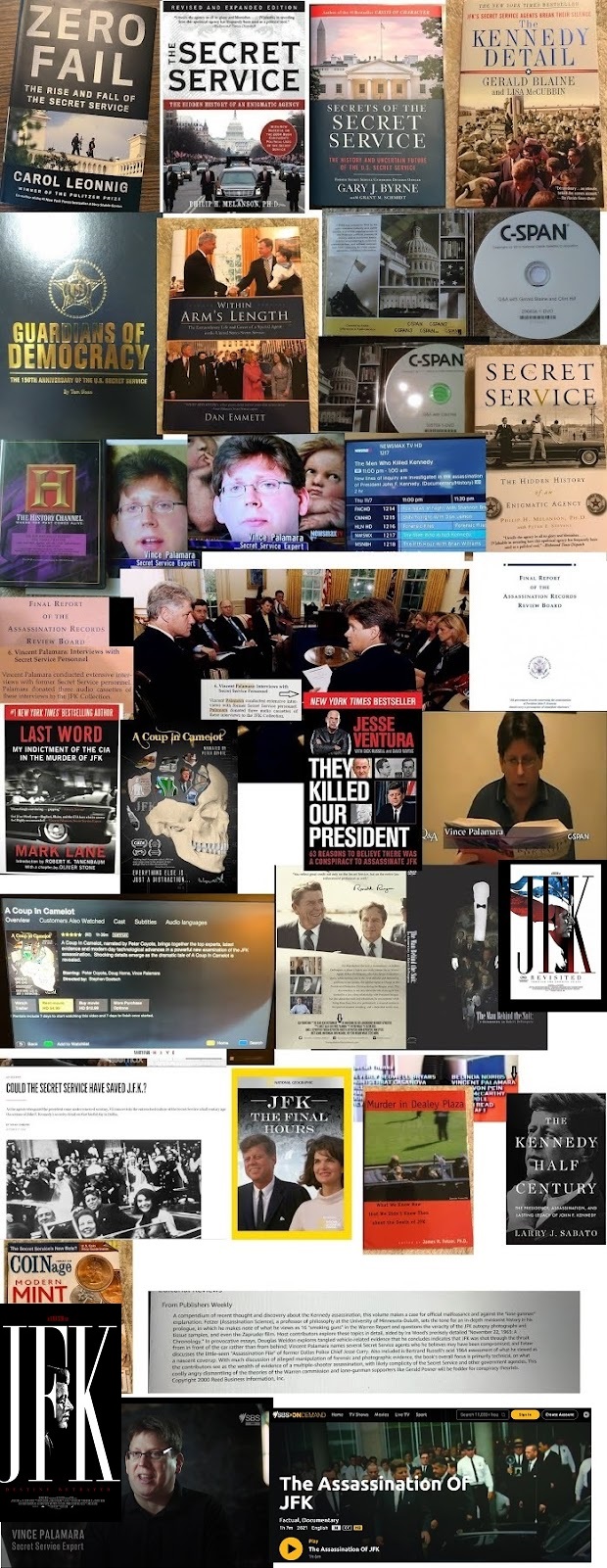

5.0 out of 5 stars Mark Lane's best, November 25, 2011
By Tyler Newcomb (Centerville, MA United States) - See all my reviews
(REAL NAME) Amazon Verified Purchase(What's this?)
This review is from: Last Word: My Indictment of the CIA in the Murder of JFK (Hardcover)
Reading it on my iPad....this reminds me of the Mark Lane of the 1960's in terms of passion and detailed research. This is the Mark Lane I remember on the Mort Sahl TV show in LA when I was a kid and he was my hero. The book is a scorching indictment of the White House detail of the Secret Service and the CIA.
Ty Newcomb
(Meanwhile, back at the ranch, Jer posted NOTHING about 11/22/63 on 11/22/11, but today cut and paste a review from fellow agent Ed Z Tucker re: his book...)
Friday, November 25, 2011


Wednesday, November 23, 2011
The holy grail of the JFK story
Tuesday, Nov 22, 2011 3:20 PM 07:46:27 EST
The holy grail of the JFK story
Seven steps to unlocking the historical truth about the assassination in Dallas
By Jefferson Morley
Two years from today Americans will observe the 50th anniversary of the assassination of President John F. Kennedy. It is likely to be a moment of national introspection, as well as an opportunity to complete the historical record of one of the most painful days in American history. Yet, incredibly enough, the Central Intelligence Agency is likely to object to declassifying all of its records related to the murder of the 35th president in Dallas on Nov. 22, 1963. The question on the 48th anniversary of the tragedy is whether the CIA’s extreme claims of JFK secrecy — reiterated in federal court filings this year — will be allowed to stand.
The tediously unresolved case of the assassinated president never quite goes away as some would wish. Stephen King’s new book, “November 22, 1963,” is yet another imaginative retelling of a critical day in American history, a densely layered epic that appeals to the enduring impulse to understand how the president of the United States was gunned down in broad daylight, and why no one was ever brought to justice for the crime.
The official story, still defended by an articulate minority, was heard in a National Geographic special last weekend. Kennedy’s death was said to be the tragic result of the psychotic actions of one individual. But as the NatGeo special demonstrates, the defense of that perspective is growing more eccentric. The program offered a novel interpretation of the photographic and forensic evidence from historian Max Holland that has been cogently addressed by independent researchers and is not shared by many JFK scholars, whether pro- or anti-conspiracy. Holland’s theory merely confirms what has long been obvious to many: There are a lot implausible theories of who killed JFK, and the notion that a “lone nut” was solely responsible is one of them.
More likely, Kennedy was ambushed by enemies who sought to avoid detection. That is what JFK’s widow, Jacqueline, and his brother Robert believed. As David Talbot demonstrated in his 2007 book “Brothers,” Bobby Kennedy concluded within hours of the gunfire in Dallas that his brother had been killed by anti-Castro Cubans. For the rest of his life, RFK never abandoned a conspiratorial interpretation of his brother’s death. (Full disclosure: Talbot is my boss and friend.)
The story is well-documented. Within a week of the assassination, RFK and Jackie Kennedy sent a friend to Moscow with a message for the leadership of the Soviet Union. As historians Aleksandr Fursenko and Tim Naftali reported in their 1999 book on the Cuban missile crisis, “One Hell of a Gamble,” Bobby and Jackie wanted the Soviet leadership to know that “despite Oswald’s connections to the communist world, the Kennedys believed that the president was felled by domestic opponents.” This finding is worth repeating on the 48thanniversary of JFK’s death: Jackie and Bobby Kennedy “believed that the president was felled by domestic opponents.”
Naftali, now the director of the Richard Nixon Presidential Library in California, told me in an email that he and his co-author learned the story from a Soviet diplomat, Georgi Bolshakov, and found his written account of Bobby and Jackie’s message in the Soviet archives. In that message Bobby and Jackie sought to assure the Soviet leadership that they did not believe that Oswald acted at Castro’s behest. The clear implication of the message was that Bobby and Jackie held the American right, not the international left, responsible for the crime in Dallas. “I was a little surprised what little reaction the … story got,” Naftali wrote.
No doubt inadvertently, the National Geographic JFK special fostered a reassuring yet false view of American history: that there is little reason to doubt the official story blaming a “lone nut.” In fact, Bobby and Jackie were not alone in suspecting conspiracy in Dallas. At the time, 60 percent of Dallas residents suspected a plot. JFK’s successor, Lyndon Johnson, privately suspected a plot emanating from JFK enemies in Cuba or Vietnam. In Havana, Fidel Castro, a man whose peaceful dotage is proof positive he knows something about detecting CIA conspiracies, concluded JFK had been killed by a right-wing faction within his own government. More recently, University of Virginia professor Larry Sabato, a mainstream political pundit and author of a forthcoming book on the legacy of Kennedy’s assassination, has joined critics of the official JFK story.
“Critical documents that could explain more about what happened are being hidden, and aggressively so,” Sabato told me in an email. “It’s no wonder a large majority of Americans believe in various conspiracy theories. There’s plenty to be suspicious about.”
Sabato has company in academia. There is a growing scholarly consensus that JFK was killed by a conspiracy. Since 2000, five tenured historians at U.S. universities have published scholarly studies that addressed the causes of JFK’s death. Four of the five concluded there was a conspiracy (though they did not all agree on who was responsible).
Thus the enduring conundrum of JFK’s assassination story. While a confident minority in the opinion-making class dismisses any consideration of conspiracy, the majority of the public is left to ponder a bewildering array of theories without much guidance about what is actually the most plausible explanation of how the president came to be killed.
As someone who has written about the JFK story for 28 years without advocating any ”theory” of the case, I recommend seven steps for those who want to understand the causes of JFK’s death.
Step 1: If you are looking for evidence of a JFK conspiracy, do as prosecutors and law enforcement do: start in the middle and work your way up.
It is tempting but foolish to start your personal JFK investigation by seeking to identify the gunmen or the intellectual authors of the crime. Start by identifying the people who were less involved and use them to identify those who were more complicit.
As a reporter for the Washington Post, I started by investigating those employees of the CIA most knowledgeable about the accused assassin, Lee Harvey Oswald. Over the years, I found a dozen or more CIA officers who had sent or received cables about Oswald while President Kennedy was still alive. I interviewed some of them, as well as their surviving descendants, friends and associates. My goal was to answer the investigative reporter’s basic question: What did these CIA people know about Oswald? And when did they know it?
Step 2: Understand the intense psychological resistance to Step 1.
Some people cannot distinguish between serious journalism about the JFK story and the meretricious conspiracy theories peddled by the 9/11 truthers. This is unfortunate. Such resistance to conspiratorial thinking, while sometimes useful, too often rationalizes a kind of anti-journalistic defensiveness that actually prevents discussion of the JFK story.
Talk show host Chris Matthews, a decent liberal and huge fan of JFK, grows agitated at the suggestion that a serious person might disagree with the official story. Cass Sunstein, an otherwise sane senior advisor to President Obama, has proposed that the government infiltrate JFK conspiracy chat groups to dispel the allegedly dangerous and delusional ideas discussed there. Former New York Times editor Bill Keller recently admitted he deletes all emails on JFK assassination without reading them, but offhandedly noted, “There’s always has been something fishy about that assassination.”
In the face of such denial and indifference, the interested citizen must turn to books such as David Kaiser’s “The Road to Dallas,” and James Douglas’ “JFK and the Unspeakable” to get the latest evidence on JFK’s assassination. Fortunately, the public can now visit quality websites, such as that of the Mary Ferrrell Foundation — which has the largest online collection of JFK records – JFKLancer, and the home page of professor John McAdams. The sites seek to identify the most reliable information about the JFK story and encourage debate about the key questions, a chore most U.S. news organizations have long disdained.
Step 3: If you want to get into the conspiratorial weeds, educate yourself on Operation Northwoods.
This is story that the likes of Chris Matthews and Bill Keller don’t care to engage too closely. It emerged from a wealth of new information released as a result of Oliver Stone’s all-too-believable 1992 movie “JFK.” Among the new records were a batch of long-secret records about a Pentagon scheme known as Operation Northwoods. These documents showed that by mid-1963, U.S. military planners had developed a uniquely devious approach to advancing their preferred policy of “regime change” in Cuba. The Northwoods concept called for CIA operatives to mount “terrorist” actions on U.S. soil that would then be blamed on the Castro government. By framing Cuba as an irresponsible and violent actor, the U.S. could justify an invasion of Cuba — something that the Joint Chiefs of Staff unanimously favored. JFK emphatically rejected such pretext operations in a tense meeting with the JCS in March 1962. Yet the Northwoods planning continued, with CIA input, through the summer of 1963, according to the documents.
The Northwoods documents lend credence to Stone’s depiction of Kennedy’s death as the work of a high-level national security cabal that sought to blame the crime on a communist to avoid detection. That sort of scenario was not the ex post facto invention of a Hollywood screenwriter. It was Pentagon policy circa Nov. 22, 1963.
Step 4: Understand the CIA’s role in the JFK story as it emerges from files declassified since Stone’s movie.
The new JFK files do not prove there was a conspiracy but they do prove this: There was a group of senior Agency officers who knew much more about Lee Harvey Oswald in late 1963 than they ever said publicly or shared privately with colleagues.
In Langley those knowledgeable about Oswald while JFK was still alive included James Angleton, the chief of the Agency’s Counterintelligence (CI) Staff. Angleton was a protean character whose penetrating intellect and obscure exploits have inspired a small library of books and several Hollywood movies. He was also an alcoholic, ultra-right-wing paranoiac who ran covert operations with no oversight from anyone. At least three of his closest aides, Jane Roman, William J. Hood and Birch D. O’Neal received pre-assassination intelligence on Oswald.
In Mexico City, Winston Scott, the trusted chief of the CIA’s Mexico City Station (the subject of my book “Our Man in Mexico”), his aide Anne Goodpasture, and his not-so-trusted deputy David A. Phillips oversaw the surveillance of Oswald’s visit there just six weeks before JFK was shot dead.
In the CIA’s Miami station, the chief of the psychological warfare branch, George Joannides, was running a network of Cuban agents who exposed and denounced Oswald for his pro-Castro political activities in New Orleans.
Most of these officials were not involved in any plot to kill JFK. I interviewed Roman, Hood and Goodpasture at length and came away certain they had nothing to do with any JFK conspiracy. I wrote a book about Win Scott and came to the same conclusion. As for Jim Angleton and David Phillips, I presume their innocence but have much less certainty about it.
The newly declassified CIA’s records show that Angleton’s CI staff kept track of Oswald constantly from October 1959 to November 1963. At Angleton’s direction, more than 40 reports about Oswald’s travels in the communist world, his family life and his political views were funneled to a secretive office in the Counterintelligence Staff known as the Special Investigations Group. The SIG was headed by Birch O’Neal, a loyal aide who had served as CIA station chief in Guatemala during the CIA-sponsored coup d’etat in 1954.
The CIA files show that the pace of intelligence gathering around Oswald quickened in mid-1963. In August 1963, Joannides’ assets started reporting on Oswald’s antics in New Orleans. When Oswald visited the Cuban consulate in Mexico City a few weeks later, he was surveilled by Phillips. When CIA and FBI reports on Oswald were sent to the SIG, they were signed for, and read by Angleton’s staff. No, this isn’t Internet fable: The routing sheets with their signatures can be found in the National Archives, and Roman and Hood confirmed their authenticity in separate interviews.
Six weeks after Angleton’s aides reviewed the Oswald file, JFK was shot dead and Oswald was arrested for the crime. These CIA officers did not investigate and conclude that Oswald had acted alone. Some, including Phillips and Joannides, took actions to insure that blame for the crime of Dallas would fall on Cuba. Others, like Scott, scrambled to learn more about Oswald. Angleton blandly disavowed his long-standing interest in Kennedy’s accused killer and concealed the paper trail that proved it.
Step 5: See the crime of Dallas as people in the CIA saw it.
In the course of writing my book about Win Scott, a math teacher from rural Alabama who transformed himself into one of the best CIA officers of his generation, I found that he knew there was something very wrong with the Agency’s handling of information about Oswald.
Scott knew that deputy CIA director Dick Helms had lied to the Warren Commission about the Agency’s pre-assassination surveillance of Oswald. And he learned that Angleton, a longtime friend, had kept him “out of the loop” on the latest intelligence about Oswald in October 1963.
Scott also harbored doubts about his deputy Phillips, the chief of the agency’s covert operations against the Castro government at the time. After Kennedy’s assassination, Scott downgraded Phillips on his job evaluation, and came to question his reporting on Oswald. When Scott privately aired some of his misgivings to a colleague in the British intelligence service a few years later, Angleton intercepted the message and sent a warning to Scott: Do not talk about JFK’s assassination with anyone.
In the upper echelons of the CIA, Lee Harvey Oswald was not regarded as a “lone nut.” At the level of Jim Angleton, Win Scott and David Phillips, Oswald was regarded as an extremely sensitive operational matter. It is inevitable that historians will view him the same way.
Step 6: Understand how U.S. national security operatives organized political assassinations in the 1960s and 1970s.
David Phillips was still alive when I arrived in Washington in the 1980s. He had retired from the Agency to found a pro-CIA lobbying group, the Association of Foreign Intelligence Officers. Phillips was a charming, cunning man, and a lively writer, even penning the occasional column for the Washington Post Outlook section where I later worked. One colleague at the Post, well-versed in the intelligence world, once told me that he had gotten to know Phillips. “He wasn’t the type” to be involved in a plot against JFK, this colleagues assured me.
A couple of years later, the nonprofit National Security Archive obtained via the Freedom of Information Act (FOIA) a cache of CIA records about a notorious political assassination in October 1970. The documents showed President Richard Nixon had ordered the CIA to take action to prevent leftist Salvatore Allende from assuming the presidency of Chile. The assignment was given to a task force directed by Phillips, by then one of the most senior operative in the Agency’s Latin America division, which identified a target: Gen. Rene Schneider, the commander in chief of the Chilean armed forces. Schneider’s crime: He had decided that Allende, winner of a recent election, should take office.
If you want to know how the CIA went about killing a political enemy at that time, study the records of this operation. Phillips brought in a team of four Agency operatives to organize a group of Chilean co-conspirators who were supplied with “three sterile 45 caliber machine guns.” The Agency’s operatives consulted with the Chileans about when to act and how they might justify the crime. The conspirators ambushed Schneider’s car in traffic, smashed the window with a sledgehammer, and shot him with the U.S.-supplied guns. After Schneider died a day later, Chile scholar Peter Kornbluh notes that Phillips co-authored a cable saying the CIA station had “done [an] excellent job of guiding [the] Chileans.”
Perhaps David Phillips was not the type to participate in the assassination of a U.S. president. But he did orchestrate the murder of a Latin American commander in chief. And his operational expertise in political assassination was never disclosed to congressional JFK investigators in the late 1970s.
Of course, this appalling episode in 1970 does not prove that Phillips participated in a JFK conspiracy in 1963. But if the CIA is interested in quelling long-standing conspiratorial speculation about Phillips, it should practice full disclosure to set the record straight.
Step 7: Return to Step 1; start in the middle of the alleged conspiracy and work your way up.
Thanks to CIA records declassified since 1998, we now know much more about a key aspect of the JFK story: the Agency’s underappreciated role in spreading the story that JFK had been killed by a communist.
As David Phillips mounted covert operations against the Castro government in the summer and fall of 1963, he was assisted by George Joannides, a dapper, 40-year-old spy from New York City. In Miami Joannides handled the CIA’s contacts with a network of anti-Castro Cuban students whom Phillips had recruited on the campus of the University of Havana before Castro’s revolution. Within hours of JFK’s murder in Dallas, Joannides’ agents got his approval to alert reporters to the fact that Kennedy’s accused killer was a member of a pro-Castro group called the Fair Play for Cuba Committee. Their revelation generated headlines in the Washington Post, New York Times and dozens of newspapers across the country asserting what some still believe: JFK was killed by a pro-Castro communist.
We can now see that the aftermath of JFK’s assassination bore an eerie resemblance to the schemes envisioned in Operation Northwoods: After a terrible crime was committed in the United States, CIA operatives covertly sought to arrange for the blame to fall on Castro, the better to justify a U.S. invasion.
Was the CIA’s post-assassination propaganda about Oswald (to use Bill Keller’s word) “fishy”? The likes of Chris Matthews and Cass Sunstein (and even Keller himself) may try to dismiss the thought. But Jackie and Bobby Kennedy could not. They “believed that the president was felled by domestic opponents.”
It certainly seems fair to ask: Did Angleton, Phillips or others who were well-informed about Oswald before the assassination simply misunderstand and underestimate him as he made his way to Dallas with a gun? Or is it possible that one or more of them participated in some kind of covert operation — sponsored by the Agency or the Pentagon — to manipulate Oswald before Nov. 22, 1963, for the sake of advancing the U.S. policy of overthrowing Castro?
Thanks to CIA secrecy, such questions cannot be answered.
One view is that there is not much more to learn about the CIA and the JFK assassination. On the National Geographic show, Max Holland was asked if there was a “holy grail” of JFK assassination researchers. He cited Oswald’s tax records, which remain private at the request of his widow, Marina, who still lives in Texas (and believes her first husband innocent of JFK’s murder).
I think most published JFK authors would find Holland’s assessment too narrow. There are other important JFK records that remain at large. Diplomatic historian David Kaiser has identified several. Researcher William Kelly has shown that Office of Naval Intelligence (which had responsibility for tracking Oswald, an ex-Marine) possesses assassination-related files that it has never released.
James Lesar, a veteran Freedom of Information Act litigator in Washington (and, more full disclosure, my pro bono attorney), has a larger holy grail: the 50,000-plus pages of unreleased JFK assassination records now held by the National Archives. Much of this material has been classified as “Not Believed Relevant” to JFK’s assassination — and most of it is. But within the NBR records, and elsewhere in CIA archives, are still-secret files of some of those officers who were knowledgeable about Oswald before Kennedy’s murder — and they are quite relevant to understanding how JFK was killed. At least 1,000 pages of such material remains secret.
How do we know? In 2003 I sued the CIA for the records of George Joannides, a secondary character in the JFK story. Eight years later, the Agency is still fighting the release of some 330 records on him, a legal defense that the New York Times aptly described in 2009 as “cagey.” Agency lawyers are scheduled to appear in federal court later this year to argue that none of this antique material can be made public in any form — supposedly for reasons of “national security.”
With Lesar’s help, I discovered that the National Archives retains 605 pages of CIA records about David Phillips in the JFK Assassination Records Collection in College Park, Md. The Archives also has 222 pages about Birch D. O’Neal, Angleton’s aide who received reports on Oswald regularly between 1959 and 1963. The Agency says it will not release the Phillips and O’Neil material until at least 2017.
(Anyone can view what is known about these files by searching the National Archive’s JFK Assassination Records Collection here. Enter “David Phillips” or “Birch O’Neal in the first search field and “NBR” in the second. Then click on “Display Search Results.” To view more details about the withheld files, click on “Display All/Selected Hits.”)
These records can and should be made public by the 50thanniversary of JFK’s death in 2013. The National Archives is now embarked on a crash course to declassify some 400 million pages of classified U.S. government records. Two years ago, Michael Kurtz, a senior official at the Archives, said in a public hearing in Washington that the still-secret JFK assassination records would be a priority for release by 2013, a position that the Archives has since backed off. In the risk-averse culture of Washington, there is little appetite for full JFK disclosure. President Obama’s laudatory executive order on open government has proven entirely ineffectual in the case of assassination-related records.
Thus on the 48th anniversary of the Dallas tragedy, we have the usual dispiriting situation: the public remains confused, and the prospects for full disclosure are not bright. We collectively wonder if there is a “holy grail” of the JFK assassination story and the CIA refuses to share. The courts are acquiescent, and what remains of the press cannot be bothered to address the obvious questions.
Nonetheless, I prefer to experience Nov. 22 as a day of hard-won hope. Public interest in JFK and Jackie Kennedy (and to a lesser extent, Bobby) remains intense and widespread. Thanks to the Internet, public access to the full historical record of the JFK assassination story has never been greater. Many people sense that JFK died for a reason and want to know what it was. We’re not delusional. We’re realistic. We want the real history of our country.
The holy grail of the JFK story
Seven steps to unlocking the historical truth about the assassination in Dallas
By Jefferson Morley
Two years from today Americans will observe the 50th anniversary of the assassination of President John F. Kennedy. It is likely to be a moment of national introspection, as well as an opportunity to complete the historical record of one of the most painful days in American history. Yet, incredibly enough, the Central Intelligence Agency is likely to object to declassifying all of its records related to the murder of the 35th president in Dallas on Nov. 22, 1963. The question on the 48th anniversary of the tragedy is whether the CIA’s extreme claims of JFK secrecy — reiterated in federal court filings this year — will be allowed to stand.
The tediously unresolved case of the assassinated president never quite goes away as some would wish. Stephen King’s new book, “November 22, 1963,” is yet another imaginative retelling of a critical day in American history, a densely layered epic that appeals to the enduring impulse to understand how the president of the United States was gunned down in broad daylight, and why no one was ever brought to justice for the crime.
The official story, still defended by an articulate minority, was heard in a National Geographic special last weekend. Kennedy’s death was said to be the tragic result of the psychotic actions of one individual. But as the NatGeo special demonstrates, the defense of that perspective is growing more eccentric. The program offered a novel interpretation of the photographic and forensic evidence from historian Max Holland that has been cogently addressed by independent researchers and is not shared by many JFK scholars, whether pro- or anti-conspiracy. Holland’s theory merely confirms what has long been obvious to many: There are a lot implausible theories of who killed JFK, and the notion that a “lone nut” was solely responsible is one of them.
More likely, Kennedy was ambushed by enemies who sought to avoid detection. That is what JFK’s widow, Jacqueline, and his brother Robert believed. As David Talbot demonstrated in his 2007 book “Brothers,” Bobby Kennedy concluded within hours of the gunfire in Dallas that his brother had been killed by anti-Castro Cubans. For the rest of his life, RFK never abandoned a conspiratorial interpretation of his brother’s death. (Full disclosure: Talbot is my boss and friend.)
The story is well-documented. Within a week of the assassination, RFK and Jackie Kennedy sent a friend to Moscow with a message for the leadership of the Soviet Union. As historians Aleksandr Fursenko and Tim Naftali reported in their 1999 book on the Cuban missile crisis, “One Hell of a Gamble,” Bobby and Jackie wanted the Soviet leadership to know that “despite Oswald’s connections to the communist world, the Kennedys believed that the president was felled by domestic opponents.” This finding is worth repeating on the 48thanniversary of JFK’s death: Jackie and Bobby Kennedy “believed that the president was felled by domestic opponents.”
Naftali, now the director of the Richard Nixon Presidential Library in California, told me in an email that he and his co-author learned the story from a Soviet diplomat, Georgi Bolshakov, and found his written account of Bobby and Jackie’s message in the Soviet archives. In that message Bobby and Jackie sought to assure the Soviet leadership that they did not believe that Oswald acted at Castro’s behest. The clear implication of the message was that Bobby and Jackie held the American right, not the international left, responsible for the crime in Dallas. “I was a little surprised what little reaction the … story got,” Naftali wrote.
No doubt inadvertently, the National Geographic JFK special fostered a reassuring yet false view of American history: that there is little reason to doubt the official story blaming a “lone nut.” In fact, Bobby and Jackie were not alone in suspecting conspiracy in Dallas. At the time, 60 percent of Dallas residents suspected a plot. JFK’s successor, Lyndon Johnson, privately suspected a plot emanating from JFK enemies in Cuba or Vietnam. In Havana, Fidel Castro, a man whose peaceful dotage is proof positive he knows something about detecting CIA conspiracies, concluded JFK had been killed by a right-wing faction within his own government. More recently, University of Virginia professor Larry Sabato, a mainstream political pundit and author of a forthcoming book on the legacy of Kennedy’s assassination, has joined critics of the official JFK story.
“Critical documents that could explain more about what happened are being hidden, and aggressively so,” Sabato told me in an email. “It’s no wonder a large majority of Americans believe in various conspiracy theories. There’s plenty to be suspicious about.”
Sabato has company in academia. There is a growing scholarly consensus that JFK was killed by a conspiracy. Since 2000, five tenured historians at U.S. universities have published scholarly studies that addressed the causes of JFK’s death. Four of the five concluded there was a conspiracy (though they did not all agree on who was responsible).
Thus the enduring conundrum of JFK’s assassination story. While a confident minority in the opinion-making class dismisses any consideration of conspiracy, the majority of the public is left to ponder a bewildering array of theories without much guidance about what is actually the most plausible explanation of how the president came to be killed.
As someone who has written about the JFK story for 28 years without advocating any ”theory” of the case, I recommend seven steps for those who want to understand the causes of JFK’s death.
Step 1: If you are looking for evidence of a JFK conspiracy, do as prosecutors and law enforcement do: start in the middle and work your way up.
It is tempting but foolish to start your personal JFK investigation by seeking to identify the gunmen or the intellectual authors of the crime. Start by identifying the people who were less involved and use them to identify those who were more complicit.
As a reporter for the Washington Post, I started by investigating those employees of the CIA most knowledgeable about the accused assassin, Lee Harvey Oswald. Over the years, I found a dozen or more CIA officers who had sent or received cables about Oswald while President Kennedy was still alive. I interviewed some of them, as well as their surviving descendants, friends and associates. My goal was to answer the investigative reporter’s basic question: What did these CIA people know about Oswald? And when did they know it?
Step 2: Understand the intense psychological resistance to Step 1.
Some people cannot distinguish between serious journalism about the JFK story and the meretricious conspiracy theories peddled by the 9/11 truthers. This is unfortunate. Such resistance to conspiratorial thinking, while sometimes useful, too often rationalizes a kind of anti-journalistic defensiveness that actually prevents discussion of the JFK story.
Talk show host Chris Matthews, a decent liberal and huge fan of JFK, grows agitated at the suggestion that a serious person might disagree with the official story. Cass Sunstein, an otherwise sane senior advisor to President Obama, has proposed that the government infiltrate JFK conspiracy chat groups to dispel the allegedly dangerous and delusional ideas discussed there. Former New York Times editor Bill Keller recently admitted he deletes all emails on JFK assassination without reading them, but offhandedly noted, “There’s always has been something fishy about that assassination.”
In the face of such denial and indifference, the interested citizen must turn to books such as David Kaiser’s “The Road to Dallas,” and James Douglas’ “JFK and the Unspeakable” to get the latest evidence on JFK’s assassination. Fortunately, the public can now visit quality websites, such as that of the Mary Ferrrell Foundation — which has the largest online collection of JFK records – JFKLancer, and the home page of professor John McAdams. The sites seek to identify the most reliable information about the JFK story and encourage debate about the key questions, a chore most U.S. news organizations have long disdained.
Step 3: If you want to get into the conspiratorial weeds, educate yourself on Operation Northwoods.
This is story that the likes of Chris Matthews and Bill Keller don’t care to engage too closely. It emerged from a wealth of new information released as a result of Oliver Stone’s all-too-believable 1992 movie “JFK.” Among the new records were a batch of long-secret records about a Pentagon scheme known as Operation Northwoods. These documents showed that by mid-1963, U.S. military planners had developed a uniquely devious approach to advancing their preferred policy of “regime change” in Cuba. The Northwoods concept called for CIA operatives to mount “terrorist” actions on U.S. soil that would then be blamed on the Castro government. By framing Cuba as an irresponsible and violent actor, the U.S. could justify an invasion of Cuba — something that the Joint Chiefs of Staff unanimously favored. JFK emphatically rejected such pretext operations in a tense meeting with the JCS in March 1962. Yet the Northwoods planning continued, with CIA input, through the summer of 1963, according to the documents.
The Northwoods documents lend credence to Stone’s depiction of Kennedy’s death as the work of a high-level national security cabal that sought to blame the crime on a communist to avoid detection. That sort of scenario was not the ex post facto invention of a Hollywood screenwriter. It was Pentagon policy circa Nov. 22, 1963.
Step 4: Understand the CIA’s role in the JFK story as it emerges from files declassified since Stone’s movie.
The new JFK files do not prove there was a conspiracy but they do prove this: There was a group of senior Agency officers who knew much more about Lee Harvey Oswald in late 1963 than they ever said publicly or shared privately with colleagues.
In Langley those knowledgeable about Oswald while JFK was still alive included James Angleton, the chief of the Agency’s Counterintelligence (CI) Staff. Angleton was a protean character whose penetrating intellect and obscure exploits have inspired a small library of books and several Hollywood movies. He was also an alcoholic, ultra-right-wing paranoiac who ran covert operations with no oversight from anyone. At least three of his closest aides, Jane Roman, William J. Hood and Birch D. O’Neal received pre-assassination intelligence on Oswald.
In Mexico City, Winston Scott, the trusted chief of the CIA’s Mexico City Station (the subject of my book “Our Man in Mexico”), his aide Anne Goodpasture, and his not-so-trusted deputy David A. Phillips oversaw the surveillance of Oswald’s visit there just six weeks before JFK was shot dead.
In the CIA’s Miami station, the chief of the psychological warfare branch, George Joannides, was running a network of Cuban agents who exposed and denounced Oswald for his pro-Castro political activities in New Orleans.
Most of these officials were not involved in any plot to kill JFK. I interviewed Roman, Hood and Goodpasture at length and came away certain they had nothing to do with any JFK conspiracy. I wrote a book about Win Scott and came to the same conclusion. As for Jim Angleton and David Phillips, I presume their innocence but have much less certainty about it.
The newly declassified CIA’s records show that Angleton’s CI staff kept track of Oswald constantly from October 1959 to November 1963. At Angleton’s direction, more than 40 reports about Oswald’s travels in the communist world, his family life and his political views were funneled to a secretive office in the Counterintelligence Staff known as the Special Investigations Group. The SIG was headed by Birch O’Neal, a loyal aide who had served as CIA station chief in Guatemala during the CIA-sponsored coup d’etat in 1954.
The CIA files show that the pace of intelligence gathering around Oswald quickened in mid-1963. In August 1963, Joannides’ assets started reporting on Oswald’s antics in New Orleans. When Oswald visited the Cuban consulate in Mexico City a few weeks later, he was surveilled by Phillips. When CIA and FBI reports on Oswald were sent to the SIG, they were signed for, and read by Angleton’s staff. No, this isn’t Internet fable: The routing sheets with their signatures can be found in the National Archives, and Roman and Hood confirmed their authenticity in separate interviews.
Six weeks after Angleton’s aides reviewed the Oswald file, JFK was shot dead and Oswald was arrested for the crime. These CIA officers did not investigate and conclude that Oswald had acted alone. Some, including Phillips and Joannides, took actions to insure that blame for the crime of Dallas would fall on Cuba. Others, like Scott, scrambled to learn more about Oswald. Angleton blandly disavowed his long-standing interest in Kennedy’s accused killer and concealed the paper trail that proved it.
Step 5: See the crime of Dallas as people in the CIA saw it.
In the course of writing my book about Win Scott, a math teacher from rural Alabama who transformed himself into one of the best CIA officers of his generation, I found that he knew there was something very wrong with the Agency’s handling of information about Oswald.
Scott knew that deputy CIA director Dick Helms had lied to the Warren Commission about the Agency’s pre-assassination surveillance of Oswald. And he learned that Angleton, a longtime friend, had kept him “out of the loop” on the latest intelligence about Oswald in October 1963.
Scott also harbored doubts about his deputy Phillips, the chief of the agency’s covert operations against the Castro government at the time. After Kennedy’s assassination, Scott downgraded Phillips on his job evaluation, and came to question his reporting on Oswald. When Scott privately aired some of his misgivings to a colleague in the British intelligence service a few years later, Angleton intercepted the message and sent a warning to Scott: Do not talk about JFK’s assassination with anyone.
In the upper echelons of the CIA, Lee Harvey Oswald was not regarded as a “lone nut.” At the level of Jim Angleton, Win Scott and David Phillips, Oswald was regarded as an extremely sensitive operational matter. It is inevitable that historians will view him the same way.
Step 6: Understand how U.S. national security operatives organized political assassinations in the 1960s and 1970s.
David Phillips was still alive when I arrived in Washington in the 1980s. He had retired from the Agency to found a pro-CIA lobbying group, the Association of Foreign Intelligence Officers. Phillips was a charming, cunning man, and a lively writer, even penning the occasional column for the Washington Post Outlook section where I later worked. One colleague at the Post, well-versed in the intelligence world, once told me that he had gotten to know Phillips. “He wasn’t the type” to be involved in a plot against JFK, this colleagues assured me.
A couple of years later, the nonprofit National Security Archive obtained via the Freedom of Information Act (FOIA) a cache of CIA records about a notorious political assassination in October 1970. The documents showed President Richard Nixon had ordered the CIA to take action to prevent leftist Salvatore Allende from assuming the presidency of Chile. The assignment was given to a task force directed by Phillips, by then one of the most senior operative in the Agency’s Latin America division, which identified a target: Gen. Rene Schneider, the commander in chief of the Chilean armed forces. Schneider’s crime: He had decided that Allende, winner of a recent election, should take office.
If you want to know how the CIA went about killing a political enemy at that time, study the records of this operation. Phillips brought in a team of four Agency operatives to organize a group of Chilean co-conspirators who were supplied with “three sterile 45 caliber machine guns.” The Agency’s operatives consulted with the Chileans about when to act and how they might justify the crime. The conspirators ambushed Schneider’s car in traffic, smashed the window with a sledgehammer, and shot him with the U.S.-supplied guns. After Schneider died a day later, Chile scholar Peter Kornbluh notes that Phillips co-authored a cable saying the CIA station had “done [an] excellent job of guiding [the] Chileans.”
Perhaps David Phillips was not the type to participate in the assassination of a U.S. president. But he did orchestrate the murder of a Latin American commander in chief. And his operational expertise in political assassination was never disclosed to congressional JFK investigators in the late 1970s.
Of course, this appalling episode in 1970 does not prove that Phillips participated in a JFK conspiracy in 1963. But if the CIA is interested in quelling long-standing conspiratorial speculation about Phillips, it should practice full disclosure to set the record straight.
Step 7: Return to Step 1; start in the middle of the alleged conspiracy and work your way up.
Thanks to CIA records declassified since 1998, we now know much more about a key aspect of the JFK story: the Agency’s underappreciated role in spreading the story that JFK had been killed by a communist.
As David Phillips mounted covert operations against the Castro government in the summer and fall of 1963, he was assisted by George Joannides, a dapper, 40-year-old spy from New York City. In Miami Joannides handled the CIA’s contacts with a network of anti-Castro Cuban students whom Phillips had recruited on the campus of the University of Havana before Castro’s revolution. Within hours of JFK’s murder in Dallas, Joannides’ agents got his approval to alert reporters to the fact that Kennedy’s accused killer was a member of a pro-Castro group called the Fair Play for Cuba Committee. Their revelation generated headlines in the Washington Post, New York Times and dozens of newspapers across the country asserting what some still believe: JFK was killed by a pro-Castro communist.
We can now see that the aftermath of JFK’s assassination bore an eerie resemblance to the schemes envisioned in Operation Northwoods: After a terrible crime was committed in the United States, CIA operatives covertly sought to arrange for the blame to fall on Castro, the better to justify a U.S. invasion.
Was the CIA’s post-assassination propaganda about Oswald (to use Bill Keller’s word) “fishy”? The likes of Chris Matthews and Cass Sunstein (and even Keller himself) may try to dismiss the thought. But Jackie and Bobby Kennedy could not. They “believed that the president was felled by domestic opponents.”
It certainly seems fair to ask: Did Angleton, Phillips or others who were well-informed about Oswald before the assassination simply misunderstand and underestimate him as he made his way to Dallas with a gun? Or is it possible that one or more of them participated in some kind of covert operation — sponsored by the Agency or the Pentagon — to manipulate Oswald before Nov. 22, 1963, for the sake of advancing the U.S. policy of overthrowing Castro?
Thanks to CIA secrecy, such questions cannot be answered.
One view is that there is not much more to learn about the CIA and the JFK assassination. On the National Geographic show, Max Holland was asked if there was a “holy grail” of JFK assassination researchers. He cited Oswald’s tax records, which remain private at the request of his widow, Marina, who still lives in Texas (and believes her first husband innocent of JFK’s murder).
I think most published JFK authors would find Holland’s assessment too narrow. There are other important JFK records that remain at large. Diplomatic historian David Kaiser has identified several. Researcher William Kelly has shown that Office of Naval Intelligence (which had responsibility for tracking Oswald, an ex-Marine) possesses assassination-related files that it has never released.
James Lesar, a veteran Freedom of Information Act litigator in Washington (and, more full disclosure, my pro bono attorney), has a larger holy grail: the 50,000-plus pages of unreleased JFK assassination records now held by the National Archives. Much of this material has been classified as “Not Believed Relevant” to JFK’s assassination — and most of it is. But within the NBR records, and elsewhere in CIA archives, are still-secret files of some of those officers who were knowledgeable about Oswald before Kennedy’s murder — and they are quite relevant to understanding how JFK was killed. At least 1,000 pages of such material remains secret.
How do we know? In 2003 I sued the CIA for the records of George Joannides, a secondary character in the JFK story. Eight years later, the Agency is still fighting the release of some 330 records on him, a legal defense that the New York Times aptly described in 2009 as “cagey.” Agency lawyers are scheduled to appear in federal court later this year to argue that none of this antique material can be made public in any form — supposedly for reasons of “national security.”
With Lesar’s help, I discovered that the National Archives retains 605 pages of CIA records about David Phillips in the JFK Assassination Records Collection in College Park, Md. The Archives also has 222 pages about Birch D. O’Neal, Angleton’s aide who received reports on Oswald regularly between 1959 and 1963. The Agency says it will not release the Phillips and O’Neil material until at least 2017.
(Anyone can view what is known about these files by searching the National Archive’s JFK Assassination Records Collection here. Enter “David Phillips” or “Birch O’Neal in the first search field and “NBR” in the second. Then click on “Display Search Results.” To view more details about the withheld files, click on “Display All/Selected Hits.”)
These records can and should be made public by the 50thanniversary of JFK’s death in 2013. The National Archives is now embarked on a crash course to declassify some 400 million pages of classified U.S. government records. Two years ago, Michael Kurtz, a senior official at the Archives, said in a public hearing in Washington that the still-secret JFK assassination records would be a priority for release by 2013, a position that the Archives has since backed off. In the risk-averse culture of Washington, there is little appetite for full JFK disclosure. President Obama’s laudatory executive order on open government has proven entirely ineffectual in the case of assassination-related records.
Thus on the 48th anniversary of the Dallas tragedy, we have the usual dispiriting situation: the public remains confused, and the prospects for full disclosure are not bright. We collectively wonder if there is a “holy grail” of the JFK assassination story and the CIA refuses to share. The courts are acquiescent, and what remains of the press cannot be bothered to address the obvious questions.
Nonetheless, I prefer to experience Nov. 22 as a day of hard-won hope. Public interest in JFK and Jackie Kennedy (and to a lesser extent, Bobby) remains intense and widespread. Thanks to the Internet, public access to the full historical record of the JFK assassination story has never been greater. Many people sense that JFK died for a reason and want to know what it was. We’re not delusional. We’re realistic. We want the real history of our country.
Tuesday, November 22, 2011
11/22/11: 48 YEARS AGO TODAY (The Kennedy Detail failed)- various news articles
Modern Dallas coming to grips with Kennedy assassination
A museum plans a 50th anniversary event in 2013 and a restoration of Dealey Plaza, part of an effort to shed for good any lingering collective guilt in the city.
By Molly Hennessy-Fiske, Los Angeles Times
November 22, 2011
Reporting from Dallas
On Tuesday, a few of the faithful will make a pilgrimage to Dealey Plaza to mark the moment at 12:30 p.m. on Nov. 22, 1963, when the Kennedy motorcade came gliding down Elm Street and shots rang out.
There will be no official ceremony. For most of the last 48 years, the city has let the anniversary slide past quietly, drawing no more attention to it than an aspiring actor would to a brutal facial scar.
That's all about to change.
Dallas officials and the Sixth Floor Museum — located in the former Texas School Book Depository where Lee Harvey Oswald fired upon President Kennedy — have announced plans for a large 50th anniversary event in 2013, and are raising $2.2 million in public and private money to restore Dealey Plaza.
Although some conspiracy theorists fear they will be excluded, and traditionalists worry about change, many locals praise the effort, saying it's time they shed their collective guilt as "the city that killed Kennedy."
"Dallas is still scarred and wounded," said Nicola Longford, executive director of the Sixth Floor Museum, which last year drew 330,000 visitors from 133 countries. "For Dallas, this is an opportunity to look back and not ignore it, to move through it and be inspired."
In the past, city officials said they were honoring requests by the Kennedy family not to observe the anniversary in Dallas.
Those organizing the 50th anniversary event — many of whom, like Longford, are not from Dallas or were born after 1963 — say they are not capitalizing on memories of Camelot. They want to show the world how far "Big D," the fourth-largest metropolitan area in the country, has come from its days as a conservative outpost of big-haired socialites, oil tycoons and cowboys.
"People arrive and expect to see people walking down the street in cowboy hats," said Phillip Jones, head of the Dallas Convention and Visitors Bureau. "Instead, they find a city with the sixth-largest gay and lesbian population in the country, where 40% of the population is Hispanic and more than 20% is African American."
Many residents walking the city's streets this weekend said Dallas should embrace the anniversary. They included suburbanites, painters in the downtown arts district and hipsters in the Deep Ellum neighborhood.
"You can't get away from it — it's one of the things people associate with the city," said Robert Escobar, 38, who lives in suburban Irving and was downtown with his family perusing holiday displays at the flagship Neiman Marcus store.
Escobar, a self-described "history nerd," said he hoped the attention on the anniversary helped dispel the stigma that haunted Dallas, reinforced over time by the "Dallas" of J.R. Ewing.
"Dallas is really working to find its identity. I feel it grasping sometimes," said Jeff Sprick, 33, of suburban Flower Mound as he shared a beer outside a vintage Dallas bar called Lee Harvey's, which was also hosting the Assassination City Roller Derby after-party.
Pauline Medrano, who represents the Dealey Plaza area on the City Council, has watched the Dallas area diversify into what she calls a "blue county" that has an African American police chief, a Democratic mayor and the state's only female sheriff, who also happens to be a lesbian.
Medrano was standing with her class from Sam Houston Elementary School when Kennedy's motorcade drove by. Her older brother watched the motorcade on Main Street, and his photo hangs in the Sixth Floor Museum.
Medrano recalls the reputation Dallas had after the killing.
"Any time that we traveled anywhere and said we were from Dallas, you just saw the 'Hmmm!' " she said.
Darwin Payne, then a reporter with the Dallas Times Herald, had run to Dealey Plaza to interview a teary Abraham Zapruder, who filmed his iconic footage of the assassination while standing at one of the pergolas, a spot that came to be known as Zapruder's Perch. Payne said many Dallasites felt guilty because they had ignored or condoned other conflicts leading up to the assassination, including an attack by conservative activists on U.N. Ambassador Adlai Stevenson.
We were defensive at first. Then the realization came — we let the extreme right wing go on too long. We let them do too much," said Payne, author of "Big D: Triumphs and Troubles of an American Supercity in the 20th Century."
But in time, Payne said, "the attitude became, 'We have to be tolerant of other viewpoints and not allow extremists to run rampant.' "
Lindalyn Adams is among those whose attitudes toward the assassination evolved through the years. Adams, 81, recalls how her physician husband reported seeing a comatose Oswald being wheeled into an elevator at Parkland Hospital after he had been shot by Jack Ruby. Adams long had trouble visiting the book depository, even after she was chosen to lead the Dallas Historical Commission.
"I was down in the area all the time and had never wanted to even look in the direction of that notorious building," she said. "But I noticed how many people were visiting, at all hours."
Adams went on to champion the founding of the Sixth Floor Museum in 1989, in part because of the success of Ford's Theatre in Washington. Four years later, a ceremony was held on Nov. 22 to dedicate Dealey Plaza as a national historic landmark.
Tom Knock, an associate professor of history at Southern Methodist University, called the museum "a kind of penance" that, along with Oliver Stone's 1991 film "JFK," has "convinced a lot people that Dallas was not responsible" for the assassination, or at least, "did a lot to dim that memory."
Work at Dealy Plaza is scheduled to start no later than October 2012, and planners hope to finish the summer before the anniversary. Improvements include fixing up the pergolas, making the grassy knoll accessible to handicapped people and adding historical signs.
Willis Winters, assistant director of planning, design and construction for the Dallas Park and Recreation Department, said the goal was to better serve those who already frequented the plaza.
"I don't want to interpret for anyone the events, whether there was a conspiracy or not," he said. "What I do want to achieve is that Dealey Plaza is in pristine condition so that when millions of people come there, they're going to see a well-restored site — not peeling paint, broken light fixtures and broken-up sidewalks."
Debra Conway, president of JFK Lancer, a group that has sponsored an annual conference on the assassination in Dallas for 16 years, said some members feared being excluded from official 50th anniversary events, but she believed it could be a watershed moment uniting Kennedy historians and the city.
"The city has realized the museum can work and fill the gap in the fence between the old Dallas and what Dallas wants to be," she said.
Among those already planning to attend the 50th anniversary is Beverly Oliver Massegee, 65, who on Sunday gathered with about 50 other members of Conway's group for a remembrance at Dealey Plaza. Some grew teary. Some could not look at the knoll. At 12:30 p.m., they paused for a moment of silence. A train rattled nearby and a breeze barely stirred the live oaks. Then Massegee, a well-known witness to the assassination, sang "Amazing Grace."
In 1963, Massegee was a 17-year-old singer at the downtown Colony Club, an acquaintance of competing club owner Jack Ruby, when, she says, she strolled up Commerce Street to watch the motorcade pass. She wore a scarf over her blond bouffant, which earned her the nickname "babushka lady" and a cameo in "JFK." She has returned to Dealey Plaza almost every year since.
She gazed out at the plaza, where tourists from Japan and Germany snapped photos. "To me, this is hallowed ground," she said.
· Wayne Dorothy was reading his Sunday Abilene Reporter-News when he almost fell out of his chair, he said.
On Page 8A, in black and white, was a photo of part of a letter Gene Boone wrote to Dallas County Sheriff Bill Decker on Nov. 22, 1963.
Boone was a Dallas sheriff's deputy when President John F. Kennedy was assassinated. On the day of the shooting, Boone discovered a rifle later linked to Lee Harvey Oswald on the sixth floor of the Texas School Book Depository. As part of his duties, Boone said, he was required to notify the sheriff of anything peculiar that occurred during his shift.
So he wrote his "Decker letter" saying he had been involved in the search of the building, and had found what "appeared to be a 7.65 Mauser with a telescope sight on the rifle."
That's what nearly unseated Dorothy.
"That was the first document I've ever seen — from someone who was there — that indicated the rifle they found was a Mauser, not a Mannicher-Carcano," Dorothy said.
The exact make and model of the rifle is one of the controversies that continue to swirl around Kennedy's assassination 48 years after the fact.
Dorothy, who is the director of bands at Hardin-Simmons University, said he became interested in the various theories surrounding Kennedy's death while teaching in Tennessee in 1984.
While the band director at Tullahoma High School, Dorothy said he attended a continuing education course about the assassination taught by the high school's head football coach.
"He had always enjoyed reading about the assassination, and ever since taking his course, I've been fascinated," Dorothy said.
For almost 30 years, Dorothy and his father, who also is an armchair assassination enthusiast, have amassed a large library of films, videos and books on the topic.
The more than 40 books Dorothy currently owns is just a tiny portion of the corpus of material that exists pertaining to just what happened in Dealey Plaza on Nov. 22, 1963.
"There are theories out there that run the gamut from absolute crackpot to more sober ideas," Dorothy said. "You have some real nuts, and you have serious scientists weighing in on it."
"I mean, on the one hand you have some folks out there claiming that the Zapruder film shows the driver of Kennedy's limo turning around and shooting the president. That's absolute bunk," he said.
On the other, he said, is a book "Assassination Science," written by James H. Fetzer, a professor at the University of Minnesota-Duluth. In that book, Fetzer uses expert testimony from a number of doctors and scientists to look at the facts of the assassination, Dorothy said.
Dorothy said he has his own questions about the case, but he doesn't think they will ever be fully resolved.
"There's enough variation in all the theories out there that I don't think we'll ever be able to prove anything beyond a shadow of a doubt. Look, we have two different official government reports (the 1964 Warren Commission report and the 1979 House Select Committee on Assassinations report) that basically contradict each other," he said.
The Warren Commission ultimately decided that Kennedy was assassinated by a lone gunman, and that gunman was Lee Harvey Oswald. The House Select Committee reported that it was likely Kennedy was killed as the result of a conspiracy.
Boone, who initially found the rifle, said he doesn't put much stock in conspiracy theories. He said he believes the Warren Commission's finding that only one shooter was involved.
"But, because of the political climate at the time, if it ever came out that there was a conspiracy, I wouldn't be surprised," Boone said. "If there was a conspiracy, I'd say it involved getting Oswald into the right place at the right time."
Any possible conspiracy could only have involved a handful of people, Boone said, "otherwise, something would have come out already."
Dorothy said he doesn't believe Oswald was the lone assassin, and that he doubts whether he even fired a single round. The amount of metal recovered from bullet fragments raises doubts about the number of shots fired, he said. Discrepancies between official medical reports from Parkland Hospital in Dallas, and the official autopsy performed in Maryland several days later need to be explained, he said.
But as for the rifle, identified initially as a German Mauser then later as an Italian infantry rifle?
"Well, I was mistaken," Boone said. He said he used the term "Mauser" to describe the weapon — which he only saw from two to three feet away — as a bolt-action rifle, not the particular brand.
Dorothy, however, is skeptical.
"The very first information out of Dallas said the rifle was a Mauser. Then it all changed, and it was said to be a Mannlicher-Carcano. How did three police officers all misidentify it?" he said.
"You know, the more I read about the assassination, the more questions I tend to have," he said.
Sarasota doctor was at hospital when JFK died
By JAY BRADY
Correspondent
Published: Monday, November 21, 2011 at 6:08 p.m.
Last Modified: Monday, November 21, 2011 at 6:08 p.m.
"Oh, they're bringing them in. They've all been shot!'" It was the scream of a secretary rushing into the cafeteria of Parkland Memorial Hospital in Dallas, the beginning of a series of days that Malouf Abraham will never forget. Today, the 72-year-old is a retired allergy doctor, who spends part of his time as a Sarasota resident.
Forty-eight years ago — on Nov. 22, 1963 — Abraham was 24, the youngest of his 85 classmates at the teaching hospital for the University of Texas Southwestern Medical School.
A dying President John F. Kennedy — shot by assassin Lee Harvey Oswald only 10 minutes earlier — had just arrived in his blood-stained limousine.
Abraham, now one of a shrinking group on hand that day, would see the president's limousine before it was scrubbed by Secret Service agents. His friend at the hospital would help console a shocked Jackie Kennedy minutes before she was informed of her husband's death.
Only a week before Kennedy's shooting, the young Lebanese-American medical student from Canadian, Texas, would watch Jack Ruby, the assassin's assassin, parade around on the runway of his Dallas nightclub.
Years later, a chance meeting with JFK's mother at a mass in Palm Beach would remind Abraham of the shared grief of those who lived through November 1963.
On that Friday, Abraham was on duty at the hospital when the open-air limousine carrying Kennedy and Texas Gov. John Connally screeched up to the trauma center's "AMBULANCES ONLY" entrance, the end of a four-mile sprint from Dealey Plaza.
The medical student was midway through a 12-hour shift and was getting something to eat, just setting his tray on a table in the hospital cafeteria when the secretary rushed in yelling
I never sat down. I ran." Taking nearby stairs, he went down into the trauma center hallway separating rooms one and two. The area was packed with the Secret Service, FBI, police and the press.
Five minutes later, NBC interrupted its normal coverage to report that Kennedy and Connally had been shot.
Deciding it would be best to stay out of the way, Abraham moved to the adjoining ER waiting room at the opposite end of the hallway.
Somewhere nearby stood First Lady Jackie Kennedy, who had just helped 22-year-old trauma room nurse Diana Bowron lift her husband out of the limousine on to a four-wheeled stretcher.
Abraham went through the back door into the ambulance arrival area.
Before him, unattended, sat the president's bloodied 1961 Lincoln Continental four-door convertible limousine. A half hour before, Abraham's fiancé, Therese Browne, had watched the car proceed down Lemmon Avenue, the first leg of the fateful journey.
"I went immediately over to it and I did not put my hands on it, but I just stood — standing right there," Abraham said.
There were not huge amounts of blood, Abraham said.
"What I remember is flowers and blood, you know, like flowers that Jackie would have had," referring to the red roses and lavender asters given to her at Dallas' Love Field airport when the Kennedys arrived.
"I've waded through a lot of blood and guts, but this wasn't really that."
According to a classmate Abraham spoke to later, while doctors attended to the president, an aide to Jackie Kennedy asked the first lady if she would like to change her clothes. They were the now famous raspberry dress with matching pillbox hat.
"No, let them see what they've done," the first lady replied, according to William Manchester's account in his book, "The Death of a President."
Another Abraham classmate — close friend Norman Borge — encountered Jackie Kennedy as she briefly stood alone outside the trauma room.
Borge recalled in an interview with the Herald-Tribune that a priest had surprised her by trying to remove her bloody glove.
Borge, 81, a retired general practitioner from Fort Worth, found her a folding chair and a glass of water.
Later, Father Oscar Huber, pastor of Holy Trinity Church in Dallas, and Rev. James Thompson, two local Catholic priests from Abraham's church, administered last rites to the president. They were the same men who provided Abraham and his wife the couple's Pre-Cana marriage counseling.
Minutes later, it was 1 p.m. when Dr. Kemp Clark, one of Abraham's professors and the hospital's chief of neurosurgery, pronounced the president dead.
According to news accounts of the day, Kemp also was the doctor who informed Jackie Kennedy.
The next day, Abraham returned to Parkland, where he had trauma room duty.
Nearly 50 years later, Abraham says he still has a vivid memory of the spray of flowers attached to the door of the room where Kennedy died.
"We had these flowers on the door like a funeral spray — hanging on the outside door," Abraham said, pausing to collect himself. "We had the door just ajar and the only light was from the X-ray view box."
On Sunday, the engaged Abrahams — who married five weeks later — attended mass at Holy Trinity Church.
Eight days earlier the couple had been at Ruby's Carousel Club in Dallas for the first and last time.
As the couple exited the church the Sunday after Kennedy's assassination, they noticed a commotion and people chattering.
"We came out of church and here's all this buzz out in the church parking lot, people getting worried that Jack Ruby had shot Oswald in the Dallas jail," Abraham said. "We went from the church back to the hospital — Parkland."
Leaving the hospital, Abraham and his future wife went to Dealey Plaza, the site of the shooting. There was gridlock, forcing them to park blocks away and to walk.
"Everybody in the world was there," recalled Abraham, choking back tears again. "Everybody was crying, laying flowers, notes, posters. I've never seen anything like it. It was highly, highly emotional."
Fourteen years later, by a chance encounter, the Abrahams had another brush with the Kennedys at a mass at St. Edwards Catholic Church in Palm Beach.
There were three empty rows of pews in front of Abraham and the Kennedy group took some of them.
"I'm looking at the back of Rose Kennedy through this mass, and I'm just being bombarded with all these thoughts of things that I saw that she didn't have to see," Abraham said.
Then Abraham thought about the cup of communion, soon to be offered to each of those attending the mass.
"I thought we are — really in this life — we're all in this same leaky little boat," Abraham said. "We're drinking out of the same cup. Some people think they have their own cup.
"They really don't in this life, you know."
November 21, 2011
Kennedy Assassination Transformed US Secret Service
The assassination of President John F. Kennedy on November 22, 1963, 48 years ago, stunned the world. It was the first time since 1901- when President William McKinley was killed - that a U.S. president fell to an assassin’s bullet.
The Secret Service is responsible for protecting the president and his family. President Kennedy’s death put the service on the defensive. In conversations with several former Secret Service agents, our correspondent reports that the assassination, and later attempts on Presidents Gerald Ford and Ronald Reagan, led to changes in how the President and first family are protected.
On November 22, 1963, when shots rang out in Dallas, Secret Service Agent Clint Hill was in the best position to react. His analysis of that day is simple.
“There’s no question that we failed in providing protection for President Kennedy," said Hill.
Agent Gerald Blaine was also in Texas that day, but not in Dallas. He says a lack of manpower was partly responsible. “In 1963 we had 330 agents; we had about 34 agents on the White House detail," said Blaine.
The agents were visible. Some ran alongside or stood on cars in the presidential motorcade. But Blaine says they couldn't communicate with each other.
“We didn’t have radios," he said. "We operated through hand signals. We had photographs of subjects that we had concerns about, and we would memorize those subjects. And we had to rely on each other to work together as a team."
Author Lisa McCubbin collaborated with Blaine on the book The Kennedy Detail.
She says weaknesses exposed by the Kennedy assassination forced a change in how the Secret Service was funded.
“So it made them realize even more how important their mission was, and they were able then to convince Congress to get more money," said McCubbin. "They had been asking for more money for years and years, to get more people. They knew they couldn't protect the president with what they had."
Clint Hill stayed with the Secret Service after the assassination.
He rose to assistant director, and witnessed changes in the agency: no more travel in open automobiles and more agents, more money, and better communication.
But Hill suffered from guilt after the assassination. He retired in 1975.
Several months later, not once but twice, assailants tried to kill President Gerald Ford during visits he made to California.
And in 1981, another disaster was narrowly averted.
President Ronald Reagan, emerging from a Washington hotel, was shot by John Hinckley Jr. Reagan was rushed to a nearby hospital for life-saving surgery.
Secret Service agent Tim McCarthy was shot in the abdomen. Press Secretary James Brady was struck in the head and seriously disabled..
But no one died in the attack.
McCarthy says the incident led to even more changes. “After that, metal detectors were used to screen anyone who gets near the president," said McCarthy. "Shortly thereafter, and the legacy is that since that time, there has not been an attack on any of our presidents by the historic assassin which is the lone gunman."
Though the assassination of President Kennedy was a transforming event for the Secret Service, recent incidents are a reminder that the president is still a target.
At 21-year-old Idaho man is under arrest for allegedly firing several shots at the White House on November 11.
November 21, 2011
Secret Service Agents Open Up About Kennedy Assassination
President John F. Kennedy’s trip to Dallas on November 22, 1963 was intended to boost support in Texas for his 1964 re-election campaign. An assassin’s bullet ended his life, however, remaining an event still shrouded in controversy. Since that time, Secret Service agents assigned to protect President Kennedy have spoken only rarely about that day. But in a recent book, called The Kennedy Detail, and in an interview with VOA, former agent Clint Hill explains how the day unfolded, and how it changed his life.
Former Secret Service agent Clint Hill said providing security for President John F. Kennedy was a challenge.
“With President Kennedy it was mix and mingle. He didn’t like anybody to be, come between he and the people,” said Hill.
November 22, 1963 began like most presidential visits... even though it was in a part of the country - Texas - that was not enthusiastic about the president.
“This was an extremely conservative area. Kennedy was not labeled as a conservative by any stretch of the imagination, so it was considered that there could be some problems that could develop. But we had no threats, no information that would lead us to believe that we would have a major problem,” said Hill.
As the president's motorcade made its way through Dealey Plaza in Dallas, Hill was on a vehicle behind the presidential limousine.
“I heard an explosive noise to my right rear, the rear of the motorcade," said Hill. "I saw the president grab at his throat and move to his left and I knew something was wrong, so I jumped and ran toward the presidential car with the idea of getting up on top.
"By the time I just about got to the car, the third shot had been fired, hit the President in the head, caused a massive wound, which caused blood, brains and other material to be exploded out on to the car, onto me, onto Mrs. Kennedy. She was trying to retrieve some material that had come off from the president’s head and went to the right rear. I grabbed her and did the best I could to get her back in the seat.
"When I did that, the president fell to his left into her lap. I got up on top and lay on top behind both of them, and I turned and gave a thumbs down to the follow up car," said Hill.
That event lasted less than a minute, but it scarred Hill for life.
“I feel guilt, I feel responsibility. I was the only agent who was in a position to do anything that day,” said Hill.
The assassination shook the nation, and the Secret Service.
Clint Hill protected three more presidents, but in 1975, overcome by depression, he retired.
In 2009, author Lisa McCubbin requested an interview with Hill for a possible book.
“He did one interview in 1975 with 60 Minutes that’s a classic interview in which he had basically a nervous breakdown on television. Then he went into seclusion," said McCubbin.
Encouraged by friend, former agent and now author Gerald Blaine, Hill and other agents in Dallas on that day decided to talk, in part, to document how the assassination affected them.
Hill said the release last year of The Kennedy Detail has been therapeutic.
“...especially being able to go out and talk to people about the book and answer it, a lot of the questions that they have because there are still a lot of questions out there,” said Hill.
One question often asked is whether or not there was more than one assassin. Hill supports the findings of the Warren Commission, which concluded that Lee Harvey Oswald was the lone gunman.
New Book Marks 48th Anniversary of U.S. Kennedy Assassination
Posted Tuesday, November 22nd, 2011 at 1:25 am
As U.S. citizens reflect on the 48th anniversary of the assassination of President John F. Kennedy, a former member of the agency responsible for guarding the U.S. president tells VOA that the shooting exposed weaknesses in the security detail.
Former U.S. Secret Service agent Gerald Blaine says a lack of manpower contributed to Mr. Kennedy's assassination during a presidential motorcade on November 22, 1963. He said the 34 agents accompanying the president in Dallas, Texas, that day communicated with hand signals rather than radios, as the president traveled with his wife and the state governor in an open-air convertible.
The sixth floor of the Texas School Book Depository, from where suspected assassin Lee Harvey Oswald is believed to have made the fatal shots, has been turned into a museum.
Blaine said the assassination of the young president, which shocked the world, led to security improvements such as better funding for the Secret Service and closed vehicles for motorcades.
He said security tightened further after an unsuccessful attempts on the lives of Presidents Gerald Ford in 1975, and Ronald Reagan and 1981. Now, anyone who will be near the president must be screened by metal detector. Blaine has written a book about the Kennedy assassination called The Kennedy Detail.
But despite all the security, a U.S. president is still under threat of attack. On November 11 of this year, shots were fired at the White House. Authorities have detained a 21-year-old man in connection with the shooting. He appeared in court for the first time Monday.
New Book Indicts CIA in Kennedy Assassination
22 Nov, 2011 03:19 CET
Last Word: My Indictment of the CIA in the Murder of JFK
New York Times number one bestselling author and JFK historian Mark Lane tried the only U.S. court case in which jurors concluded that the CIA plotted the murder of President Kennedy, but there were always missing pieces: How did the CIA control Dallas police and Secret Service agents on the ground in Dealey Plaza? How did federal authorities prevent the Warren Commission and the House Select Committee on Assassinations from discovering the truth about the complicity of the CIA?
Now, Lane tells all in his explosive new book – Last Word: My Indictment of the CIA in the Murder of JFK – with exclusive new interviews, sworn statements and meticulous new research (including interviews with Oliver Stone, Dallas Police deputy sheriffs, Robert K. Tanenbaum, and Secret Service agent Abraham Bolden) Lane finds out first hand exactly what went on the day JFK was assassinated. Lane includes testimony given to the Warren Commission by a police officer who confronted a man who he thought was the assassin. The officer testified that he drew his gun and pointed it at the suspect who showed Secret Service ID. Yet, the Secret Service later reported that there were no Secret Service agents on foot in Dealey Plaza.
Last Word proves that the CIA, operating through a secret small group, prepared and distributed all credentials for Secret Service agents in Dallas for the two days that Kennedy was going to be there including providing the assassins with those credentials.
The nation’s most respected and ethical former high ranking prosecutor, Robert K. Tanenbaum (Chief of Homicide for the New York District Attorney’s Office under the legendary Frank Hogan), wrote : “Lane’s Last Word reveals his courageous challenge to the Warren Commission report and his scathing critique of unconscionable CIA outrages. The penetrating accuracy of his reportage may be measured by the personal attacks he endured that were orchestrated by upper-echelon rogue CIA operatives…. Whether one agrees with Mark Lane’s conclusions or not, everyone should read Last Word. His courageous efforts, his scholarly research and remarkable advocacy are a tribute to his enormous capacity to seek the truth. We are all better people because of that he has done.” – Robert K. Tanenbaum, Deputy Chief Counsel for the House Select Committee on Assassinations to investigate the John F. Kennedy assassination.
Skyhorse Publishing, November, 2011. Available on Amazon.com, BarnesandNoble.com, and wherever fine books are sold.
JFK theories won't die
By CARTER VANDERHOOF / Reformer Staff
Posted: 11/22/2011 03:00:00 AM EST
Updated: 11/22/2011 07:10:31 AM EST
Tuesday November 22, 2011
BRATTLEBORO -- 48 years after the assassination of President John F. Kennedy, new evidence and theories are still being brought to light.
Bill Holiday, a social studies teacher at Brattleboro Union High School, will be giving a presentation at the Brooks Memorial Library today at 7 p.m. discussing eyewitness testimony and conspiracy theories surrounding the assassination of JFK.
The presentation is being held on the anniversary of the assassination that occurred Nov. 22, 1963, as JFK rode in a motorcade through Dealey Plaza in downtown Dallas.
Jack Houk, a student at BUHS, said he got a chance to make his own theory about one of the most controversial events in history. Houk traveled last week to Dallas with Holiday and about six other high school students to meet eyewitnesses and researchers, and study the Kennedy assassination.
Houk said he got to learn some new information about the assassination, but was still just scratching the surface.
"There's a lot more I need to know," he said.
Houk said making the trip to Dallas was a great opportunity to learn more. He said it helped put things into perspective when he got to see the actual location of the assassination.
He believes there is a 95-percent certainty that there was a shooter on the grassy knoll.
"I think it means there were two shooters," said Houk.
He said most history books don't even mention a second shooter.
"We keep
learning more about stuff that happened a long time ago," said Houk.
Holiday has been giving presentations on the Kennedy assassination since a video of the incident was broadcast on public television -- the Zapruder film, a video shot by private citizen Abraham Zapruder capturing the assassination as it happened. The film was aired on ABC's Good Night America in 1975 for the first time on network television.
"I don't think there is any better experience than being out in the field," said Holiday. "It gives students the opportunity to question and come up with their own conclusions."
He said the trip to Dallas exposed the students to researchers that work to find the truth.
"There are people still digging," said Holiday.
He said 48 years later, details are still unclear about how and what actually happened. Holiday said some theories involve the mob or the Secret Service.
"People want to know why," said Holiday.
He said one of the things that has gotten him interested in the assassination is details that don't make since. Holiday has spoken with eyewitnesses and researchers over the years and has found particular details that may have led to Kennedy's assassination.
He said there were no officers on the presidential limousine that day, and the president's car was the first in the motorcade, which Holiday said doesn't usually happen.
"The way they did things in Dallas was different," he said.
There have been about two dozen incidents involving people who were in a place to offer testimony about the assassination or who may have shed some light on the case, but died due to suspicious circumstances. He said there was one reporter about to testify but died as a result of a karate chop to the neck. Another man, Lee Bowers, had given testimony that he saw three cars enter a forbidden area just before the assassination of John F. Kennedy. He also stated that he saw two strangers on the grassy knoll. Bowers was killed shortly after in 1966 as a result of a motor vehicle crash. However, eyewitnesses report that he was run off the road by another car.
"One of the tragedies of the Kennedy assassination; there was never an autopsy," said Holiday.
Holiday said the doctor was told to ignore procedures in a normal autopsy.
While researchers have been pondering what really happened for almost 50 years, questions about the assassination may never be fully answered, said Holiday.
A museum plans a 50th anniversary event in 2013 and a restoration of Dealey Plaza, part of an effort to shed for good any lingering collective guilt in the city.
By Molly Hennessy-Fiske, Los Angeles Times
November 22, 2011
Reporting from Dallas
On Tuesday, a few of the faithful will make a pilgrimage to Dealey Plaza to mark the moment at 12:30 p.m. on Nov. 22, 1963, when the Kennedy motorcade came gliding down Elm Street and shots rang out.
There will be no official ceremony. For most of the last 48 years, the city has let the anniversary slide past quietly, drawing no more attention to it than an aspiring actor would to a brutal facial scar.
That's all about to change.
Dallas officials and the Sixth Floor Museum — located in the former Texas School Book Depository where Lee Harvey Oswald fired upon President Kennedy — have announced plans for a large 50th anniversary event in 2013, and are raising $2.2 million in public and private money to restore Dealey Plaza.
Although some conspiracy theorists fear they will be excluded, and traditionalists worry about change, many locals praise the effort, saying it's time they shed their collective guilt as "the city that killed Kennedy."
"Dallas is still scarred and wounded," said Nicola Longford, executive director of the Sixth Floor Museum, which last year drew 330,000 visitors from 133 countries. "For Dallas, this is an opportunity to look back and not ignore it, to move through it and be inspired."
In the past, city officials said they were honoring requests by the Kennedy family not to observe the anniversary in Dallas.
Those organizing the 50th anniversary event — many of whom, like Longford, are not from Dallas or were born after 1963 — say they are not capitalizing on memories of Camelot. They want to show the world how far "Big D," the fourth-largest metropolitan area in the country, has come from its days as a conservative outpost of big-haired socialites, oil tycoons and cowboys.
"People arrive and expect to see people walking down the street in cowboy hats," said Phillip Jones, head of the Dallas Convention and Visitors Bureau. "Instead, they find a city with the sixth-largest gay and lesbian population in the country, where 40% of the population is Hispanic and more than 20% is African American."
Many residents walking the city's streets this weekend said Dallas should embrace the anniversary. They included suburbanites, painters in the downtown arts district and hipsters in the Deep Ellum neighborhood.
"You can't get away from it — it's one of the things people associate with the city," said Robert Escobar, 38, who lives in suburban Irving and was downtown with his family perusing holiday displays at the flagship Neiman Marcus store.
Escobar, a self-described "history nerd," said he hoped the attention on the anniversary helped dispel the stigma that haunted Dallas, reinforced over time by the "Dallas" of J.R. Ewing.
"Dallas is really working to find its identity. I feel it grasping sometimes," said Jeff Sprick, 33, of suburban Flower Mound as he shared a beer outside a vintage Dallas bar called Lee Harvey's, which was also hosting the Assassination City Roller Derby after-party.
Pauline Medrano, who represents the Dealey Plaza area on the City Council, has watched the Dallas area diversify into what she calls a "blue county" that has an African American police chief, a Democratic mayor and the state's only female sheriff, who also happens to be a lesbian.
Medrano was standing with her class from Sam Houston Elementary School when Kennedy's motorcade drove by. Her older brother watched the motorcade on Main Street, and his photo hangs in the Sixth Floor Museum.
Medrano recalls the reputation Dallas had after the killing.
"Any time that we traveled anywhere and said we were from Dallas, you just saw the 'Hmmm!' " she said.
Darwin Payne, then a reporter with the Dallas Times Herald, had run to Dealey Plaza to interview a teary Abraham Zapruder, who filmed his iconic footage of the assassination while standing at one of the pergolas, a spot that came to be known as Zapruder's Perch. Payne said many Dallasites felt guilty because they had ignored or condoned other conflicts leading up to the assassination, including an attack by conservative activists on U.N. Ambassador Adlai Stevenson.
We were defensive at first. Then the realization came — we let the extreme right wing go on too long. We let them do too much," said Payne, author of "Big D: Triumphs and Troubles of an American Supercity in the 20th Century."
But in time, Payne said, "the attitude became, 'We have to be tolerant of other viewpoints and not allow extremists to run rampant.' "
Lindalyn Adams is among those whose attitudes toward the assassination evolved through the years. Adams, 81, recalls how her physician husband reported seeing a comatose Oswald being wheeled into an elevator at Parkland Hospital after he had been shot by Jack Ruby. Adams long had trouble visiting the book depository, even after she was chosen to lead the Dallas Historical Commission.
"I was down in the area all the time and had never wanted to even look in the direction of that notorious building," she said. "But I noticed how many people were visiting, at all hours."
Adams went on to champion the founding of the Sixth Floor Museum in 1989, in part because of the success of Ford's Theatre in Washington. Four years later, a ceremony was held on Nov. 22 to dedicate Dealey Plaza as a national historic landmark.
Tom Knock, an associate professor of history at Southern Methodist University, called the museum "a kind of penance" that, along with Oliver Stone's 1991 film "JFK," has "convinced a lot people that Dallas was not responsible" for the assassination, or at least, "did a lot to dim that memory."
Work at Dealy Plaza is scheduled to start no later than October 2012, and planners hope to finish the summer before the anniversary. Improvements include fixing up the pergolas, making the grassy knoll accessible to handicapped people and adding historical signs.
Willis Winters, assistant director of planning, design and construction for the Dallas Park and Recreation Department, said the goal was to better serve those who already frequented the plaza.
"I don't want to interpret for anyone the events, whether there was a conspiracy or not," he said. "What I do want to achieve is that Dealey Plaza is in pristine condition so that when millions of people come there, they're going to see a well-restored site — not peeling paint, broken light fixtures and broken-up sidewalks."
Debra Conway, president of JFK Lancer, a group that has sponsored an annual conference on the assassination in Dallas for 16 years, said some members feared being excluded from official 50th anniversary events, but she believed it could be a watershed moment uniting Kennedy historians and the city.
"The city has realized the museum can work and fill the gap in the fence between the old Dallas and what Dallas wants to be," she said.
Among those already planning to attend the 50th anniversary is Beverly Oliver Massegee, 65, who on Sunday gathered with about 50 other members of Conway's group for a remembrance at Dealey Plaza. Some grew teary. Some could not look at the knoll. At 12:30 p.m., they paused for a moment of silence. A train rattled nearby and a breeze barely stirred the live oaks. Then Massegee, a well-known witness to the assassination, sang "Amazing Grace."
In 1963, Massegee was a 17-year-old singer at the downtown Colony Club, an acquaintance of competing club owner Jack Ruby, when, she says, she strolled up Commerce Street to watch the motorcade pass. She wore a scarf over her blond bouffant, which earned her the nickname "babushka lady" and a cameo in "JFK." She has returned to Dealey Plaza almost every year since.
She gazed out at the plaza, where tourists from Japan and Germany snapped photos. "To me, this is hallowed ground," she said.
· Wayne Dorothy was reading his Sunday Abilene Reporter-News when he almost fell out of his chair, he said.
On Page 8A, in black and white, was a photo of part of a letter Gene Boone wrote to Dallas County Sheriff Bill Decker on Nov. 22, 1963.
Boone was a Dallas sheriff's deputy when President John F. Kennedy was assassinated. On the day of the shooting, Boone discovered a rifle later linked to Lee Harvey Oswald on the sixth floor of the Texas School Book Depository. As part of his duties, Boone said, he was required to notify the sheriff of anything peculiar that occurred during his shift.
So he wrote his "Decker letter" saying he had been involved in the search of the building, and had found what "appeared to be a 7.65 Mauser with a telescope sight on the rifle."
That's what nearly unseated Dorothy.
"That was the first document I've ever seen — from someone who was there — that indicated the rifle they found was a Mauser, not a Mannicher-Carcano," Dorothy said.
The exact make and model of the rifle is one of the controversies that continue to swirl around Kennedy's assassination 48 years after the fact.
Dorothy, who is the director of bands at Hardin-Simmons University, said he became interested in the various theories surrounding Kennedy's death while teaching in Tennessee in 1984.
While the band director at Tullahoma High School, Dorothy said he attended a continuing education course about the assassination taught by the high school's head football coach.
"He had always enjoyed reading about the assassination, and ever since taking his course, I've been fascinated," Dorothy said.
For almost 30 years, Dorothy and his father, who also is an armchair assassination enthusiast, have amassed a large library of films, videos and books on the topic.
The more than 40 books Dorothy currently owns is just a tiny portion of the corpus of material that exists pertaining to just what happened in Dealey Plaza on Nov. 22, 1963.
"There are theories out there that run the gamut from absolute crackpot to more sober ideas," Dorothy said. "You have some real nuts, and you have serious scientists weighing in on it."
"I mean, on the one hand you have some folks out there claiming that the Zapruder film shows the driver of Kennedy's limo turning around and shooting the president. That's absolute bunk," he said.
On the other, he said, is a book "Assassination Science," written by James H. Fetzer, a professor at the University of Minnesota-Duluth. In that book, Fetzer uses expert testimony from a number of doctors and scientists to look at the facts of the assassination, Dorothy said.
Dorothy said he has his own questions about the case, but he doesn't think they will ever be fully resolved.
"There's enough variation in all the theories out there that I don't think we'll ever be able to prove anything beyond a shadow of a doubt. Look, we have two different official government reports (the 1964 Warren Commission report and the 1979 House Select Committee on Assassinations report) that basically contradict each other," he said.
The Warren Commission ultimately decided that Kennedy was assassinated by a lone gunman, and that gunman was Lee Harvey Oswald. The House Select Committee reported that it was likely Kennedy was killed as the result of a conspiracy.
Boone, who initially found the rifle, said he doesn't put much stock in conspiracy theories. He said he believes the Warren Commission's finding that only one shooter was involved.
"But, because of the political climate at the time, if it ever came out that there was a conspiracy, I wouldn't be surprised," Boone said. "If there was a conspiracy, I'd say it involved getting Oswald into the right place at the right time."
Any possible conspiracy could only have involved a handful of people, Boone said, "otherwise, something would have come out already."
Dorothy said he doesn't believe Oswald was the lone assassin, and that he doubts whether he even fired a single round. The amount of metal recovered from bullet fragments raises doubts about the number of shots fired, he said. Discrepancies between official medical reports from Parkland Hospital in Dallas, and the official autopsy performed in Maryland several days later need to be explained, he said.
But as for the rifle, identified initially as a German Mauser then later as an Italian infantry rifle?
"Well, I was mistaken," Boone said. He said he used the term "Mauser" to describe the weapon — which he only saw from two to three feet away — as a bolt-action rifle, not the particular brand.
Dorothy, however, is skeptical.
"The very first information out of Dallas said the rifle was a Mauser. Then it all changed, and it was said to be a Mannlicher-Carcano. How did three police officers all misidentify it?" he said.
"You know, the more I read about the assassination, the more questions I tend to have," he said.
Sarasota doctor was at hospital when JFK died
By JAY BRADY
Correspondent
Published: Monday, November 21, 2011 at 6:08 p.m.
Last Modified: Monday, November 21, 2011 at 6:08 p.m.
"Oh, they're bringing them in. They've all been shot!'" It was the scream of a secretary rushing into the cafeteria of Parkland Memorial Hospital in Dallas, the beginning of a series of days that Malouf Abraham will never forget. Today, the 72-year-old is a retired allergy doctor, who spends part of his time as a Sarasota resident.
Forty-eight years ago — on Nov. 22, 1963 — Abraham was 24, the youngest of his 85 classmates at the teaching hospital for the University of Texas Southwestern Medical School.
A dying President John F. Kennedy — shot by assassin Lee Harvey Oswald only 10 minutes earlier — had just arrived in his blood-stained limousine.
Abraham, now one of a shrinking group on hand that day, would see the president's limousine before it was scrubbed by Secret Service agents. His friend at the hospital would help console a shocked Jackie Kennedy minutes before she was informed of her husband's death.
Only a week before Kennedy's shooting, the young Lebanese-American medical student from Canadian, Texas, would watch Jack Ruby, the assassin's assassin, parade around on the runway of his Dallas nightclub.
Years later, a chance meeting with JFK's mother at a mass in Palm Beach would remind Abraham of the shared grief of those who lived through November 1963.
On that Friday, Abraham was on duty at the hospital when the open-air limousine carrying Kennedy and Texas Gov. John Connally screeched up to the trauma center's "AMBULANCES ONLY" entrance, the end of a four-mile sprint from Dealey Plaza.
The medical student was midway through a 12-hour shift and was getting something to eat, just setting his tray on a table in the hospital cafeteria when the secretary rushed in yelling
I never sat down. I ran." Taking nearby stairs, he went down into the trauma center hallway separating rooms one and two. The area was packed with the Secret Service, FBI, police and the press.
Five minutes later, NBC interrupted its normal coverage to report that Kennedy and Connally had been shot.
Deciding it would be best to stay out of the way, Abraham moved to the adjoining ER waiting room at the opposite end of the hallway.
Somewhere nearby stood First Lady Jackie Kennedy, who had just helped 22-year-old trauma room nurse Diana Bowron lift her husband out of the limousine on to a four-wheeled stretcher.
Abraham went through the back door into the ambulance arrival area.
Before him, unattended, sat the president's bloodied 1961 Lincoln Continental four-door convertible limousine. A half hour before, Abraham's fiancé, Therese Browne, had watched the car proceed down Lemmon Avenue, the first leg of the fateful journey.
"I went immediately over to it and I did not put my hands on it, but I just stood — standing right there," Abraham said.
There were not huge amounts of blood, Abraham said.
"What I remember is flowers and blood, you know, like flowers that Jackie would have had," referring to the red roses and lavender asters given to her at Dallas' Love Field airport when the Kennedys arrived.
"I've waded through a lot of blood and guts, but this wasn't really that."
According to a classmate Abraham spoke to later, while doctors attended to the president, an aide to Jackie Kennedy asked the first lady if she would like to change her clothes. They were the now famous raspberry dress with matching pillbox hat.
"No, let them see what they've done," the first lady replied, according to William Manchester's account in his book, "The Death of a President."
Another Abraham classmate — close friend Norman Borge — encountered Jackie Kennedy as she briefly stood alone outside the trauma room.
Borge recalled in an interview with the Herald-Tribune that a priest had surprised her by trying to remove her bloody glove.
Borge, 81, a retired general practitioner from Fort Worth, found her a folding chair and a glass of water.
Later, Father Oscar Huber, pastor of Holy Trinity Church in Dallas, and Rev. James Thompson, two local Catholic priests from Abraham's church, administered last rites to the president. They were the same men who provided Abraham and his wife the couple's Pre-Cana marriage counseling.
Minutes later, it was 1 p.m. when Dr. Kemp Clark, one of Abraham's professors and the hospital's chief of neurosurgery, pronounced the president dead.
According to news accounts of the day, Kemp also was the doctor who informed Jackie Kennedy.
The next day, Abraham returned to Parkland, where he had trauma room duty.
Nearly 50 years later, Abraham says he still has a vivid memory of the spray of flowers attached to the door of the room where Kennedy died.
"We had these flowers on the door like a funeral spray — hanging on the outside door," Abraham said, pausing to collect himself. "We had the door just ajar and the only light was from the X-ray view box."
On Sunday, the engaged Abrahams — who married five weeks later — attended mass at Holy Trinity Church.
Eight days earlier the couple had been at Ruby's Carousel Club in Dallas for the first and last time.
As the couple exited the church the Sunday after Kennedy's assassination, they noticed a commotion and people chattering.
"We came out of church and here's all this buzz out in the church parking lot, people getting worried that Jack Ruby had shot Oswald in the Dallas jail," Abraham said. "We went from the church back to the hospital — Parkland."
Leaving the hospital, Abraham and his future wife went to Dealey Plaza, the site of the shooting. There was gridlock, forcing them to park blocks away and to walk.
"Everybody in the world was there," recalled Abraham, choking back tears again. "Everybody was crying, laying flowers, notes, posters. I've never seen anything like it. It was highly, highly emotional."
Fourteen years later, by a chance encounter, the Abrahams had another brush with the Kennedys at a mass at St. Edwards Catholic Church in Palm Beach.
There were three empty rows of pews in front of Abraham and the Kennedy group took some of them.
"I'm looking at the back of Rose Kennedy through this mass, and I'm just being bombarded with all these thoughts of things that I saw that she didn't have to see," Abraham said.
Then Abraham thought about the cup of communion, soon to be offered to each of those attending the mass.
"I thought we are — really in this life — we're all in this same leaky little boat," Abraham said. "We're drinking out of the same cup. Some people think they have their own cup.
"They really don't in this life, you know."
November 21, 2011
Kennedy Assassination Transformed US Secret Service
The assassination of President John F. Kennedy on November 22, 1963, 48 years ago, stunned the world. It was the first time since 1901- when President William McKinley was killed - that a U.S. president fell to an assassin’s bullet.
The Secret Service is responsible for protecting the president and his family. President Kennedy’s death put the service on the defensive. In conversations with several former Secret Service agents, our correspondent reports that the assassination, and later attempts on Presidents Gerald Ford and Ronald Reagan, led to changes in how the President and first family are protected.
On November 22, 1963, when shots rang out in Dallas, Secret Service Agent Clint Hill was in the best position to react. His analysis of that day is simple.
“There’s no question that we failed in providing protection for President Kennedy," said Hill.
Agent Gerald Blaine was also in Texas that day, but not in Dallas. He says a lack of manpower was partly responsible. “In 1963 we had 330 agents; we had about 34 agents on the White House detail," said Blaine.
The agents were visible. Some ran alongside or stood on cars in the presidential motorcade. But Blaine says they couldn't communicate with each other.
“We didn’t have radios," he said. "We operated through hand signals. We had photographs of subjects that we had concerns about, and we would memorize those subjects. And we had to rely on each other to work together as a team."
Author Lisa McCubbin collaborated with Blaine on the book The Kennedy Detail.
She says weaknesses exposed by the Kennedy assassination forced a change in how the Secret Service was funded.
“So it made them realize even more how important their mission was, and they were able then to convince Congress to get more money," said McCubbin. "They had been asking for more money for years and years, to get more people. They knew they couldn't protect the president with what they had."
Clint Hill stayed with the Secret Service after the assassination.
He rose to assistant director, and witnessed changes in the agency: no more travel in open automobiles and more agents, more money, and better communication.
But Hill suffered from guilt after the assassination. He retired in 1975.
Several months later, not once but twice, assailants tried to kill President Gerald Ford during visits he made to California.
And in 1981, another disaster was narrowly averted.
President Ronald Reagan, emerging from a Washington hotel, was shot by John Hinckley Jr. Reagan was rushed to a nearby hospital for life-saving surgery.
Secret Service agent Tim McCarthy was shot in the abdomen. Press Secretary James Brady was struck in the head and seriously disabled..
But no one died in the attack.
McCarthy says the incident led to even more changes. “After that, metal detectors were used to screen anyone who gets near the president," said McCarthy. "Shortly thereafter, and the legacy is that since that time, there has not been an attack on any of our presidents by the historic assassin which is the lone gunman."
Though the assassination of President Kennedy was a transforming event for the Secret Service, recent incidents are a reminder that the president is still a target.
At 21-year-old Idaho man is under arrest for allegedly firing several shots at the White House on November 11.
November 21, 2011
Secret Service Agents Open Up About Kennedy Assassination
President John F. Kennedy’s trip to Dallas on November 22, 1963 was intended to boost support in Texas for his 1964 re-election campaign. An assassin’s bullet ended his life, however, remaining an event still shrouded in controversy. Since that time, Secret Service agents assigned to protect President Kennedy have spoken only rarely about that day. But in a recent book, called The Kennedy Detail, and in an interview with VOA, former agent Clint Hill explains how the day unfolded, and how it changed his life.
Former Secret Service agent Clint Hill said providing security for President John F. Kennedy was a challenge.
“With President Kennedy it was mix and mingle. He didn’t like anybody to be, come between he and the people,” said Hill.
November 22, 1963 began like most presidential visits... even though it was in a part of the country - Texas - that was not enthusiastic about the president.
“This was an extremely conservative area. Kennedy was not labeled as a conservative by any stretch of the imagination, so it was considered that there could be some problems that could develop. But we had no threats, no information that would lead us to believe that we would have a major problem,” said Hill.
As the president's motorcade made its way through Dealey Plaza in Dallas, Hill was on a vehicle behind the presidential limousine.
“I heard an explosive noise to my right rear, the rear of the motorcade," said Hill. "I saw the president grab at his throat and move to his left and I knew something was wrong, so I jumped and ran toward the presidential car with the idea of getting up on top.
"By the time I just about got to the car, the third shot had been fired, hit the President in the head, caused a massive wound, which caused blood, brains and other material to be exploded out on to the car, onto me, onto Mrs. Kennedy. She was trying to retrieve some material that had come off from the president’s head and went to the right rear. I grabbed her and did the best I could to get her back in the seat.
"When I did that, the president fell to his left into her lap. I got up on top and lay on top behind both of them, and I turned and gave a thumbs down to the follow up car," said Hill.
That event lasted less than a minute, but it scarred Hill for life.
“I feel guilt, I feel responsibility. I was the only agent who was in a position to do anything that day,” said Hill.
The assassination shook the nation, and the Secret Service.
Clint Hill protected three more presidents, but in 1975, overcome by depression, he retired.
In 2009, author Lisa McCubbin requested an interview with Hill for a possible book.
“He did one interview in 1975 with 60 Minutes that’s a classic interview in which he had basically a nervous breakdown on television. Then he went into seclusion," said McCubbin.
Encouraged by friend, former agent and now author Gerald Blaine, Hill and other agents in Dallas on that day decided to talk, in part, to document how the assassination affected them.
Hill said the release last year of The Kennedy Detail has been therapeutic.
“...especially being able to go out and talk to people about the book and answer it, a lot of the questions that they have because there are still a lot of questions out there,” said Hill.
One question often asked is whether or not there was more than one assassin. Hill supports the findings of the Warren Commission, which concluded that Lee Harvey Oswald was the lone gunman.
New Book Marks 48th Anniversary of U.S. Kennedy Assassination
Posted Tuesday, November 22nd, 2011 at 1:25 am
As U.S. citizens reflect on the 48th anniversary of the assassination of President John F. Kennedy, a former member of the agency responsible for guarding the U.S. president tells VOA that the shooting exposed weaknesses in the security detail.
Former U.S. Secret Service agent Gerald Blaine says a lack of manpower contributed to Mr. Kennedy's assassination during a presidential motorcade on November 22, 1963. He said the 34 agents accompanying the president in Dallas, Texas, that day communicated with hand signals rather than radios, as the president traveled with his wife and the state governor in an open-air convertible.
The sixth floor of the Texas School Book Depository, from where suspected assassin Lee Harvey Oswald is believed to have made the fatal shots, has been turned into a museum.
Blaine said the assassination of the young president, which shocked the world, led to security improvements such as better funding for the Secret Service and closed vehicles for motorcades.
He said security tightened further after an unsuccessful attempts on the lives of Presidents Gerald Ford in 1975, and Ronald Reagan and 1981. Now, anyone who will be near the president must be screened by metal detector. Blaine has written a book about the Kennedy assassination called The Kennedy Detail.
But despite all the security, a U.S. president is still under threat of attack. On November 11 of this year, shots were fired at the White House. Authorities have detained a 21-year-old man in connection with the shooting. He appeared in court for the first time Monday.
New Book Indicts CIA in Kennedy Assassination
22 Nov, 2011 03:19 CET
Last Word: My Indictment of the CIA in the Murder of JFK
New York Times number one bestselling author and JFK historian Mark Lane tried the only U.S. court case in which jurors concluded that the CIA plotted the murder of President Kennedy, but there were always missing pieces: How did the CIA control Dallas police and Secret Service agents on the ground in Dealey Plaza? How did federal authorities prevent the Warren Commission and the House Select Committee on Assassinations from discovering the truth about the complicity of the CIA?
Now, Lane tells all in his explosive new book – Last Word: My Indictment of the CIA in the Murder of JFK – with exclusive new interviews, sworn statements and meticulous new research (including interviews with Oliver Stone, Dallas Police deputy sheriffs, Robert K. Tanenbaum, and Secret Service agent Abraham Bolden) Lane finds out first hand exactly what went on the day JFK was assassinated. Lane includes testimony given to the Warren Commission by a police officer who confronted a man who he thought was the assassin. The officer testified that he drew his gun and pointed it at the suspect who showed Secret Service ID. Yet, the Secret Service later reported that there were no Secret Service agents on foot in Dealey Plaza.
Last Word proves that the CIA, operating through a secret small group, prepared and distributed all credentials for Secret Service agents in Dallas for the two days that Kennedy was going to be there including providing the assassins with those credentials.
The nation’s most respected and ethical former high ranking prosecutor, Robert K. Tanenbaum (Chief of Homicide for the New York District Attorney’s Office under the legendary Frank Hogan), wrote : “Lane’s Last Word reveals his courageous challenge to the Warren Commission report and his scathing critique of unconscionable CIA outrages. The penetrating accuracy of his reportage may be measured by the personal attacks he endured that were orchestrated by upper-echelon rogue CIA operatives…. Whether one agrees with Mark Lane’s conclusions or not, everyone should read Last Word. His courageous efforts, his scholarly research and remarkable advocacy are a tribute to his enormous capacity to seek the truth. We are all better people because of that he has done.” – Robert K. Tanenbaum, Deputy Chief Counsel for the House Select Committee on Assassinations to investigate the John F. Kennedy assassination.
Skyhorse Publishing, November, 2011. Available on Amazon.com, BarnesandNoble.com, and wherever fine books are sold.
JFK theories won't die
By CARTER VANDERHOOF / Reformer Staff
Posted: 11/22/2011 03:00:00 AM EST
Updated: 11/22/2011 07:10:31 AM EST
Tuesday November 22, 2011
BRATTLEBORO -- 48 years after the assassination of President John F. Kennedy, new evidence and theories are still being brought to light.
Bill Holiday, a social studies teacher at Brattleboro Union High School, will be giving a presentation at the Brooks Memorial Library today at 7 p.m. discussing eyewitness testimony and conspiracy theories surrounding the assassination of JFK.
The presentation is being held on the anniversary of the assassination that occurred Nov. 22, 1963, as JFK rode in a motorcade through Dealey Plaza in downtown Dallas.
Jack Houk, a student at BUHS, said he got a chance to make his own theory about one of the most controversial events in history. Houk traveled last week to Dallas with Holiday and about six other high school students to meet eyewitnesses and researchers, and study the Kennedy assassination.
Houk said he got to learn some new information about the assassination, but was still just scratching the surface.
"There's a lot more I need to know," he said.
Houk said making the trip to Dallas was a great opportunity to learn more. He said it helped put things into perspective when he got to see the actual location of the assassination.
He believes there is a 95-percent certainty that there was a shooter on the grassy knoll.
"I think it means there were two shooters," said Houk.
He said most history books don't even mention a second shooter.
"We keep
learning more about stuff that happened a long time ago," said Houk.
Holiday has been giving presentations on the Kennedy assassination since a video of the incident was broadcast on public television -- the Zapruder film, a video shot by private citizen Abraham Zapruder capturing the assassination as it happened. The film was aired on ABC's Good Night America in 1975 for the first time on network television.
"I don't think there is any better experience than being out in the field," said Holiday. "It gives students the opportunity to question and come up with their own conclusions."
He said the trip to Dallas exposed the students to researchers that work to find the truth.
"There are people still digging," said Holiday.
He said 48 years later, details are still unclear about how and what actually happened. Holiday said some theories involve the mob or the Secret Service.
"People want to know why," said Holiday.
He said one of the things that has gotten him interested in the assassination is details that don't make since. Holiday has spoken with eyewitnesses and researchers over the years and has found particular details that may have led to Kennedy's assassination.
He said there were no officers on the presidential limousine that day, and the president's car was the first in the motorcade, which Holiday said doesn't usually happen.
"The way they did things in Dallas was different," he said.
There have been about two dozen incidents involving people who were in a place to offer testimony about the assassination or who may have shed some light on the case, but died due to suspicious circumstances. He said there was one reporter about to testify but died as a result of a karate chop to the neck. Another man, Lee Bowers, had given testimony that he saw three cars enter a forbidden area just before the assassination of John F. Kennedy. He also stated that he saw two strangers on the grassy knoll. Bowers was killed shortly after in 1966 as a result of a motor vehicle crash. However, eyewitnesses report that he was run off the road by another car.
"One of the tragedies of the Kennedy assassination; there was never an autopsy," said Holiday.
Holiday said the doctor was told to ignore procedures in a normal autopsy.
While researchers have been pondering what really happened for almost 50 years, questions about the assassination may never be fully answered, said Holiday.
Monday, November 21, 2011
Secret Service agent at JFK assassination Clint Hill discovers Larimore link to family
Published November 19, 2011, 11:08 PM
Secret Service agent at JFK assassination discovers Larimore link to family
On Nov. 22, 1963, Geraldine Facey and her mother, Alma Broderson, who had come from Larimore, N.D., to visit her youngest daughter near Seattle, watched in common horror with the rest of America as television reporters broadcast the news of President John F. Kennedy’s assassination in Dallas. Neither woman had any idea the lone Secret Service agent they saw on the back of the President’s Lincoln limousine after the shooting, reaching for First Lady Jackie Kennedy, was her older brother, her youngest son.
By: Stephen J. Lee, Grand Forks Herald
SendPrint
Hornbachers
Assistant Store Director at Hornbachers to provide leadership to all store associates. Full benefits
SendPrint
The nation's largest beet sugar producer is hiring for positions in MN & ND.
GREAT PAY. APPLY TODAY.
SendPrint
Hornbachers
Assistant Store Director at Hornbachers to provide leadership to all store associates. Full benefits
SendPrint
The nation's largest beet sugar producer is hiring for positions in MN & ND.
GREAT PAY. APPLY TODAY.
Previous
Nextview all offers | sign up for email offers | add your businessClint Hill
.
Concordia College 2011 Alumni Achievement Award-winner Clint Hill, a former Secret Service agent who was with President John F. Kennedy the day he was assassinated, describes climbing onto the car after the gunshot to the audience Wednesday night at Concordia College. Dave Wallis / The Forum
Talk about it More...
‘Mrs. Kennedy and Me’
Hill's thoughts on conspiracies, Warren Commission
On Nov. 22, 1963, Geraldine Facey and her mother, Alma Broderson, who had come from Larimore, N.D., to visit her youngest daughter near Seattle, watched in common horror with the rest of America as television reporters broadcast the news of President John F. Kennedy’s assassination in Dallas.
Neither woman had any idea the lone Secret Service agent they saw on the back of the President’s Lincoln limousine after the shooting, reaching for First Lady Jackie Kennedy, was her older brother, her youngest son.
Clint Hill, the sunglassed Secret Service agent whose profile became burned in the nation’s memory of that day, only recently began talking about the horror of it.
And even more recently he’s talked about his connections to North Dakota, especially his unrelated twin links to Larimore through both his birth mother and the family that adopted him.
Post-traumatic stress
For years after the assassination, Hill was in a deep depression, suffering what now is known as post-traumatic stress syndrome.
“I spent 1972 to 1982 on the couch in my basement, with a bottle of scotch in one hand — Dewar’s, usually — and a carton of cigarettes in the other,” Hill said last month while visiting his alma mater, Concordia College in Moorhead, which honored him. “Guys would come over, Secret Service agents, and try to talk to me and I wouldn’t even get off the couch.”
He thought about suicide a lot, he says.
Forced to retire for his health from the Secret Service in 1975, Hill says he spiraled down even faster with nothing to do.
In the early 1980s his doctor told him he soon would die unless he stopped the free-fall and he pulled himself out of the pits.
Just in time to finally meet, shortly before she died, the woman who gave birth to him and to find another family he hadn’t known about.
Adopted by “marvelous people”
Hill grew up in Washburn, N.D., just north of Bismarck, adopted in 1932 as an infant in Fargo by Chris and Jenny Hill who already had adopted a girl, Janice, in 1927, in Grand Forks.
“They were marvelous people and really gave me a chance in life,” Hill said. “I couldn’t have been adopted by a finer couple than Chris and Jenny Hill. They devoted their life to Janice and myself.”
Little was said to Hill of his origins.
“When I was very young, maybe six years old, a neighbor girl told me I was adopted. I didn’t know what that meant. I went to my mother and asked her. My mother became quite upset. She thought I would think that I wasn’t wanted, or wasn’t really her son. So after that, my sister or I never made any mention of it.”
After Concordia, Hill was drafted into the Army and served three years in intelligence; he joined the Secret Service in 1958.
His sister Janice had also attended Concordia, worked in Grand Forks, then married Oben Gunderson, a farmer from northwest of Larimore and they raised three children.
Hill visited the Gundersons over the years, finding respite working on their farm near Larimore, getting away from his post-assassination trauma.
His father Chris Hill died when Clint was still young. Mother Jenny Hill died in 1974, in the hospital in Northwood, N.D., near Larimore, where his sister Janice — who died in 2002 — had brought her toward the end.
Learning about Alma
Some years after Jenny Hill’s death, a friend in North Dakota knowing of his adoption gave Hill a copy of his birth certificate.
For the first time, he learned the name of his birth mother, Alma Paulson, and that he was born in Larimore.
He learned his mother was born Alma Peterson in Fosston, Minn., in 1893.
“My mother was married to a man named Paulson and had five children before I was born,” Hill said. The oldest, Clarence, was born in 1910.
Alma’s marriage to Henry Paulson ended about 1930.
While she was working at the Violet Hotel in Larimore, she gave birth in January 1932 to the boy who would become Clint Hill. Within weeks, she gave him up to the Fargo Children’s Home.
“So I never did really know who my father was,” Hill said. “I have a suspicion, based on information from one of my sisters, that it was a man my mother worked for, or his brother, whose last name was Vassau.”
After he was adopted, his mother Alma married George Broderson and had another child, Geraldine, in 1934, Hill learned.
Searching for an Alma Broderson in Larimore in 1983, Hill learned from a local Lutheran pastor that she was in the nursing home in nearby Northwood.
(By an unlikely coincidence, the nursing home was part of the same hospital where Hill’s adoptive mother, Jenny Hill, died in 1974.)
Hill found Alma’s room.
“She was in there, asleep or unconscious. I looked at things she had on the wall and realized she had children. I was about ready to walk out when a lady walked in and said ‘What are you doing here? Who are you?’ She told me she was (Alma’s) daughter, her name was Helen. I explained to her who I was and she just about fainted. She knew her mother had had a child back in the early 1930s. Helen was about 16 at the time.”
Meeting a new family
It was an emotional moment for the matter-of-fact-mannered Hill.
“That day I discovered I had a family. I didn’t realize it.”
In 1984, he met Geraldine Facey, Alma’s last child, less than two years younger than Clint.
“She had no idea,” Hill said.
Facey knew her Paulson half-siblings, but says her mother never told her about having a baby in 1932.
“I didn’t find out about him until I was 50. It was really something, just the idea I had another sibling,” Facey said last week from her home in Marysville, Wash., just north of Seattle. “He looks like my Mom, from the picture I have of him. I have only seen him once.”
Hill also met Paulsons in and around Larimore, grandchildren of his mother from her first marriage, as well as his half-brother, Clarence Paulson, who died in 1986.
Everett Paulson of Larimore, also saw a family resemblance in his “new” uncle.
“Clint looked like my grandmother Alma.”
Facey can’t forget that day in 1963, too, that made her brother Clint a hero in the eyes of the nation, recognized for his courage and duty.
“I know exactly where I was, what I was doing, when I think back,” Facey said last week. “I was in my home and my mother was there with me. She was visiting with us. We both sat and watched it.”
Yet both had no inkling that the Secret Service agent they saw on the president’s limo and near Jackie Kennedy that long weekend into the funeral was their kin.
“She didn’t know, because I didn’t know,” Facey said of their mother, Alma. “I remember seeing it happen and I had no idea that was my brother. I didn’t know anything about him.”
Hill isn’t sure his birth mother ever realized who he was.
“At the time I met her, she had had a couple of strokes and didn’t have the ability to talk. I don’t know if she knew who I was at all.”
Alma died in 1984 in Northwood shortly after Hill’s visit.
She is buried in Bellevue Cemetery on the hill north of Larimore.
Gene Swanson and her family lived next door to Alma Broderson in the mid-1950s.
“She was a very sweet lady,” said Swanson, who heard only in recent years about the Clint Hill connection and that Alma would weep at times over the baby boy she had to give up. “She didn’t have a lot, no doubt about that,” Swanson said. “She babysat my son, Ron, when he was about three. Ron used to stand in the window, waiting for her and when he saw her, he would say, ‘Here comes my Broderson.’ He really liked her.”
Secret Service agent at JFK assassination discovers Larimore link to family
On Nov. 22, 1963, Geraldine Facey and her mother, Alma Broderson, who had come from Larimore, N.D., to visit her youngest daughter near Seattle, watched in common horror with the rest of America as television reporters broadcast the news of President John F. Kennedy’s assassination in Dallas. Neither woman had any idea the lone Secret Service agent they saw on the back of the President’s Lincoln limousine after the shooting, reaching for First Lady Jackie Kennedy, was her older brother, her youngest son.
By: Stephen J. Lee, Grand Forks Herald
SendPrint
Hornbachers
Assistant Store Director at Hornbachers to provide leadership to all store associates. Full benefits
SendPrint
The nation's largest beet sugar producer is hiring for positions in MN & ND.
GREAT PAY. APPLY TODAY.
SendPrint
Hornbachers
Assistant Store Director at Hornbachers to provide leadership to all store associates. Full benefits
SendPrint
The nation's largest beet sugar producer is hiring for positions in MN & ND.
GREAT PAY. APPLY TODAY.
Previous
Nextview all offers | sign up for email offers | add your businessClint Hill
.
Concordia College 2011 Alumni Achievement Award-winner Clint Hill, a former Secret Service agent who was with President John F. Kennedy the day he was assassinated, describes climbing onto the car after the gunshot to the audience Wednesday night at Concordia College. Dave Wallis / The Forum
Talk about it More...
‘Mrs. Kennedy and Me’
Hill's thoughts on conspiracies, Warren Commission
On Nov. 22, 1963, Geraldine Facey and her mother, Alma Broderson, who had come from Larimore, N.D., to visit her youngest daughter near Seattle, watched in common horror with the rest of America as television reporters broadcast the news of President John F. Kennedy’s assassination in Dallas.
Neither woman had any idea the lone Secret Service agent they saw on the back of the President’s Lincoln limousine after the shooting, reaching for First Lady Jackie Kennedy, was her older brother, her youngest son.
Clint Hill, the sunglassed Secret Service agent whose profile became burned in the nation’s memory of that day, only recently began talking about the horror of it.
And even more recently he’s talked about his connections to North Dakota, especially his unrelated twin links to Larimore through both his birth mother and the family that adopted him.
Post-traumatic stress
For years after the assassination, Hill was in a deep depression, suffering what now is known as post-traumatic stress syndrome.
“I spent 1972 to 1982 on the couch in my basement, with a bottle of scotch in one hand — Dewar’s, usually — and a carton of cigarettes in the other,” Hill said last month while visiting his alma mater, Concordia College in Moorhead, which honored him. “Guys would come over, Secret Service agents, and try to talk to me and I wouldn’t even get off the couch.”
He thought about suicide a lot, he says.
Forced to retire for his health from the Secret Service in 1975, Hill says he spiraled down even faster with nothing to do.
In the early 1980s his doctor told him he soon would die unless he stopped the free-fall and he pulled himself out of the pits.
Just in time to finally meet, shortly before she died, the woman who gave birth to him and to find another family he hadn’t known about.
Adopted by “marvelous people”
Hill grew up in Washburn, N.D., just north of Bismarck, adopted in 1932 as an infant in Fargo by Chris and Jenny Hill who already had adopted a girl, Janice, in 1927, in Grand Forks.
“They were marvelous people and really gave me a chance in life,” Hill said. “I couldn’t have been adopted by a finer couple than Chris and Jenny Hill. They devoted their life to Janice and myself.”
Little was said to Hill of his origins.
“When I was very young, maybe six years old, a neighbor girl told me I was adopted. I didn’t know what that meant. I went to my mother and asked her. My mother became quite upset. She thought I would think that I wasn’t wanted, or wasn’t really her son. So after that, my sister or I never made any mention of it.”
After Concordia, Hill was drafted into the Army and served three years in intelligence; he joined the Secret Service in 1958.
His sister Janice had also attended Concordia, worked in Grand Forks, then married Oben Gunderson, a farmer from northwest of Larimore and they raised three children.
Hill visited the Gundersons over the years, finding respite working on their farm near Larimore, getting away from his post-assassination trauma.
His father Chris Hill died when Clint was still young. Mother Jenny Hill died in 1974, in the hospital in Northwood, N.D., near Larimore, where his sister Janice — who died in 2002 — had brought her toward the end.
Learning about Alma
Some years after Jenny Hill’s death, a friend in North Dakota knowing of his adoption gave Hill a copy of his birth certificate.
For the first time, he learned the name of his birth mother, Alma Paulson, and that he was born in Larimore.
He learned his mother was born Alma Peterson in Fosston, Minn., in 1893.
“My mother was married to a man named Paulson and had five children before I was born,” Hill said. The oldest, Clarence, was born in 1910.
Alma’s marriage to Henry Paulson ended about 1930.
While she was working at the Violet Hotel in Larimore, she gave birth in January 1932 to the boy who would become Clint Hill. Within weeks, she gave him up to the Fargo Children’s Home.
“So I never did really know who my father was,” Hill said. “I have a suspicion, based on information from one of my sisters, that it was a man my mother worked for, or his brother, whose last name was Vassau.”
After he was adopted, his mother Alma married George Broderson and had another child, Geraldine, in 1934, Hill learned.
Searching for an Alma Broderson in Larimore in 1983, Hill learned from a local Lutheran pastor that she was in the nursing home in nearby Northwood.
(By an unlikely coincidence, the nursing home was part of the same hospital where Hill’s adoptive mother, Jenny Hill, died in 1974.)
Hill found Alma’s room.
“She was in there, asleep or unconscious. I looked at things she had on the wall and realized she had children. I was about ready to walk out when a lady walked in and said ‘What are you doing here? Who are you?’ She told me she was (Alma’s) daughter, her name was Helen. I explained to her who I was and she just about fainted. She knew her mother had had a child back in the early 1930s. Helen was about 16 at the time.”
Meeting a new family
It was an emotional moment for the matter-of-fact-mannered Hill.
“That day I discovered I had a family. I didn’t realize it.”
In 1984, he met Geraldine Facey, Alma’s last child, less than two years younger than Clint.
“She had no idea,” Hill said.
Facey knew her Paulson half-siblings, but says her mother never told her about having a baby in 1932.
“I didn’t find out about him until I was 50. It was really something, just the idea I had another sibling,” Facey said last week from her home in Marysville, Wash., just north of Seattle. “He looks like my Mom, from the picture I have of him. I have only seen him once.”
Hill also met Paulsons in and around Larimore, grandchildren of his mother from her first marriage, as well as his half-brother, Clarence Paulson, who died in 1986.
Everett Paulson of Larimore, also saw a family resemblance in his “new” uncle.
“Clint looked like my grandmother Alma.”
Facey can’t forget that day in 1963, too, that made her brother Clint a hero in the eyes of the nation, recognized for his courage and duty.
“I know exactly where I was, what I was doing, when I think back,” Facey said last week. “I was in my home and my mother was there with me. She was visiting with us. We both sat and watched it.”
Yet both had no inkling that the Secret Service agent they saw on the president’s limo and near Jackie Kennedy that long weekend into the funeral was their kin.
“She didn’t know, because I didn’t know,” Facey said of their mother, Alma. “I remember seeing it happen and I had no idea that was my brother. I didn’t know anything about him.”
Hill isn’t sure his birth mother ever realized who he was.
“At the time I met her, she had had a couple of strokes and didn’t have the ability to talk. I don’t know if she knew who I was at all.”
Alma died in 1984 in Northwood shortly after Hill’s visit.
She is buried in Bellevue Cemetery on the hill north of Larimore.
Gene Swanson and her family lived next door to Alma Broderson in the mid-1950s.
“She was a very sweet lady,” said Swanson, who heard only in recent years about the Clint Hill connection and that Alma would weep at times over the baby boy she had to give up. “She didn’t have a lot, no doubt about that,” Swanson said. “She babysat my son, Ron, when he was about three. Ron used to stand in the window, waiting for her and when he saw her, he would say, ‘Here comes my Broderson.’ He really liked her.”
Friday, November 18, 2011
ANOTHER scathing review of "The Kennedy Detail"
1.0 out of 5 stars This is NOT worth One Penny, November 17, 2011
By Stephen Courts "StephenJames" (Columbus, Ohio) - See all my reviews
(REAL NAME) This review is from: The Kennedy Detail: JFK's Secret Service Agents Break Their Silence (Hardcover)
I have not and will not read this book. As a serious student studying the murder of President Kennedy, this is not a book that offers one single new fact to the millions of pages in 1000's of books. If you want to read about the Secret Service and the JFK detail I highly recommend Abraham Bolden's, The Echo From Dealy Plaza. This is written by Mr. Bolden and is full of the real facts about the attitude of the Secret Service in the early 1960's. Racism, lax security, drinking on the job, cover-ups, new credentials following the murder issued to the entire Secret Service. Mr. Bolden was falsely imprisoned by low lifes like Blaine for attempting to speak to the "Johnson Commission" about the terrible work habits of the Secret Service andd their lack of protection of JFK. Most reseachers believe, rightly, that it was the Secret Service that allowed the conspirators to kill President Kennedy. I consider most of this agency to be a disgrace, Mr. Bolden and perhaps Clint Hill and a few others being the exception to the rule. Don't purchase this crap, read The Echo From Dealy Plaza.
By Stephen Courts "StephenJames" (Columbus, Ohio) - See all my reviews
(REAL NAME) This review is from: The Kennedy Detail: JFK's Secret Service Agents Break Their Silence (Hardcover)
I have not and will not read this book. As a serious student studying the murder of President Kennedy, this is not a book that offers one single new fact to the millions of pages in 1000's of books. If you want to read about the Secret Service and the JFK detail I highly recommend Abraham Bolden's, The Echo From Dealy Plaza. This is written by Mr. Bolden and is full of the real facts about the attitude of the Secret Service in the early 1960's. Racism, lax security, drinking on the job, cover-ups, new credentials following the murder issued to the entire Secret Service. Mr. Bolden was falsely imprisoned by low lifes like Blaine for attempting to speak to the "Johnson Commission" about the terrible work habits of the Secret Service andd their lack of protection of JFK. Most reseachers believe, rightly, that it was the Secret Service that allowed the conspirators to kill President Kennedy. I consider most of this agency to be a disgrace, Mr. Bolden and perhaps Clint Hill and a few others being the exception to the rule. Don't purchase this crap, read The Echo From Dealy Plaza.
Another great review for "Last Word"
5.0 out of 5 stars Very Effective, November 17, 2011
By Robert Schwartz (Houston, TX) - See all my reviews
(REAL NAME) Amazon Verified Purchase(What's this?)
This review is from: Last Word: My Indictment of the CIA in the Murder of JFK (Hardcover)
Mark Lane has provided a definitive piece of the puzzle regarding what happened to JFK in Dallas. Lane has proved that the CIA has a strong involvement as an accessory before and after the fact.
By Robert Schwartz (Houston, TX) - See all my reviews
(REAL NAME) Amazon Verified Purchase(What's this?)
This review is from: Last Word: My Indictment of the CIA in the Murder of JFK (Hardcover)
Mark Lane has provided a definitive piece of the puzzle regarding what happened to JFK in Dallas. Lane has proved that the CIA has a strong involvement as an accessory before and after the fact.
Thursday, November 17, 2011
"The Kennedy Detail" paperback (11/15/11): NOTHING truly new, no corrections, & misleading blurbs
"The Kennedy Detail" paperback (11/15/11): NOTHING truly new, no corrections, & misleading blurbs
"The Kennedy Detail" came out in paperback 11/15/11- very disappointing. Blaine had the chance to correct the record regarding the many errors and omissions pertaining to the assassination, as well as the 11/18/63 Tampa trip, and he chose not to address one iota of the criticism whatsoever.
On the front jacket and spine, it states that the book was a New York Times Bestseller. However, while technically true, it was briefly on the EXTENDED list---meaning, it was NOT even a top 20 book (it also barely, briefly, grazed the top 100 on Amazon.Com). The very first page is (once again, technically) something "new": a brief tally of "praise" for the book. However, "The Daily Sentinel (Grand Junction, CO)" blurb MERELY REPEATS EXACTLY WHAT BLAINE SAID- THESE ARE BLAINE'S OWN WORDS ("A book that needed to be written")! "The Dallas Morning News" blurb states: "John F Kennedy's Secret Service agents break their silence"...nothing more (and this is not true, either). This is ALSO the tag line to Blaine's own book! So, once again, these are BLAINE'S OWN WORDS! "The Washington Times" states that the book is "full of anecdotes, recollections, and accounts...", not stating if they are good, bad, or truthful; that's it. The "Herald Review (Decatur, IL) chimes in: "the only authoritative account of that day from the men who were there to guard the president’s life." While we can argue the merits of that statement, as well, it appears this was a favorable review...favorable, in that Lisa McCubbin, the co-author, has a Decatur, IL "connection", as the whole review states.
For its part, ABC News states: "The Kennedy Detail has brought a new perspective to the story"...but, once again: is that good or bad? CNN reports: "A newly detailed account...based on interviews with many of the agents...Former agent Hill, who has rarely granted interviews about the shooting [not entirely true: twice to CBS, once to The History Channel, once to National Geographic Channel, the Warren Commission, and to William Manchester], wrote a foreword." Not much praise there.
The Library Journal ends their brief blurb with the statement that "their best efforts were not enough." "Best efforts"?!?!?!
Only The Florida Times-Union presents a truly praiseworthy blurb. Perhaps this is why it was also presented on the cover of the book.
Same old, same old...
Vince Palamara
"The Kennedy Detail" came out in paperback 11/15/11- very disappointing. Blaine had the chance to correct the record regarding the many errors and omissions pertaining to the assassination, as well as the 11/18/63 Tampa trip, and he chose not to address one iota of the criticism whatsoever.
On the front jacket and spine, it states that the book was a New York Times Bestseller. However, while technically true, it was briefly on the EXTENDED list---meaning, it was NOT even a top 20 book (it also barely, briefly, grazed the top 100 on Amazon.Com). The very first page is (once again, technically) something "new": a brief tally of "praise" for the book. However, "The Daily Sentinel (Grand Junction, CO)" blurb MERELY REPEATS EXACTLY WHAT BLAINE SAID- THESE ARE BLAINE'S OWN WORDS ("A book that needed to be written")! "The Dallas Morning News" blurb states: "John F Kennedy's Secret Service agents break their silence"...nothing more (and this is not true, either). This is ALSO the tag line to Blaine's own book! So, once again, these are BLAINE'S OWN WORDS! "The Washington Times" states that the book is "full of anecdotes, recollections, and accounts...", not stating if they are good, bad, or truthful; that's it. The "Herald Review (Decatur, IL) chimes in: "the only authoritative account of that day from the men who were there to guard the president’s life." While we can argue the merits of that statement, as well, it appears this was a favorable review...favorable, in that Lisa McCubbin, the co-author, has a Decatur, IL "connection", as the whole review states.
For its part, ABC News states: "The Kennedy Detail has brought a new perspective to the story"...but, once again: is that good or bad? CNN reports: "A newly detailed account...based on interviews with many of the agents...Former agent Hill, who has rarely granted interviews about the shooting [not entirely true: twice to CBS, once to The History Channel, once to National Geographic Channel, the Warren Commission, and to William Manchester], wrote a foreword." Not much praise there.
The Library Journal ends their brief blurb with the statement that "their best efforts were not enough." "Best efforts"?!?!?!
Only The Florida Times-Union presents a truly praiseworthy blurb. Perhaps this is why it was also presented on the cover of the book.
Same old, same old...
Vince Palamara
Subscribe to:
Posts (Atom)



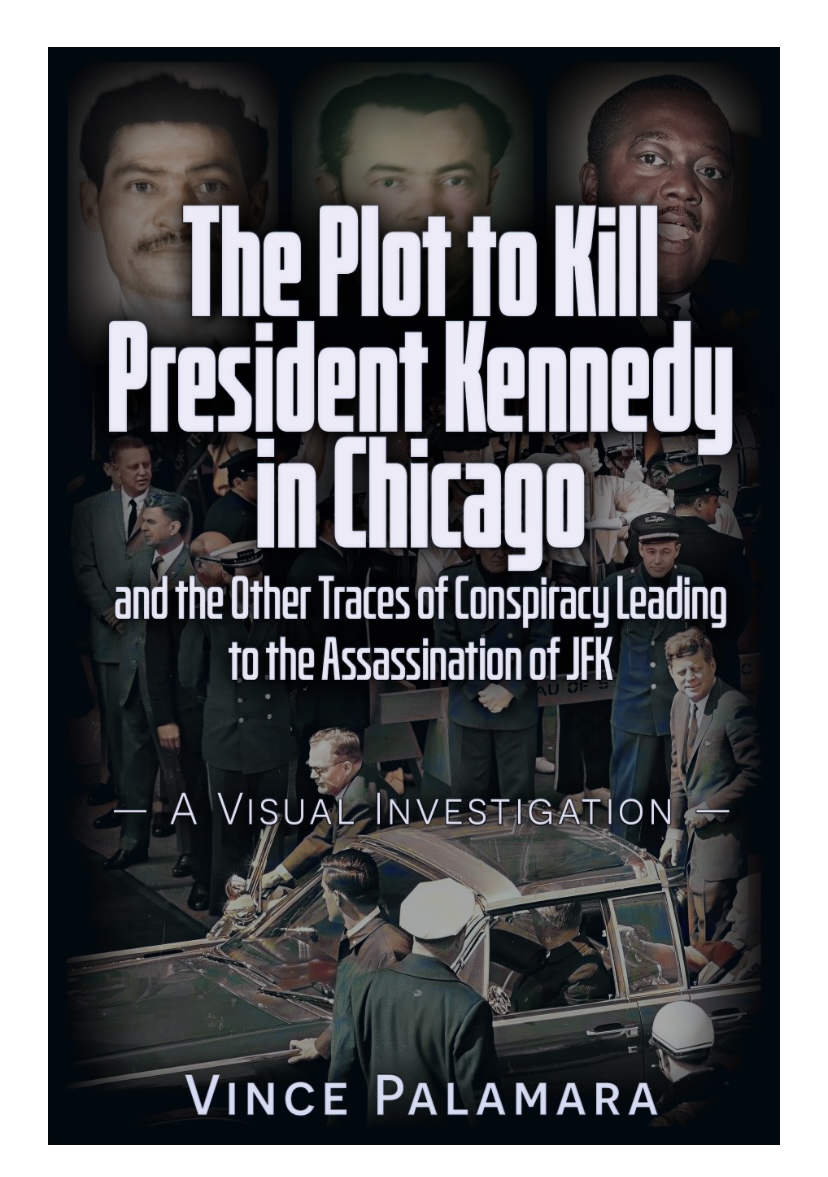


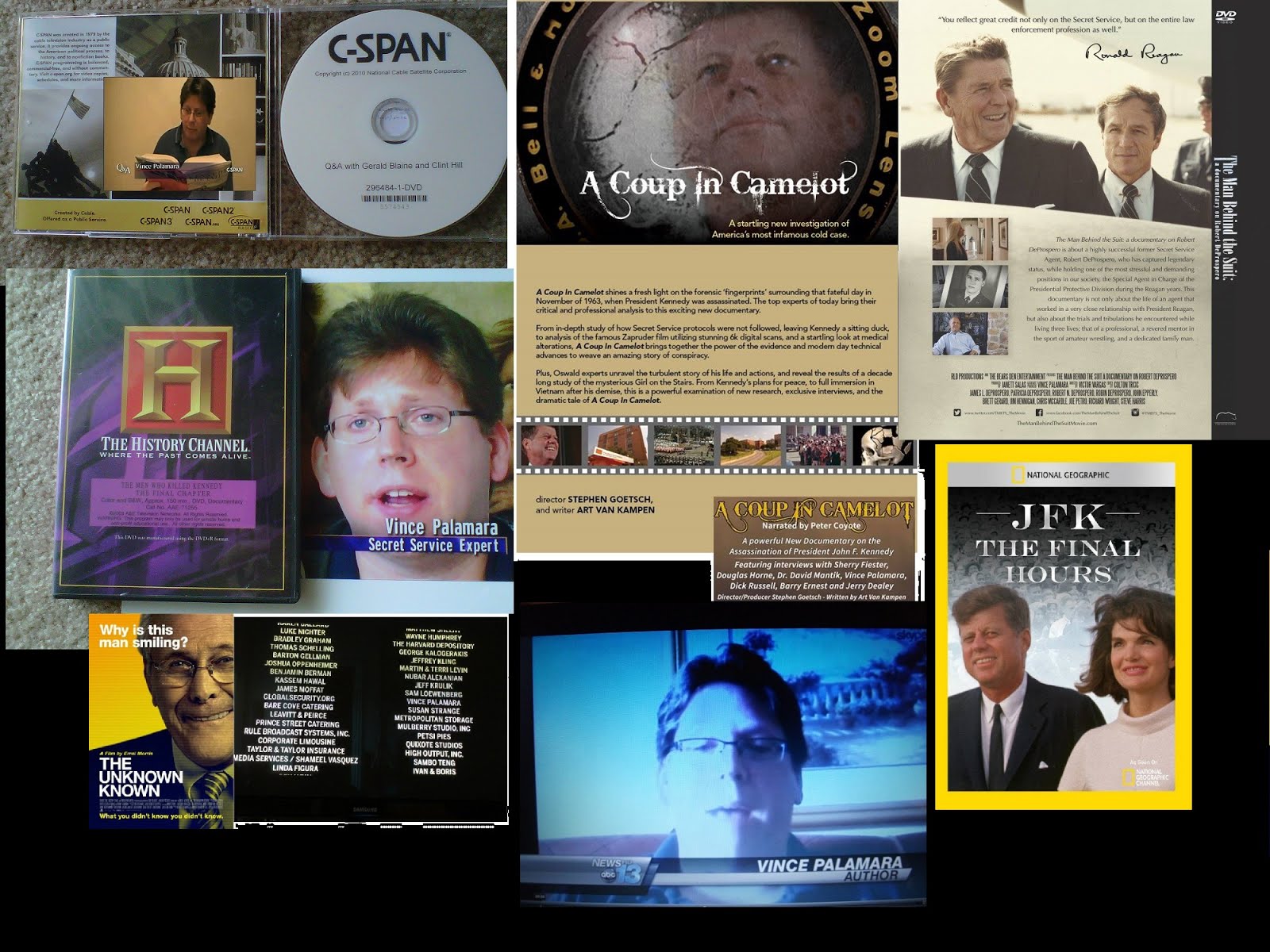

![VINCE PALAMARA [remember to scroll all the way down!]](https://blogger.googleusercontent.com/img/b/R29vZ2xl/AVvXsEjSZ-Z_puqnjl3UgdiJxBenMyIMaFhmBD-PYQUsxCtFS4UF7dJQB6n32rt9a0ZqFRPmuBoukhrMZxv6LOD9GoUGPiaShO3wj_8xL98obRAsUbIf0mXutzbq7jKDrCp8Y-Y0k9rnS5ARjQQ/s1600/11.jpg)


![CHAPTER 8 OF ARRB FINAL REPORT [I AM IN THIS REPORT, AS WELL]...HMMM---THE SECRET SERVICE DESTROYS](https://blogger.googleusercontent.com/img/b/R29vZ2xl/AVvXsEimGbOuG69gW-cgAbsfjd8p8PD-subznIjcsQXUSFq560o_kiXunf9TcH0fkOqmWuK73id6m5TyVMhWcfBrPUEee6JLbvqNZKdIVQa5Drcz568Ue6GZdf_PUtLuLwPDcucv3gOn5KGBZPw/s1600/DSCF0462.JPG)


