


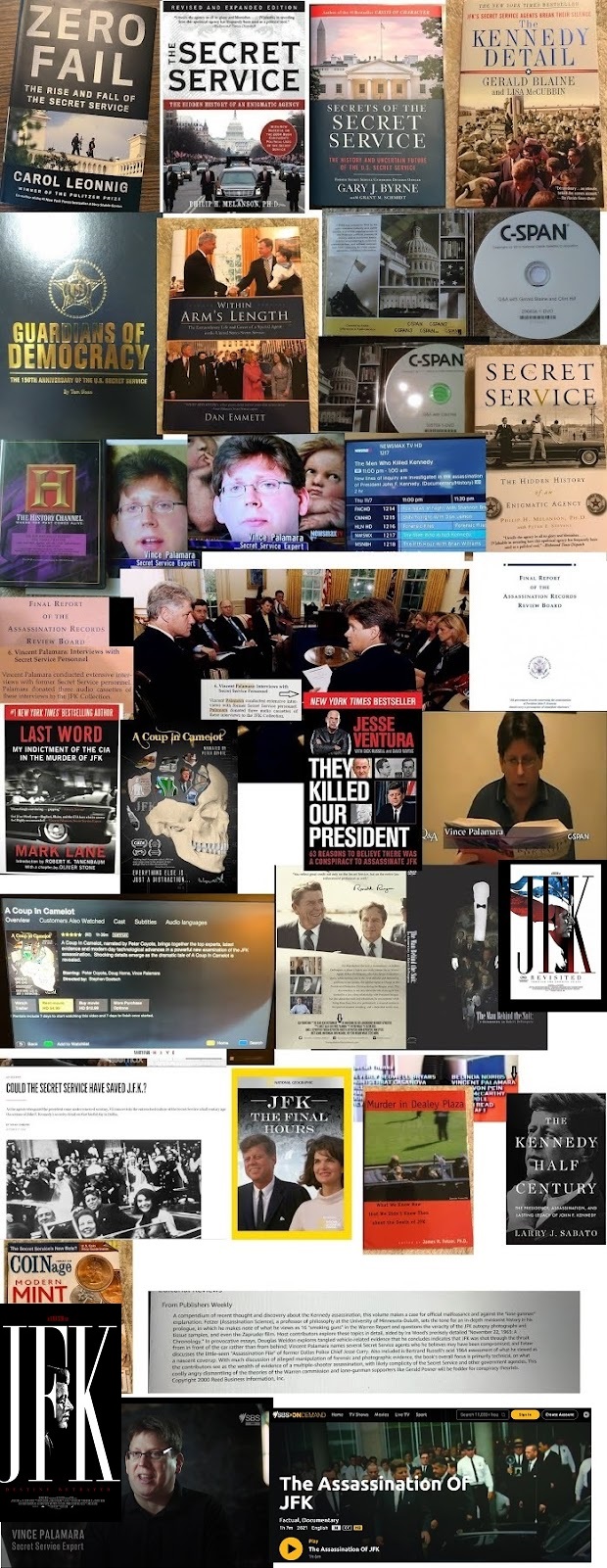

11/1/10
Stewart Stout
Vince.
Thought I would mention that one of the influential people that attended the advance planning meetings for the Dallas trip was the Mayor of Dallas in 63 and I think it was Earle Cabell or Eric ?. Doesn't really matter. I distinctly ...remember during a conversation at the dinner table weeks following (that surreal day), my father telling my mother that "the Mayor thought agents riding on the back of the car (which was common protocol) would send a message and did not want his city to appear dangerous to the world though the media. He asked for subtle security exposure if and where possible."
On that day only two individuals would have been able to direct such an order and that would have been the President himself or Floyd Boring SAIC. In my opinion, and you know about opinions, if you find out who else was in that chain of command "during that moment" you will be able to rationally determine why the agents jumped down for a portion of that politically motivated route through the city.
Take care Vince and please don't give up.
--------
Vince Palamara Thanks alot, Stewart! Yes, Earle Cabell, the brother of the CIA's Charles Cabell (fired by JFK over the Bay of Pigs), was the Mayor...and you are correct re: Floyd Boring. I admire your father (he is spoken of and pictured in The Kennedy Detail) and MOST of the agents...except Boring, Roberts, and Greer :)
------
Hi Vince. Very glad your still on the case. You know your making a difference when "Big Brother" is watching and complaining. I have reviewed your blog and I think your tenacity and perserverance will some day bring the truth to light. It DOES matter. Hang in there with greater vigilance and determination now. You got-em worried.
On another note, I noticed my dad was not mentioned as one of the A[T]SAIC on the Kennedy Detail in Dallas. As you know, he was waiting for the president at the Trade Mart. Just sayin.
Monday, November 1, 2010


Tuesday, October 26, 2010
An ignored member of The Kennedy Detail: Sam Kinney (deceased 7/21/97)
ebehere
I had two phone visits in 1991 with Sam Kinney , Secret Service agent who drove the 'Work Car' about four feet behind the JFK limo on that fateful day in Dallas in 1963 as I lived in Greenacres, Florida about 10 minutes from Sam's home in Palm Springs, Florida. He emphatically told me that there were several shots and that the "Warren Commission" was "bull@!$%#". We discussed in length the many facts leading up to that horrible day. He mentioned about the lies with the 'pristine bullet theory' as well as the shot to President JFK's head was from the front of the JFK limo. He told me we were probably being phone tapped in our conversations by some government agency and I asked him why he didn't testify in the 'Warren Commission' investigations, his reply to me was "he wanted to live to his retirement years". He loved President JFK and told me a wonderful story about one Christmas when money was lacking to pay them in the Secret Service Presidential detail and JFK paid them from his own funds. The arguments I've read about and watched on television over the years are full of half-truths with rightout lies in this cover-up still to this day. The rogue elements in our CIA with their embedded Pentagon crew who disliked JFK for varying reasons were involved notwithstanding those unwarranted 'dangerous alliances' with the "Mafia". Sam, may you rest in peace, and my deepest thoughts to his wife, Hazel, if she still is alive. I spoke with him solely because of a common acquaintance in my employment and I promised him I was not going to publish any work as I was just an individual who sought answers. I now write this as it angers me to read the continued 'BS' with 'plausible denial' on many of the facts. Oswald was what he said all along, "I'm the patsy".
http://vincepalamarasecretserviceexpert.newsvine.com
I had two phone visits in 1991 with Sam Kinney , Secret Service agent who drove the 'Work Car' about four feet behind the JFK limo on that fateful day in Dallas in 1963 as I lived in Greenacres, Florida about 10 minutes from Sam's home in Palm Springs, Florida. He emphatically told me that there were several shots and that the "Warren Commission" was "bull@!$%#". We discussed in length the many facts leading up to that horrible day. He mentioned about the lies with the 'pristine bullet theory' as well as the shot to President JFK's head was from the front of the JFK limo. He told me we were probably being phone tapped in our conversations by some government agency and I asked him why he didn't testify in the 'Warren Commission' investigations, his reply to me was "he wanted to live to his retirement years". He loved President JFK and told me a wonderful story about one Christmas when money was lacking to pay them in the Secret Service Presidential detail and JFK paid them from his own funds. The arguments I've read about and watched on television over the years are full of half-truths with rightout lies in this cover-up still to this day. The rogue elements in our CIA with their embedded Pentagon crew who disliked JFK for varying reasons were involved notwithstanding those unwarranted 'dangerous alliances' with the "Mafia". Sam, may you rest in peace, and my deepest thoughts to his wife, Hazel, if she still is alive. I spoke with him solely because of a common acquaintance in my employment and I promised him I was not going to publish any work as I was just an individual who sought answers. I now write this as it angers me to read the continued 'BS' with 'plausible denial' on many of the facts. Oswald was what he said all along, "I'm the patsy".
http://vincepalamarasecretserviceexpert.newsvine.com
Saturday, October 16, 2010
The DARK side of the Kennedy Detail II
Agent Gerald W. O'Rourke
Agent Jerry O’Rourke was part of the shift consisting of ATSAIC Arthur L. Godfrey-shift leader, SA Gerald S. Blaine, SA Kenneth S. Giannoules, SA Paul A. Burns, and SA Robert R. Faison. This group of men arrived in Fort Worth from Washington, D.C. at 2:15 p.m. on 11/21/63 for duty at the Hotel Texas as part of the 4p.m.-12 min shift (JFK arrived 11:50 p.m., ten minutes until midnight). After having helped protect the President during the morning of 11/22/63 in Fort Worth (as part of the 12 Midnight to 8 a.m. shift), this coterie of agents proceeded on to Austin for JFK’s proposed stop after his Dallas trip. [Sources-RIF#1541000110104; 1541000110064; 1541000110057; 1541000110050; 1541000110044; 1541000110033; 18 H 779; Air Force One radio tapes/ transcripts; Bill Moyers' interview on A&E 1992; "Death of a President", p.317]
Blaine went on to become a member of the Overseas Security Advisory Council---OSAC---for the U.S. Department of State, in his capacity as the OSAC Private Sector Representative representing the IBM Corporation and, later, as the Director of International Security for the ARCO International Oil and Gas Company. O’Rourke waited nearly 40 years to break his silence---it was worth the wait [“Ex-agent refuses to toe party line on JFK slaying” By Ellen Miller, Special To The News November 20, 2003. RockyMountainNews.Com
http://www.rockymountainnews.com/drmn/state/article/0,1299,DRMN_21_2442956,00.html] : “Lee Harvey Oswald didn't act alone when he killed President John F. Kennedy, a retired agent said Wednesday, and the president died because Secret Service agents failed at their jobs. "Officially, the answer to Oswald when somebody asks – because we were ordered to say it - is that the Warren Commission found that he acted alone," retired agent Jerry O'Rourke said. "But was there more than one gunman? Yes, personally I believe so. And my personal opinion about Jack Ruby is that he was paid to kill Oswald." O'Rourke grew up in Telluride and attended Western State and Regis colleges, then spent 22 years in the Secret Service. Now retired and back home, he spoke Wednesday to the downtown Grand Junction Rotary Club. O'Rourke said his group of agents, about 10 of them, had protected Kennedy the morning of Nov. 22, 1963, at a breakfast speech in Fort Worth. Then the group left by air for Austin, the next stop planned for the president's Texas tour.
"We got the word (of the assassination) in the air, and we didn't believe it at first," he said. "We were joking. But later, most of the agents had tears in their eyes. Agents believed in Kennedy, and we knew we failed our job in Dallas.” After his White House tour ended during Johnson's presidency, O'Rourke spent a year in the Secret Service intelligence division, which offered him glimpses into the investigation of Kennedy's death.
Those glimpses, and the accounts of other agents, have convinced O'Rourke that Oswald didn't act alone. He cited several reasons:
Kennedy had a number of enemies, any of whom could have plotted against him. They included Southerners angered by his insistence on civil rights; organized crime; labor unions unhappy with investigations of them by Attorney General Robert F. Kennedy; Cuban dissidents angry over the failed Bay of Pigs invasion; and FBI Director J. Edgar Hoover.
The shots were impossible to make. O'Rourke learned to shoot as a boy and trained as a marksman in the military. He said his visits to Oswald's perch at the Texas Book Depository convince him that no one could have fired a rifle three times so quickly, hitting the president and Texas Gov. John Connally.
The trajectory of one of the shots could not have been made from a gunman on the sixth floor of the Texas Book Depository. The shot entered Kennedy's body at his lower back and traveled up, to exit near his throat.
The circumstances of the autopsy were irregular. Texas law requires autopsies to be done in state, but agents, acting on the orders of White House, took Kennedy's body back to Washington, D.C. The autopsy was performed at Bethesda Naval Medical Center under secrecy that prevails to this day.
Evidence was destroyed. O'Rourke said that on the day of the assassination, one agent was ordered to clean out the cars used in the motorcade, getting rid of blood and other evidence. The agent told O'Rourke that he found a piece of skull, asked the White House doctor what to do with it, and was told to destroy it.
Instructions were given to lie. The agent in charge of motorcade protection [presumably Kellerman] told O'Rourke that he was told by the Warren Commission during his testimony that he did not hear a fourth shot and he did not see someone running across the grassy knoll. But the agent insisted that his account was accurate.
Evidence about the shots is in conflict. An open microphone on a motorcycle in the motorcade picked up four shots, not three.
"In my opinion, Hoover wanted the commission to find that Oswald acted alone," O'Rourke said. "The complete file won't be released until 2027, and the reason for that is most of us will be dead by then [emphasis added]." (Gerald Blaine wrote the author on 6/12/05: “I did not hear Jerry O'rourke's comments, but I cannot even imagine an agent who went through the whole thing expressing a conspiracy theory, but everyone is entitled to their own thoughts. My study and evaluation over the years, based upon the threat scenario's we had to deal with pointed to Oswald's acting alone”)
O’Rourke wrote the author: “"Did President Kennedy order us (agents) off the steps of the limo? To my knowledge President Kennedy never ordered us to leave the limo...President Kennedy was easy to protect as he completely trusted the agents of the Secret Service. We always had to be entirely honest with him and up front so we did not lose his trust...The bubble top was plastic and wasn't even bullet resistant but it is possible it could have deflected the bullet if the bullet was not coming straight on." Letter to author dated 1/15/04
However, O’Rourke would not respond to a second letter from the author and did not wish to speak further about the matters at hand when contacted by phone on 2/11/04.
That said, O’Rourke did consent to corresponding with the author via e-mail on 6/17/05 and 6/18/05---the former agent wrote: “Keep in mind, some of the former agents you interview are not going to be receptive to you. Most don’t mind talking about the assassination but they still are very protective. Also, many continue to have some problems (mental?) dealing with what they feel as a failure on their part…Some of the retired agents have contested my beliefs on the assassination but most of those agents were still in diapers when 11/22/63 [the assassination] came about. I always answer them by stating, ‘I was there, were you?’ Some of those guys you interviewed are great guys while the others are…[ O’Rourke ended this comment in this fashion].” O’Rourke added: “As I told you [,] a couple agents have problems with the assassination, Clint [Hill] being one. He is a good friend of mine but I have not seen him in 25 years…Yes, Clint still has problems with 11/22/63…Again, there are a lot of “people” (and agents) that disagree with my findings [regarding] Nov. 22nd but they have not done any research…I have visited with several of the agents that were right with JFK, at the time, and plied them with drink [!] When all of the records are completely released [,] we will know [what happened], if [we are] still alive.”
--------------------
Agent Thomas B. Shipman (White House Garage Detail, DIED BEFORE THE DALLAS TRIP) [include video]
A Major discovery by the author was made when perusing a passage buried in Col. George J. McNally's Page 211. Col. George J. McNally was the first commanding officer of the White House Army Signal Agency, and its successor, the White House Communications Agency (WHCA) from 1941 until his retirement in 1965. Before that, McNally was an agent of the United States Secret Service (1935-1941). McNally was in the midst of finishing a book when he died of a heart attack on 8/11/70 (he is interred in Arlington National Cemetery). The name of McNally's book, not released until 1982 (with the help of his widow and the 1600 Communications Assoc.), is "A Million Miles of Presidents. “Among countless other trips (Truman-Johnson), McNally was on the Texas trip, working closely with Chief Warrant Officer Arthur W. Bales, Jr.and Ira Gearhart, a.k.a. The Bagman (these two men rode near the end of the motorcade in the White House Signal Corps car.) For his part, McNally stayed behind at the Love Field terminal to have lunch and to check on the upcoming Austin part of the trip to see if the communication lines were working. [McNally was interviewed 4 times for Manchester's "The Death of a President" and appears on one page of Bishop's "The Day Kennedy Was Shot." In addition, McNally's name appears several times during agent Robert Bouck's JFK Library Oral History, as McNally played a critical role in the White House taping system. Finally, McNally was one of the original members of founder Floyd Boring's Association of Former Agents of the United States Secret Service in 1969]
very obscure and non-indexed book entitled "A Million Miles of Presidents"---the relevant passage reads: "One of the President's drivers, Tom Shipman, died suddenly."
In the chronology of McNally's narrative, after discussing the death of baby Patrick Kennedy (Aug. 1963) and the 11-state "Conservation Tour"(late September 1963), this would seem to indicate a time period of around Sept. 1963 for Shipman's death (McNally also mentions the death of Administrative Officer Frank Sanderson who died in May 1963, as verified by an internet search at Ancestry.Com and at other sites. Strangely, no death for a "Tom" or "Thomas" Shipman is listed for 1963.) However---Secret Service SA Tom Shipman was on the "Conservation Tour," as Office -of-the- Naval- Aide records for this trip reveal. In fact, Shipman rode on Helicopter #2 from the South Lawn of the White House on the way to Andrews Air Force Base on 9/24/63 with Ken O'Donnell, SA Gerald Blaine, SA Paul Burns, and SA William Greer. Also, Shipman is listed in the Protective Survey Report (written 9/20/63) for the 9/24/63 Milford, PA stop. RIF#180-10089-10262
Previously, Shipman had been on JFK's 3/23/63 trip to Chicago, IL, driving the follow-up car. RIF#154-10003-10012
Sam Kinney told the author: “[fellow agent/ driver] Deeter B. [Flohr, Ike’s driver] and I were buddies-traveled a lot together; Tom Shipman, Deeter B., and myself.” Author’s interview with Kinney, 4/15/94
Former agent Darwin Horn wrote: “Shipman was a driver for many years with Dick Flore [sic] and Morgan Gies.” E-mail to author dated 2/25/04
If that wasn't enough, it appears that there were two new additions to the regular White House Garage (chauffeur) detail in Oct./ Nov. 1963, in addition to veterans SA Samuel A. Kinney, SA George W. Hickey, SA William R. Greer, Special Officer (SO/ Uniformed Division) William C. Davis, WH Policeman James M. Carter, and SAIC Morgan L. Gies: SA Henry J. Rybka Rybka was a Special Officer and member of JFK’s Inaugural Detail: Protective Survey Report dated 1/16/61 Re: Inaugural Activities of the President on January 20, 1961, conducted by SAIC James M. Beary (1-15 [Washington Field Office]) and SA H.S. Knight (1-16 [WHD])
(attending Treasury School from 11/1/63 to 11/8/63 and who would go on to be recalled by Agent Roberts at Love Field) and SA Andrew M. Hutch (who doesn't join the detail until 11/18/63, having previously been a White House Policeman). Secret Service Shift Reports for November 1963, inc. 11/1/ 63:RIF# 1541000110180; 11//2/63: RIF#1541000110173; 11/3/63:RIF#1541000110167; 11/4/63: RIF# 1541000110160; 11/5/63: RIF# 1541000110153; 11/6/63: RIF# 1541000110146; 11/7/63: RIF# 1541000110139; 11/8/63: RIF#1541000110132; 11/18/63: RIF#1541000110062; 11/22/63: RIF# 1541000110034
From the record, then, it appears Shipman died suddenly sometime between October 3 and November 1 1963. It would be nice to have the travel logs for this time period, but, as previously noted, the Secret Service destroyed them in January 1995:
Once again, from the Final Report of the Assassination Records Review Board---"However, in January 1995, the Secret Service destroyed presidential protection survey reports for some of President Kennedy's trips in the fall of 1963. The Review Board learned of the destruction approximately one week after the Secret Service destroyed them, when the Board was drafting its request for additional information. The Board believed that the Secret Service files on the President's travel in the weeks preceding his murder would be relevant." Page 149.
WHY the destruction? WHERE is Shipman's death certificate?
SA Tom Shipman died in late 1963, before the Texas trip. This was the extent of the author’s knowledge from 1997, the time of discovery, until 1999, when the author came across an online website dedicated to fallen officers that listed Shipman’s middle initial Not long after the author’s discovery, the website could no longer be accessed. As of 12/1/03, this website, by the Federal Law Enforcement Foundation, has Shipman and others listed:
http://www.federallawenforcement.com/fallenssa.htm
and, most importantly, on 7/26/01, when the following information was discovered by the author, once again via the internet: THE ASSOCIATION OF FORMER AGENTS OF THE SECRET SERVICE'S website http://www.oldstar.org/In_Memoriam.html
Here is another great source of information online: http://www.aorp.org/deceasedsort.html
lists 34 agents that passed away in the line of duty---out of literally thousands of men and women---since the late nineteenth century. The ONLY JFK-era agent listed is White House Garage/ Chauffeur Special Agent THOMAS B. SHIPMAN: "October 14, 1963: Died of a heart attack while on a presidential protective assignment at Camp David, Maryland."
Because of Shipman's death, Bill Greer drove JFK in Dallas and his immediate replacement, Henry J. Rybka (fresh from Treasury School) was recalled at Love Field by Roberts! Former agent Gerald Blaine told the author that Kinney, Shipman, and Greer were “the three consistent ones” that drove JFK’s car (commenting that Greer “usually” did), also adding that Shipman and Kinney drove the follow-up car, as well. Author’s interview with Blaine, 2/7/04
Winston Lawson wrote the author: “Tom Shipman, also a driver, died of a heart attack while up at Camp David, prior to retirement. I don’t know the year and couldn’t find out. I believe Sam Kinney found his body. They would have roomed together in one of the cabins up there.” Letter to author dated 1/20/04
Former agent Vincent Mroz told the author that Shipman was “in his 40’s or early 50’s.” Author’s interview with Mroz, 2/7/04
What is even more amazing about Shipman’s death is the fact that, out of the literally thousands of agents who have come and gone since the 19th century, as mentioned above, only 34 are listed By comparison, the sister agency ATF’s list dwarfs the Secret Service’s. In addition, it was reported: “In 1973, agent Jim Connally, who’d had a drinking problem, took his own life.” [Rush (Venker), page 216]. Agent Jim Kalafatis said: “We had two [unnamed] agents die within a month, of sudden heart attacks.” [“The Secret Service,” page 264] Donald Robinson died 3/5/83, while George LaBarge died 4/5/83. In addition, a spokesman for the agency stated: “As of 2003, we have lost 34 employees as a result of on-duty incidents.” See:
http://www.secretservice.gov/kids_faq.shtml
, including the 5 agents who died tragically in the 4/19/95 Oklahoma City bombing, Leslie Coffelt (the Uniformed Division officer who died on 11/1/50), 5 others who died in the 1990’s, 7 who died in the 1980’s, 2 who died in the 1970’s (inc. J. Clifford Dietrich, who died in a helicopter crash on 5/26/73), 1 other who died in the 1960’s (Thomas Wooge Wooge is pictured on pages 64, 67, & 70 from the AFAUSSS book from 1991
, on 10/17/68) The AFAUSS (new) website had this information: “Agent Thomas K. Wooge - October 17, 1968: Died of a heart attack while protecting a Presidential candidate in Rochester, New York.”
http://www.oldstar.org/In_Memoriam.html
, 1 who died in the 1940’s (11/8/40, to be exact), 3 who died in the 1930’s, 2 who passed away in the 1920’s, and 2 who died in the 1900’s. That’s a very small, sad grouping to be in, indeed. “High Interest Books: Secret Service,” a 48-page book for young people written by Mark Beyer in 2003 (Children’s Press, a Division of Scholastic Incorporated), states on page 33: “Over thirty people have died while working as Secret Service agents.”
(Interestingly, advance man Marty Underwood told author Harry Livingstone-- "There were a couple of suicides in the thing, with the Secret Service and everything..." Livingstone: "Do you remember who committed suicide?" Underwood: "I don't remember. I think there were a couple..." [Underwood is then cut off by Livingstone] “High Treason 2,” page 439
Also, an unnamed agent took his own life "in the late Sixties, in Washington, with his own weapon. There were signs he was beginning to buckle," as former agent Chuck Rochner explained to fellow former agent Marty Venker. "Confessions of an Ex-Secret Service Agent," pp.216-217
Former agent Darwin Horn wrote: “I cannot recall the name of the SA who killed himself in the late 60's. I seem to recall something of that nature occurring though.” E-mail to author dated 3/2/04
)
Conclusion-One wonders what would have happened in Dallas if Shipman, not Greer, was behind the wheel of President Kennedy’s limousine during the shooting…a very convenient death, indeed. A picture of Agent Shipman driving JFK’s car (alongside ASAIC Floyd Boring) can be found on page 33 of the magazine “One Dozen Red Roses: The Life Story of Jacqueline Kennedy” (Washington, D.C.: Tatler Publishing Co., 1964) [kindly identified by former agent Win Lawson for the author on 2/17/04]
---------------------
More troubling are the revelations Tim McIntyre and three of his Secret Service colleagues shared with author Seymour Hersh in 1997 For Hersh’s book “The Dark Side of Camelot” (Boston: Little Brown, 1997).
---and, soon after, on ABC television “Dangerous World: The Kennedy Years,” 12/4/97, ABC, hosted by Peter Jennings. Former CBS newsman Marvin Kalb writes on page four of his book “One Scandalous Story” about an incident which occurred in September 1963 in which he stumbled upon the Secret Service escorting “a woman with stunningly attractive legs” up a private elevator in New York’s Carlyle Hotel where President Kennedy was staying. The panicked Secret Service knocked Kalb flat on the floor to prevent him from getting a good look at the woman! NY Times reporter R.W. Apple also related to Kalb that he saw a beautiful young woman escorted into JFK’s hotel suite at the Carlyle in 1963.
---concerning JFK’s private life (and, indirectly, Emory Roberts)…but not for the reason the reader might think: a disturbing and alarming mindset was demonstrated by these men concerning the president they were sworn to protect. As McIntyre put it: "His shift supervisor, the highly respected Emory Roberts, took him aside and warned...that 'you're going to see a lot of shit around here. Stuff with the President. Just forget about it. Keep it to yourself. Don't even talk to your wife'...Roberts was nervous about it. Emory would say, McIntyre recalled with a laugh, 'How in the hell do you know what's going on? He could be hurt in there. What if one bites him' in a sensitive area? Roberts 'talked about it a lot', McIntyre said. 'Bites'... In McIntyre's view, a public scandal about Kennedy's incessant womanizing was inevitable. 'It would have had to come out in the next year or so. In the campaign, maybe'. McIntyre said he and some of his colleagues...felt abused by their service on behalf of President Kennedy...McIntyre said he eventually realized that he had compromised his law enforcement beliefs to the point where he wondered whether it was 'time to get out of there. I was disappointed by what I saw' [emphasis added].” McIntyre repeated the Roberts’ story on ABC (without naming Emory), with this comment included: “Prostitution-that’s illegal. A procurement is illegal. And if you have a procurer with prostitutes paraded in front of you, then, as a sworn law enforcement officer, you’re asking yourself, ‘well, what do they think of us’?” McIntyre felt this way after having only spent a VERY brief time with JFK before the assassination: he joined the WHD in the fall of 1963 Hersh, pages 240-241.
(fellow former agent Gerald Blaine confirmed to the author on 6/10/05 that McIntyre was indeed “brand new” and lacked experience)! In addition, these feelings of anger and impotence-- especially by Roberts and McIntyre—loom large in the context of the actions and inactions of the Secret Service on 11/22/63. Soon after the airing of the aforementioned television program, Clinton Secret Service Director Lewis C. Merletti wrote a letter to 3,200 current and 500 former agents reminding them not to talk about "any aspect of the personal lives of our protectees." He further reminded the agents to recall their commission book oath, "to be worthy of trust and confidence." Merletti said this "confidence ... should continue forever." Wire service story picked up by many newspapers and media outlets, an example of which was “The Chattanooga Times” in an article written by Sandra Sobieraj on 12/18/97.
After all, this is the Secret Service’s motto: Worthy of Trust and Confidence. “Extreme Careers-Secret Service Agents: Life Protecting the President” by David Seidman (New York: The Rosen Publishing Group, Inc., 2003), pages 9 and 55. See also the 2004 National Geographic documentary “Inside The U.S. Secret Service”
In fact, the Former Secret Service agent’s association censured all four of the agents who spoke to Hersh for speaking about President Kennedy’s private life. “The Arrogance of Power” by Anthony Summers (Penguin: reissue edition), page 511.
For his part, fellow former agent J. Frank Yeager, also a Texas trip veteran, wrote: “I cannot speak for McIntyre. I personally don’t believe that the President’s personal life should be public information.” Letter to author dated 1/24/04
Former agent Walt Coughlin weighed in on the situation: “It was their rite [sic] to say it but I wish they had not. I would never say anything bad (of a personal nature) against a protectee. We are there by law, not as a guest!” E-mail to author dated 2/22/04
Coughlin later wrote the author: “[Tony] Sherman and [Larry] Newman got crossways with AFAUSSS for "talking about personal incidents" of JFK [.] Also Joe Paolella and Tim MacIntyre.” E-mail to author dated 4/27/05
An unnamed agent of the era spoke to author Philip Melanson on 1/9/2002 and stated that, while he conceded that President Kennedy was a womanizer, “it was not on the sordid scale of the four agents’ claims…The retired agent also contests the Hersh agents’ claims that Kennedy tarnished the office, and offers: “Kennedy had the most respect for the office of any president I have seen”…the agent is questioning the accuracy, scale, and the sheer venom, in his opinion, of the four accounts…He adds angrily, “I’ve never heard any agent talk about a president that way.” “The Secret Service: The Hidden History of an Enigmatic Agency” by Philip H. Melanson with Peter F. Stevens, 2003, pages 309-310.
Needless to say, this author agrees with this former agent’s account to Melanson. So, if these stories have been exaggerated (and even if they haven’t), WHY all the ire? If McIntyre and, by extension, Roberts felt this way before Dallas, and there’s every reason to believe they in fact did, the implications for their subsequent actions---or lack thereof---are frightening. At least the other three agents---Joseph Paolella, Tony Sherman, and Larry Newman---were not on Kennedy’s detail on the Texas trip, although that’s certainly no excuse for their ill feelings. As Agent Marty Venker wrote: “Goddamn, I was protecting these guys. Once you got your feeling involved, it made it that much harder to step in front of a bullet. You might think, at the last minute, 'How do I feel about this guy?' I'd just as soon not know what he stood for." Rush (Venker), page 59
Agent Dennis McCarthy reflected: " They [Secret Service] are around politicians, often some of the most powerful ones in the world, much of the time and frequently see these men and women at their worst as well as at their best." "Protecting the President,” page 31.
Agent Ron Williams wrote: “[Regarding President Bill Clinton] The primary reason I retired was because I had become disenchanted with the egotistical arrogance of the Clinton staff and because I saw character flaws in Clinton that I had not seen in the five past presidents I had protected since 1970. His attention to image and style but lack of substance and character was evident in private. He was the ultimate con man… I find myself amazed that a majority of the American people still are buying this con man… My intuition in 1992 was right. Bill Clinton lacks substance and character. I just wish the American people felt values, substance, and character were important.” Orange County Register, 10/31/96.”I retired from the United States Secret Service as the Agent in charge of protection for the Los Angeles area immediately after Clinton was elected president in 1992.”
How similar were these other agents’ feelings about JFK to those of their colleague McIntyre (and presumably, by extension, Roberts)? Very---Tony Sherman, who spent two years at the White House with JFK: "I wanted out...I didn't want a part of it...I got mad...I got angry at any president who doesn't treat the White House like I think he should..." Hersh, pages 241-243.
Sherman added: "Seventy to eighty percent of the agents thought it was nuts… Some of us were brought up the right way. Our mothers and fathers didn't do it. We lived in another world. Suddenly, I'm Joe Agent here. I'm looking at the president of the United States and telling myself, 'This is the White House and we protect the White House.'" “The Atlantic Online,” January 1998.
On the ABC special, Sherman related a tale of JFK and prostitutes that occurred during the President’s trip to Honolulu, Hawaii, in June of 1963 (incidentally, two clips are shown of this trip, depicting agents running with the limousine on all four corners of the limousine during the motorcade, motorcycles beside JFK, and SAIC Behn on the trip, among other things). Sherman said: “The Honolulu episode made me angry. It did make me angry…I’m not a holier-than-thou guy…but he shouldn’t be doing this in public.” The agent also added that this debauchery “continued constantly” and was “a regular thing.” Larry Newman: " It [JFK's behavior] caused a lot of morale problems with the Secret Service...you felt impotent and you couldn't do your job. It was frustrating...[emphasis added]" Hersh, page 230
On the ABC special, Newman mentioned JFK’s sexual trysts with White House secretaries who were known by the nicknames of “Fiddle” and “Faddle.” The agent also said that this facet of JFK made you not want to associate with the man in any way. Joseph Paolella: " [He] acknowledged that the Secret Service's socializing intensified each year of the Kennedy administration, to a point where, by late 1963, a few members of the presidential detail were regularly remaining in bars until the early morning hours [emphasis added]." Hersh, page 244
This is corroborated by what Abraham Bolden told the author, and it also is best exemplified by the drinking incident of 11/21-11/22/63. Agent Tony Sherman also told author Edward Klein: “His womanizing was so routine and common…that we slipped into the nefarious duty of protecting Kennedy from his wife by alerting him is she was returning to the White House unexpectedly…Some agents felt that if the President could get away with this kind of stuff, so could they…Drinking, partying, and sex became part of traveling with the President” “The Kennedy Curse: Why Tragedy Has Haunted America's First Family for 150 Years” by Edward Klein (New York: St. Martin’s Press, 2003), pages 171 and 173
Agent Larry Newman wasn’t finished, either---he spoke at even greater length to author Barbara Leaming about JFK’s womanizing several years later. "Mrs. Kennedy: The Missing History of the Kennedy Years" by Barbara Leaming (Free Press, 2002). See especially pages 61-63, 142, 167, 204, and 252-253 Newman also spoke to author Edward Klein: “Just Jackie: Her Private Years” by Edward Klein (Ballantine Books, 1999), page 374, and is acknowledged for his help in “The Fourth Perimeter” by Tim Green (Warner Books, 2003)
(Author Palamara did contact Newman, Sherman, Paolella, and McIntyre but did not discuss JFK’s womanizing at any length.) Incredulously, Floyd Boring stated: “I can’t recall---and I was there the entire time during the president’s administration and prior to the president’s administration---and I know I can never recall at any time the president meeting with any girl. Everything I’ve ever seen the man do was with a moral attitude…Never seen the girl [Judith Campbell Exner]. Never heard her name until I read it in the paper…wouldn’t know her [Mary Pinchot Meyer]…I never at any time had ever seen the president with Frank Sinatra…at no time was Frank Sinatra at the President’s house (!)” Boring’s JFK Library oral history, 2/25/76, released 1998. For a picture of Agent Boring right in front of to Marilyn Monroe, see page 217 of Carl Sferrazza Anthony’s “The Kennedy W hite House” (New York: Touchstone, 2001). To be fair, just with regard to Campbell and Meyers, SAIC Behn ALSO echoed the same lack of knowledge as Boring [JFK Library oral history, 2/24/76]. See also “The Arrogance of Power” by Anthony Summers (Penguin: reissue edition), page 511
Regarding Agent Boring, former agent Larry Newman told the author, “He’s been a proponent that JFK wasn’t a womanizer.” Author’s interview with Newman, 2/7/04
Former ASAIC of the Los Angeles office Darwin David Horn, Sr. wrote the author: “Never saw Marilyn Monroe...ever.” E-mail to author dated 1/30/04
(Horn later wrote: “Never saw Marilyn Monroe with him but wouldn't tell you if I had.” E-mail to author dated 2/28/04
) Horn also wrote: “Never saw JFK and Sinatra together.” E-mail to author dated 2/26/04
Finally, former Chief James Rowley stated to the JFK Library in 1976: “I never saw or heard anything [regarding allegations of women and JFK]...I had never heard or saw anything that would indicate any truth to it, because certainly any agent on the detail that saw anything like that naturally would report it [!] But I hadn't received...[ellipsis in text]...This was all a surprise to me when I read these so-called stories." James J. Rowley Oral History, JFK Library, 3/29/76
Agent Jerry O’Rourke was part of the shift consisting of ATSAIC Arthur L. Godfrey-shift leader, SA Gerald S. Blaine, SA Kenneth S. Giannoules, SA Paul A. Burns, and SA Robert R. Faison. This group of men arrived in Fort Worth from Washington, D.C. at 2:15 p.m. on 11/21/63 for duty at the Hotel Texas as part of the 4p.m.-12 min shift (JFK arrived 11:50 p.m., ten minutes until midnight). After having helped protect the President during the morning of 11/22/63 in Fort Worth (as part of the 12 Midnight to 8 a.m. shift), this coterie of agents proceeded on to Austin for JFK’s proposed stop after his Dallas trip. [Sources-RIF#1541000110104; 1541000110064; 1541000110057; 1541000110050; 1541000110044; 1541000110033; 18 H 779; Air Force One radio tapes/ transcripts; Bill Moyers' interview on A&E 1992; "Death of a President", p.317]
Blaine went on to become a member of the Overseas Security Advisory Council---OSAC---for the U.S. Department of State, in his capacity as the OSAC Private Sector Representative representing the IBM Corporation and, later, as the Director of International Security for the ARCO International Oil and Gas Company. O’Rourke waited nearly 40 years to break his silence---it was worth the wait [“Ex-agent refuses to toe party line on JFK slaying” By Ellen Miller, Special To The News November 20, 2003. RockyMountainNews.Com
http://www.rockymountainnews.com/drmn/state/article/0,1299,DRMN_21_2442956,00.html] : “Lee Harvey Oswald didn't act alone when he killed President John F. Kennedy, a retired agent said Wednesday, and the president died because Secret Service agents failed at their jobs. "Officially, the answer to Oswald when somebody asks – because we were ordered to say it - is that the Warren Commission found that he acted alone," retired agent Jerry O'Rourke said. "But was there more than one gunman? Yes, personally I believe so. And my personal opinion about Jack Ruby is that he was paid to kill Oswald." O'Rourke grew up in Telluride and attended Western State and Regis colleges, then spent 22 years in the Secret Service. Now retired and back home, he spoke Wednesday to the downtown Grand Junction Rotary Club. O'Rourke said his group of agents, about 10 of them, had protected Kennedy the morning of Nov. 22, 1963, at a breakfast speech in Fort Worth. Then the group left by air for Austin, the next stop planned for the president's Texas tour.
"We got the word (of the assassination) in the air, and we didn't believe it at first," he said. "We were joking. But later, most of the agents had tears in their eyes. Agents believed in Kennedy, and we knew we failed our job in Dallas.” After his White House tour ended during Johnson's presidency, O'Rourke spent a year in the Secret Service intelligence division, which offered him glimpses into the investigation of Kennedy's death.
Those glimpses, and the accounts of other agents, have convinced O'Rourke that Oswald didn't act alone. He cited several reasons:
Kennedy had a number of enemies, any of whom could have plotted against him. They included Southerners angered by his insistence on civil rights; organized crime; labor unions unhappy with investigations of them by Attorney General Robert F. Kennedy; Cuban dissidents angry over the failed Bay of Pigs invasion; and FBI Director J. Edgar Hoover.
The shots were impossible to make. O'Rourke learned to shoot as a boy and trained as a marksman in the military. He said his visits to Oswald's perch at the Texas Book Depository convince him that no one could have fired a rifle three times so quickly, hitting the president and Texas Gov. John Connally.
The trajectory of one of the shots could not have been made from a gunman on the sixth floor of the Texas Book Depository. The shot entered Kennedy's body at his lower back and traveled up, to exit near his throat.
The circumstances of the autopsy were irregular. Texas law requires autopsies to be done in state, but agents, acting on the orders of White House, took Kennedy's body back to Washington, D.C. The autopsy was performed at Bethesda Naval Medical Center under secrecy that prevails to this day.
Evidence was destroyed. O'Rourke said that on the day of the assassination, one agent was ordered to clean out the cars used in the motorcade, getting rid of blood and other evidence. The agent told O'Rourke that he found a piece of skull, asked the White House doctor what to do with it, and was told to destroy it.
Instructions were given to lie. The agent in charge of motorcade protection [presumably Kellerman] told O'Rourke that he was told by the Warren Commission during his testimony that he did not hear a fourth shot and he did not see someone running across the grassy knoll. But the agent insisted that his account was accurate.
Evidence about the shots is in conflict. An open microphone on a motorcycle in the motorcade picked up four shots, not three.
"In my opinion, Hoover wanted the commission to find that Oswald acted alone," O'Rourke said. "The complete file won't be released until 2027, and the reason for that is most of us will be dead by then [emphasis added]." (Gerald Blaine wrote the author on 6/12/05: “I did not hear Jerry O'rourke's comments, but I cannot even imagine an agent who went through the whole thing expressing a conspiracy theory, but everyone is entitled to their own thoughts. My study and evaluation over the years, based upon the threat scenario's we had to deal with pointed to Oswald's acting alone”)
O’Rourke wrote the author: “"Did President Kennedy order us (agents) off the steps of the limo? To my knowledge President Kennedy never ordered us to leave the limo...President Kennedy was easy to protect as he completely trusted the agents of the Secret Service. We always had to be entirely honest with him and up front so we did not lose his trust...The bubble top was plastic and wasn't even bullet resistant but it is possible it could have deflected the bullet if the bullet was not coming straight on." Letter to author dated 1/15/04
However, O’Rourke would not respond to a second letter from the author and did not wish to speak further about the matters at hand when contacted by phone on 2/11/04.
That said, O’Rourke did consent to corresponding with the author via e-mail on 6/17/05 and 6/18/05---the former agent wrote: “Keep in mind, some of the former agents you interview are not going to be receptive to you. Most don’t mind talking about the assassination but they still are very protective. Also, many continue to have some problems (mental?) dealing with what they feel as a failure on their part…Some of the retired agents have contested my beliefs on the assassination but most of those agents were still in diapers when 11/22/63 [the assassination] came about. I always answer them by stating, ‘I was there, were you?’ Some of those guys you interviewed are great guys while the others are…[ O’Rourke ended this comment in this fashion].” O’Rourke added: “As I told you [,] a couple agents have problems with the assassination, Clint [Hill] being one. He is a good friend of mine but I have not seen him in 25 years…Yes, Clint still has problems with 11/22/63…Again, there are a lot of “people” (and agents) that disagree with my findings [regarding] Nov. 22nd but they have not done any research…I have visited with several of the agents that were right with JFK, at the time, and plied them with drink [!] When all of the records are completely released [,] we will know [what happened], if [we are] still alive.”
--------------------
Agent Thomas B. Shipman (White House Garage Detail, DIED BEFORE THE DALLAS TRIP) [include video]
A Major discovery by the author was made when perusing a passage buried in Col. George J. McNally's Page 211. Col. George J. McNally was the first commanding officer of the White House Army Signal Agency, and its successor, the White House Communications Agency (WHCA) from 1941 until his retirement in 1965. Before that, McNally was an agent of the United States Secret Service (1935-1941). McNally was in the midst of finishing a book when he died of a heart attack on 8/11/70 (he is interred in Arlington National Cemetery). The name of McNally's book, not released until 1982 (with the help of his widow and the 1600 Communications Assoc.), is "A Million Miles of Presidents. “Among countless other trips (Truman-Johnson), McNally was on the Texas trip, working closely with Chief Warrant Officer Arthur W. Bales, Jr.and Ira Gearhart, a.k.a. The Bagman (these two men rode near the end of the motorcade in the White House Signal Corps car.) For his part, McNally stayed behind at the Love Field terminal to have lunch and to check on the upcoming Austin part of the trip to see if the communication lines were working. [McNally was interviewed 4 times for Manchester's "The Death of a President" and appears on one page of Bishop's "The Day Kennedy Was Shot." In addition, McNally's name appears several times during agent Robert Bouck's JFK Library Oral History, as McNally played a critical role in the White House taping system. Finally, McNally was one of the original members of founder Floyd Boring's Association of Former Agents of the United States Secret Service in 1969]
very obscure and non-indexed book entitled "A Million Miles of Presidents"---the relevant passage reads: "One of the President's drivers, Tom Shipman, died suddenly."
In the chronology of McNally's narrative, after discussing the death of baby Patrick Kennedy (Aug. 1963) and the 11-state "Conservation Tour"(late September 1963), this would seem to indicate a time period of around Sept. 1963 for Shipman's death (McNally also mentions the death of Administrative Officer Frank Sanderson who died in May 1963, as verified by an internet search at Ancestry.Com and at other sites. Strangely, no death for a "Tom" or "Thomas" Shipman is listed for 1963.) However---Secret Service SA Tom Shipman was on the "Conservation Tour," as Office -of-the- Naval- Aide records for this trip reveal. In fact, Shipman rode on Helicopter #2 from the South Lawn of the White House on the way to Andrews Air Force Base on 9/24/63 with Ken O'Donnell, SA Gerald Blaine, SA Paul Burns, and SA William Greer. Also, Shipman is listed in the Protective Survey Report (written 9/20/63) for the 9/24/63 Milford, PA stop. RIF#180-10089-10262
Previously, Shipman had been on JFK's 3/23/63 trip to Chicago, IL, driving the follow-up car. RIF#154-10003-10012
Sam Kinney told the author: “[fellow agent/ driver] Deeter B. [Flohr, Ike’s driver] and I were buddies-traveled a lot together; Tom Shipman, Deeter B., and myself.” Author’s interview with Kinney, 4/15/94
Former agent Darwin Horn wrote: “Shipman was a driver for many years with Dick Flore [sic] and Morgan Gies.” E-mail to author dated 2/25/04
If that wasn't enough, it appears that there were two new additions to the regular White House Garage (chauffeur) detail in Oct./ Nov. 1963, in addition to veterans SA Samuel A. Kinney, SA George W. Hickey, SA William R. Greer, Special Officer (SO/ Uniformed Division) William C. Davis, WH Policeman James M. Carter, and SAIC Morgan L. Gies: SA Henry J. Rybka Rybka was a Special Officer and member of JFK’s Inaugural Detail: Protective Survey Report dated 1/16/61 Re: Inaugural Activities of the President on January 20, 1961, conducted by SAIC James M. Beary (1-15 [Washington Field Office]) and SA H.S. Knight (1-16 [WHD])
(attending Treasury School from 11/1/63 to 11/8/63 and who would go on to be recalled by Agent Roberts at Love Field) and SA Andrew M. Hutch (who doesn't join the detail until 11/18/63, having previously been a White House Policeman). Secret Service Shift Reports for November 1963, inc. 11/1/ 63:RIF# 1541000110180; 11//2/63: RIF#1541000110173; 11/3/63:RIF#1541000110167; 11/4/63: RIF# 1541000110160; 11/5/63: RIF# 1541000110153; 11/6/63: RIF# 1541000110146; 11/7/63: RIF# 1541000110139; 11/8/63: RIF#1541000110132; 11/18/63: RIF#1541000110062; 11/22/63: RIF# 1541000110034
From the record, then, it appears Shipman died suddenly sometime between October 3 and November 1 1963. It would be nice to have the travel logs for this time period, but, as previously noted, the Secret Service destroyed them in January 1995:
Once again, from the Final Report of the Assassination Records Review Board---"However, in January 1995, the Secret Service destroyed presidential protection survey reports for some of President Kennedy's trips in the fall of 1963. The Review Board learned of the destruction approximately one week after the Secret Service destroyed them, when the Board was drafting its request for additional information. The Board believed that the Secret Service files on the President's travel in the weeks preceding his murder would be relevant." Page 149.
WHY the destruction? WHERE is Shipman's death certificate?
SA Tom Shipman died in late 1963, before the Texas trip. This was the extent of the author’s knowledge from 1997, the time of discovery, until 1999, when the author came across an online website dedicated to fallen officers that listed Shipman’s middle initial Not long after the author’s discovery, the website could no longer be accessed. As of 12/1/03, this website, by the Federal Law Enforcement Foundation, has Shipman and others listed:
http://www.federallawenforcement.com/fallenssa.htm
and, most importantly, on 7/26/01, when the following information was discovered by the author, once again via the internet: THE ASSOCIATION OF FORMER AGENTS OF THE SECRET SERVICE'S website http://www.oldstar.org/In_Memoriam.html
Here is another great source of information online: http://www.aorp.org/deceasedsort.html
lists 34 agents that passed away in the line of duty---out of literally thousands of men and women---since the late nineteenth century. The ONLY JFK-era agent listed is White House Garage/ Chauffeur Special Agent THOMAS B. SHIPMAN: "October 14, 1963: Died of a heart attack while on a presidential protective assignment at Camp David, Maryland."
Because of Shipman's death, Bill Greer drove JFK in Dallas and his immediate replacement, Henry J. Rybka (fresh from Treasury School) was recalled at Love Field by Roberts! Former agent Gerald Blaine told the author that Kinney, Shipman, and Greer were “the three consistent ones” that drove JFK’s car (commenting that Greer “usually” did), also adding that Shipman and Kinney drove the follow-up car, as well. Author’s interview with Blaine, 2/7/04
Winston Lawson wrote the author: “Tom Shipman, also a driver, died of a heart attack while up at Camp David, prior to retirement. I don’t know the year and couldn’t find out. I believe Sam Kinney found his body. They would have roomed together in one of the cabins up there.” Letter to author dated 1/20/04
Former agent Vincent Mroz told the author that Shipman was “in his 40’s or early 50’s.” Author’s interview with Mroz, 2/7/04
What is even more amazing about Shipman’s death is the fact that, out of the literally thousands of agents who have come and gone since the 19th century, as mentioned above, only 34 are listed By comparison, the sister agency ATF’s list dwarfs the Secret Service’s. In addition, it was reported: “In 1973, agent Jim Connally, who’d had a drinking problem, took his own life.” [Rush (Venker), page 216]. Agent Jim Kalafatis said: “We had two [unnamed] agents die within a month, of sudden heart attacks.” [“The Secret Service,” page 264] Donald Robinson died 3/5/83, while George LaBarge died 4/5/83. In addition, a spokesman for the agency stated: “As of 2003, we have lost 34 employees as a result of on-duty incidents.” See:
http://www.secretservice.gov/kids_faq.shtml
, including the 5 agents who died tragically in the 4/19/95 Oklahoma City bombing, Leslie Coffelt (the Uniformed Division officer who died on 11/1/50), 5 others who died in the 1990’s, 7 who died in the 1980’s, 2 who died in the 1970’s (inc. J. Clifford Dietrich, who died in a helicopter crash on 5/26/73), 1 other who died in the 1960’s (Thomas Wooge Wooge is pictured on pages 64, 67, & 70 from the AFAUSSS book from 1991
, on 10/17/68) The AFAUSS (new) website had this information: “Agent Thomas K. Wooge - October 17, 1968: Died of a heart attack while protecting a Presidential candidate in Rochester, New York.”
http://www.oldstar.org/In_Memoriam.html
, 1 who died in the 1940’s (11/8/40, to be exact), 3 who died in the 1930’s, 2 who passed away in the 1920’s, and 2 who died in the 1900’s. That’s a very small, sad grouping to be in, indeed. “High Interest Books: Secret Service,” a 48-page book for young people written by Mark Beyer in 2003 (Children’s Press, a Division of Scholastic Incorporated), states on page 33: “Over thirty people have died while working as Secret Service agents.”
(Interestingly, advance man Marty Underwood told author Harry Livingstone-- "There were a couple of suicides in the thing, with the Secret Service and everything..." Livingstone: "Do you remember who committed suicide?" Underwood: "I don't remember. I think there were a couple..." [Underwood is then cut off by Livingstone] “High Treason 2,” page 439
Also, an unnamed agent took his own life "in the late Sixties, in Washington, with his own weapon. There were signs he was beginning to buckle," as former agent Chuck Rochner explained to fellow former agent Marty Venker. "Confessions of an Ex-Secret Service Agent," pp.216-217
Former agent Darwin Horn wrote: “I cannot recall the name of the SA who killed himself in the late 60's. I seem to recall something of that nature occurring though.” E-mail to author dated 3/2/04
)
Conclusion-One wonders what would have happened in Dallas if Shipman, not Greer, was behind the wheel of President Kennedy’s limousine during the shooting…a very convenient death, indeed. A picture of Agent Shipman driving JFK’s car (alongside ASAIC Floyd Boring) can be found on page 33 of the magazine “One Dozen Red Roses: The Life Story of Jacqueline Kennedy” (Washington, D.C.: Tatler Publishing Co., 1964) [kindly identified by former agent Win Lawson for the author on 2/17/04]
---------------------
More troubling are the revelations Tim McIntyre and three of his Secret Service colleagues shared with author Seymour Hersh in 1997 For Hersh’s book “The Dark Side of Camelot” (Boston: Little Brown, 1997).
---and, soon after, on ABC television “Dangerous World: The Kennedy Years,” 12/4/97, ABC, hosted by Peter Jennings. Former CBS newsman Marvin Kalb writes on page four of his book “One Scandalous Story” about an incident which occurred in September 1963 in which he stumbled upon the Secret Service escorting “a woman with stunningly attractive legs” up a private elevator in New York’s Carlyle Hotel where President Kennedy was staying. The panicked Secret Service knocked Kalb flat on the floor to prevent him from getting a good look at the woman! NY Times reporter R.W. Apple also related to Kalb that he saw a beautiful young woman escorted into JFK’s hotel suite at the Carlyle in 1963.
---concerning JFK’s private life (and, indirectly, Emory Roberts)…but not for the reason the reader might think: a disturbing and alarming mindset was demonstrated by these men concerning the president they were sworn to protect. As McIntyre put it: "His shift supervisor, the highly respected Emory Roberts, took him aside and warned...that 'you're going to see a lot of shit around here. Stuff with the President. Just forget about it. Keep it to yourself. Don't even talk to your wife'...Roberts was nervous about it. Emory would say, McIntyre recalled with a laugh, 'How in the hell do you know what's going on? He could be hurt in there. What if one bites him' in a sensitive area? Roberts 'talked about it a lot', McIntyre said. 'Bites'... In McIntyre's view, a public scandal about Kennedy's incessant womanizing was inevitable. 'It would have had to come out in the next year or so. In the campaign, maybe'. McIntyre said he and some of his colleagues...felt abused by their service on behalf of President Kennedy...McIntyre said he eventually realized that he had compromised his law enforcement beliefs to the point where he wondered whether it was 'time to get out of there. I was disappointed by what I saw' [emphasis added].” McIntyre repeated the Roberts’ story on ABC (without naming Emory), with this comment included: “Prostitution-that’s illegal. A procurement is illegal. And if you have a procurer with prostitutes paraded in front of you, then, as a sworn law enforcement officer, you’re asking yourself, ‘well, what do they think of us’?” McIntyre felt this way after having only spent a VERY brief time with JFK before the assassination: he joined the WHD in the fall of 1963 Hersh, pages 240-241.
(fellow former agent Gerald Blaine confirmed to the author on 6/10/05 that McIntyre was indeed “brand new” and lacked experience)! In addition, these feelings of anger and impotence-- especially by Roberts and McIntyre—loom large in the context of the actions and inactions of the Secret Service on 11/22/63. Soon after the airing of the aforementioned television program, Clinton Secret Service Director Lewis C. Merletti wrote a letter to 3,200 current and 500 former agents reminding them not to talk about "any aspect of the personal lives of our protectees." He further reminded the agents to recall their commission book oath, "to be worthy of trust and confidence." Merletti said this "confidence ... should continue forever." Wire service story picked up by many newspapers and media outlets, an example of which was “The Chattanooga Times” in an article written by Sandra Sobieraj on 12/18/97.
After all, this is the Secret Service’s motto: Worthy of Trust and Confidence. “Extreme Careers-Secret Service Agents: Life Protecting the President” by David Seidman (New York: The Rosen Publishing Group, Inc., 2003), pages 9 and 55. See also the 2004 National Geographic documentary “Inside The U.S. Secret Service”
In fact, the Former Secret Service agent’s association censured all four of the agents who spoke to Hersh for speaking about President Kennedy’s private life. “The Arrogance of Power” by Anthony Summers (Penguin: reissue edition), page 511.
For his part, fellow former agent J. Frank Yeager, also a Texas trip veteran, wrote: “I cannot speak for McIntyre. I personally don’t believe that the President’s personal life should be public information.” Letter to author dated 1/24/04
Former agent Walt Coughlin weighed in on the situation: “It was their rite [sic] to say it but I wish they had not. I would never say anything bad (of a personal nature) against a protectee. We are there by law, not as a guest!” E-mail to author dated 2/22/04
Coughlin later wrote the author: “[Tony] Sherman and [Larry] Newman got crossways with AFAUSSS for "talking about personal incidents" of JFK [.] Also Joe Paolella and Tim MacIntyre.” E-mail to author dated 4/27/05
An unnamed agent of the era spoke to author Philip Melanson on 1/9/2002 and stated that, while he conceded that President Kennedy was a womanizer, “it was not on the sordid scale of the four agents’ claims…The retired agent also contests the Hersh agents’ claims that Kennedy tarnished the office, and offers: “Kennedy had the most respect for the office of any president I have seen”…the agent is questioning the accuracy, scale, and the sheer venom, in his opinion, of the four accounts…He adds angrily, “I’ve never heard any agent talk about a president that way.” “The Secret Service: The Hidden History of an Enigmatic Agency” by Philip H. Melanson with Peter F. Stevens, 2003, pages 309-310.
Needless to say, this author agrees with this former agent’s account to Melanson. So, if these stories have been exaggerated (and even if they haven’t), WHY all the ire? If McIntyre and, by extension, Roberts felt this way before Dallas, and there’s every reason to believe they in fact did, the implications for their subsequent actions---or lack thereof---are frightening. At least the other three agents---Joseph Paolella, Tony Sherman, and Larry Newman---were not on Kennedy’s detail on the Texas trip, although that’s certainly no excuse for their ill feelings. As Agent Marty Venker wrote: “Goddamn, I was protecting these guys. Once you got your feeling involved, it made it that much harder to step in front of a bullet. You might think, at the last minute, 'How do I feel about this guy?' I'd just as soon not know what he stood for." Rush (Venker), page 59
Agent Dennis McCarthy reflected: " They [Secret Service] are around politicians, often some of the most powerful ones in the world, much of the time and frequently see these men and women at their worst as well as at their best." "Protecting the President,” page 31.
Agent Ron Williams wrote: “[Regarding President Bill Clinton] The primary reason I retired was because I had become disenchanted with the egotistical arrogance of the Clinton staff and because I saw character flaws in Clinton that I had not seen in the five past presidents I had protected since 1970. His attention to image and style but lack of substance and character was evident in private. He was the ultimate con man… I find myself amazed that a majority of the American people still are buying this con man… My intuition in 1992 was right. Bill Clinton lacks substance and character. I just wish the American people felt values, substance, and character were important.” Orange County Register, 10/31/96.”I retired from the United States Secret Service as the Agent in charge of protection for the Los Angeles area immediately after Clinton was elected president in 1992.”
How similar were these other agents’ feelings about JFK to those of their colleague McIntyre (and presumably, by extension, Roberts)? Very---Tony Sherman, who spent two years at the White House with JFK: "I wanted out...I didn't want a part of it...I got mad...I got angry at any president who doesn't treat the White House like I think he should..." Hersh, pages 241-243.
Sherman added: "Seventy to eighty percent of the agents thought it was nuts… Some of us were brought up the right way. Our mothers and fathers didn't do it. We lived in another world. Suddenly, I'm Joe Agent here. I'm looking at the president of the United States and telling myself, 'This is the White House and we protect the White House.'" “The Atlantic Online,” January 1998.
On the ABC special, Sherman related a tale of JFK and prostitutes that occurred during the President’s trip to Honolulu, Hawaii, in June of 1963 (incidentally, two clips are shown of this trip, depicting agents running with the limousine on all four corners of the limousine during the motorcade, motorcycles beside JFK, and SAIC Behn on the trip, among other things). Sherman said: “The Honolulu episode made me angry. It did make me angry…I’m not a holier-than-thou guy…but he shouldn’t be doing this in public.” The agent also added that this debauchery “continued constantly” and was “a regular thing.” Larry Newman: " It [JFK's behavior] caused a lot of morale problems with the Secret Service...you felt impotent and you couldn't do your job. It was frustrating...[emphasis added]" Hersh, page 230
On the ABC special, Newman mentioned JFK’s sexual trysts with White House secretaries who were known by the nicknames of “Fiddle” and “Faddle.” The agent also said that this facet of JFK made you not want to associate with the man in any way. Joseph Paolella: " [He] acknowledged that the Secret Service's socializing intensified each year of the Kennedy administration, to a point where, by late 1963, a few members of the presidential detail were regularly remaining in bars until the early morning hours [emphasis added]." Hersh, page 244
This is corroborated by what Abraham Bolden told the author, and it also is best exemplified by the drinking incident of 11/21-11/22/63. Agent Tony Sherman also told author Edward Klein: “His womanizing was so routine and common…that we slipped into the nefarious duty of protecting Kennedy from his wife by alerting him is she was returning to the White House unexpectedly…Some agents felt that if the President could get away with this kind of stuff, so could they…Drinking, partying, and sex became part of traveling with the President” “The Kennedy Curse: Why Tragedy Has Haunted America's First Family for 150 Years” by Edward Klein (New York: St. Martin’s Press, 2003), pages 171 and 173
Agent Larry Newman wasn’t finished, either---he spoke at even greater length to author Barbara Leaming about JFK’s womanizing several years later. "Mrs. Kennedy: The Missing History of the Kennedy Years" by Barbara Leaming (Free Press, 2002). See especially pages 61-63, 142, 167, 204, and 252-253 Newman also spoke to author Edward Klein: “Just Jackie: Her Private Years” by Edward Klein (Ballantine Books, 1999), page 374, and is acknowledged for his help in “The Fourth Perimeter” by Tim Green (Warner Books, 2003)
(Author Palamara did contact Newman, Sherman, Paolella, and McIntyre but did not discuss JFK’s womanizing at any length.) Incredulously, Floyd Boring stated: “I can’t recall---and I was there the entire time during the president’s administration and prior to the president’s administration---and I know I can never recall at any time the president meeting with any girl. Everything I’ve ever seen the man do was with a moral attitude…Never seen the girl [Judith Campbell Exner]. Never heard her name until I read it in the paper…wouldn’t know her [Mary Pinchot Meyer]…I never at any time had ever seen the president with Frank Sinatra…at no time was Frank Sinatra at the President’s house (!)” Boring’s JFK Library oral history, 2/25/76, released 1998. For a picture of Agent Boring right in front of to Marilyn Monroe, see page 217 of Carl Sferrazza Anthony’s “The Kennedy W hite House” (New York: Touchstone, 2001). To be fair, just with regard to Campbell and Meyers, SAIC Behn ALSO echoed the same lack of knowledge as Boring [JFK Library oral history, 2/24/76]. See also “The Arrogance of Power” by Anthony Summers (Penguin: reissue edition), page 511
Regarding Agent Boring, former agent Larry Newman told the author, “He’s been a proponent that JFK wasn’t a womanizer.” Author’s interview with Newman, 2/7/04
Former ASAIC of the Los Angeles office Darwin David Horn, Sr. wrote the author: “Never saw Marilyn Monroe...ever.” E-mail to author dated 1/30/04
(Horn later wrote: “Never saw Marilyn Monroe with him but wouldn't tell you if I had.” E-mail to author dated 2/28/04
) Horn also wrote: “Never saw JFK and Sinatra together.” E-mail to author dated 2/26/04
Finally, former Chief James Rowley stated to the JFK Library in 1976: “I never saw or heard anything [regarding allegations of women and JFK]...I had never heard or saw anything that would indicate any truth to it, because certainly any agent on the detail that saw anything like that naturally would report it [!] But I hadn't received...[ellipsis in text]...This was all a surprise to me when I read these so-called stories." James J. Rowley Oral History, JFK Library, 3/29/76
Friday, October 8, 2010
SA Richard Johnsen, keeper of CE399, deceased
Via Jerry Blaine's blog (buy his book when it comes out!):
"Thursday, October 7, 2010
Richard Johnsen, a Kennedy Detail Secret Service Agent Passed away last week.
Dick was born in California and graduated from the University of California.
He joined the Secret Service in September 1959 and was assigned to the Eisenhower detail. When President Kennedy was sworn in Dick became a member of the Kennedy Detail.
On November 22 nd, Dick was assigned to the 4:00 PM to Midnight shift and was on post at the Trade Center when word came in that the President had been shot. Dick along with his fellow shift members immediately went to Parkland Hospital to assist in securing the hospital and provided assistance on the trip back to Washington D.C.
He remained on the White House Detail through President Ronald Reagan. He is survived by his wife of 44 years, Patricia and his son Erick B. Johnsen and his wife Diane and his grand daughter Isabella.
Dick personified the agents assigned to the Kennedy Detail in dedication to his profession and lived by the values of his generation. Dick provided material for "The Kennedy Detail." He will be missed."
Obituary from the net:
JOHNSEN RICHARD EDWIN JOHNSEN January 30, 1934 - October 2, 2010 Richard Johnsen, retired Secret Service Agent at his home in Annandale, VA. Born and raised in California and a graduate of the University of California, Berkley. He served in the Secret Service from presidents Eisenhower to Reagan. Survived by beloved wife, Patricia of 44 years; son, Erik B. Johnsen; daughter-in-law, Diane and granddaughter, Isabella. He is also survived by his sister, Gwen Giusti (Bruno); brother-in-law, Alan Howells; brother in law, John Hinds (Maryann) and several nieces and nephews.
"Thursday, October 7, 2010
Richard Johnsen, a Kennedy Detail Secret Service Agent Passed away last week.
Dick was born in California and graduated from the University of California.
He joined the Secret Service in September 1959 and was assigned to the Eisenhower detail. When President Kennedy was sworn in Dick became a member of the Kennedy Detail.
On November 22 nd, Dick was assigned to the 4:00 PM to Midnight shift and was on post at the Trade Center when word came in that the President had been shot. Dick along with his fellow shift members immediately went to Parkland Hospital to assist in securing the hospital and provided assistance on the trip back to Washington D.C.
He remained on the White House Detail through President Ronald Reagan. He is survived by his wife of 44 years, Patricia and his son Erick B. Johnsen and his wife Diane and his grand daughter Isabella.
Dick personified the agents assigned to the Kennedy Detail in dedication to his profession and lived by the values of his generation. Dick provided material for "The Kennedy Detail." He will be missed."
Obituary from the net:
JOHNSEN RICHARD EDWIN JOHNSEN January 30, 1934 - October 2, 2010 Richard Johnsen, retired Secret Service Agent at his home in Annandale, VA. Born and raised in California and a graduate of the University of California, Berkley. He served in the Secret Service from presidents Eisenhower to Reagan. Survived by beloved wife, Patricia of 44 years; son, Erik B. Johnsen; daughter-in-law, Diane and granddaughter, Isabella. He is also survived by his sister, Gwen Giusti (Bruno); brother-in-law, Alan Howells; brother in law, John Hinds (Maryann) and several nieces and nephews.
Tuesday, August 24, 2010
Floyd Boring JFK Library Oral History (released via MY efforts!)
http://forums.leoaffairs.com/viewtopic.php?f=157&t=101198
http://www.findagrave.com/cgi-bin/fg.cgi?page=gr&GRid=24417632
http://www.jfklibrary.org/NR/rdonlyres/8DDAAF61-24DB-4D4F-B608-4D4ED96B9F3B/44131/BoringFloyd_oralhistory.pdf
http://www.findagrave.com/cgi-bin/fg.cgi?page=gr&GRid=24417632
http://www.jfklibrary.org/NR/rdonlyres/8DDAAF61-24DB-4D4F-B608-4D4ED96B9F3B/44131/BoringFloyd_oralhistory.pdf
Friday, June 18, 2010
6/6/10 article on Secret Service Agent Mike Howard
http://www.courier-gazette.com/articles/2010/06/06/news_update/228.txt
Collin County man lives 'secret' life
Ronnie Baker / Staff Photo - Mike Howard served as a Secret Service agent behind the scenes with Presidents Kennedy, Johnson, Nixon, Ford, Reagan and their families. Behind him are reminders of his time with the Johnson family.
By Marthe Stinton, mstinton@acnpapers.com
Published: Sunday, June 6, 2010 10:05 PM CDT
Imagine exaggerating on a resume. Now imagine exaggerating on a resume, getting hired, and being assigned to work with the first lady of the United States in one of the most controversial times in U.S. history. For former Secret Service agent Mike Howard, one little exaggeration took him farther than he ever thought he would go: the White House.
Upon walking into his home, it is very clear that Mike Howard is a native Texan. It is even clearer that this retired agent has served his country in almost every aspect, from military, to Secret Service, to police and now to instructor. However, perhaps what's unclear about this man is what story he will tell next.
"I was assigned to protect Mrs. Jacqueline Kennedy," Howard said. "I was working a counterfeit case and they called and said, 'You're being reassigned.' Mr. Sorrels, the agent in charge of the Dallas (branch), called me in his office and said, 'You're going to be working with the first lady.' I thought, 'That's not going to work - I don't speak Bostonian and she doesn't speak Texican.' I was scared to death."
But the fear soon turned to a lasting friendship with the first lady, one that started with a small exaggeration in his personnel file.
"When you first come into the Secret Service, one of the things they ask you is what you are good at," Howard said. "One of the things they asked me was my hobbies, and one of them was that I was a horseback rider. On the card it gives you an option: good, better, best and expert; and guess what I put? 'Expert.'"
Howard said when he met Mrs. Kennedy, she was ecstatic.
"She said, 'Oh, you're Mr. Howard. I'm so glad you're here; now I can ride every day if I want to, can't I?" Howard said. "What am I going to say? All I could think to say was, 'Yes, Ma'am.'"
Howard said he became very good friends with Mrs. Kennedy, calling her "gracious" and "always a lady."
"It's hard to imagine a first lady being just another lady," Howard said. "That's all she was: a lady. It was always 'Mr. Howard' this and 'Mr. Howard' that - it was never 'Agent Howard.' She was great to work with."
Howard spoke of several outings he had with the first lady, including shopping excursions, dinners and the fateful trip to Texas.
According to Howard, because of his experience with the Saginaw Police Department he was sent to accompany the president and first lady during the Fort Worth leg of their Texas tour. When they arrived it was after midnight, and crowds of people lined the streets in front of the Texas Hotel. Howard assisted the couple to their room on the last night they would spend together.
"The next morning was the big breakfast," Howard said. "Everyone was giving their speeches, and I was asked to have Mrs. Kennedy come down from her room. Well, the worst thing you can do is tell a woman to hurry up - especially the first lady."
He had tried to pass off the assignment to other agents, but he said, "That didn't work." Howard said that before he could even knock on the door, she opened it.
"There she was; she was all dressed in that pink suit, pink pillbox hat and leather purse," Howard said. "She said, 'Oh good morning, Mr. Howard, isn't it a beautiful day?' And it was. It had been raining all morning, but all of a sudden it was beautiful."
Howard escorted President Kennedy and the first lady to Carswell Air Force Base, where they boarded Air Force One for the short flight to Dallas. Howard, along with other agents, stayed behind and swept the hotel rooms before their scheduled trip to Love Field, where they were to meet the president and head to Austin.
"We were fixing to leave the room when we heard the TV say there were shots fired in Dallas," Howard said. "We went downstairs and found a 1963 white Ford Interceptor that belonged to Tarrant County Sheriff Lon Evans. I told him I needed his car and that I wasn't sure what was going on but that shots had been fired. He asked where we were going, and I said, 'Dallas.'"
Upon arriving in Dallas, Howard went straight to Parkland Hospital, where fellow agents directed him to the emergency room.
"I went in and they were working on President Kennedy, and in the other room they were working on John Connolly because he was hit also," Howard said. "As I was standing there, Mrs. Kennedy walked in and the pink suit I had seen her in that morning was all spattered in blood. They asked the priest to come in to administer the last rites. We then took the body into the hearse and then to Air Force One. That was the last time I saw Mrs. Kennedy like that."
In an unusual turn of events, the next morning Howard received orders that he was to protect the Oswald family.
"People wanted to kill the whole family. Emotion was very high," Howard said.
Fellow agent Charlie Kunkel went with Howard to the Oswald's home. However, the family was nowhere to be found. According to Howard, he picked up a pad of paper on the table.
"We could tell it had been scribbled on, so we picked up a pencil and" - Howard pantomimed rubbing a pencil on a sheet of paper - "sure enough, it said, 'Executive Inn,'" he said. "It was the only clue we had."
The two agents went to the inn, where they waited until the next morning to take the family into protective custody. Marina Oswald requested that the men take her by the house to get supplies for the baby.
"As we left there, we had the police radio on and they said that they were fixing to move Lee Oswald from the city jail to the county jail," Howard said. "They said that Oswald had been shot and that he was on the way to the hospital. Mamma Oswald translated for Marina - who only spoke Russian - and said, 'She would like to go see my son.' When we arrived at the hospital, the surgeon was cursing, saying, 'I had the S.O.B. saved and he died of shock.'"
When asked about the transition from protecting the First Family to protecting the assassin's family, Howard said, "You just tighten your belt and do your job."
"It was hard because I was protecting the president and first lady one day, and then I had the assassin's family the next," Howard said. "That really hits you; but by order of the president and when you are an agent with the Secret Service, you do your job."
After the Kennedy assassination, Howard worked with Presidents Johnson, Nixon, Ford, Reagan and their families. After his retirement from the Secret Service, Howard was a police officer for the city of Frisco for 20 years. He is now a concealed handgun license instructor and also teaches classes for Collin College's SAIL program. Howard has made and continues to make presentations about his life during the Kennedy and Secret Service years.
Collin County man lives 'secret' life
Ronnie Baker / Staff Photo - Mike Howard served as a Secret Service agent behind the scenes with Presidents Kennedy, Johnson, Nixon, Ford, Reagan and their families. Behind him are reminders of his time with the Johnson family.
By Marthe Stinton, mstinton@acnpapers.com
Published: Sunday, June 6, 2010 10:05 PM CDT
Imagine exaggerating on a resume. Now imagine exaggerating on a resume, getting hired, and being assigned to work with the first lady of the United States in one of the most controversial times in U.S. history. For former Secret Service agent Mike Howard, one little exaggeration took him farther than he ever thought he would go: the White House.
Upon walking into his home, it is very clear that Mike Howard is a native Texan. It is even clearer that this retired agent has served his country in almost every aspect, from military, to Secret Service, to police and now to instructor. However, perhaps what's unclear about this man is what story he will tell next.
"I was assigned to protect Mrs. Jacqueline Kennedy," Howard said. "I was working a counterfeit case and they called and said, 'You're being reassigned.' Mr. Sorrels, the agent in charge of the Dallas (branch), called me in his office and said, 'You're going to be working with the first lady.' I thought, 'That's not going to work - I don't speak Bostonian and she doesn't speak Texican.' I was scared to death."
But the fear soon turned to a lasting friendship with the first lady, one that started with a small exaggeration in his personnel file.
"When you first come into the Secret Service, one of the things they ask you is what you are good at," Howard said. "One of the things they asked me was my hobbies, and one of them was that I was a horseback rider. On the card it gives you an option: good, better, best and expert; and guess what I put? 'Expert.'"
Howard said when he met Mrs. Kennedy, she was ecstatic.
"She said, 'Oh, you're Mr. Howard. I'm so glad you're here; now I can ride every day if I want to, can't I?" Howard said. "What am I going to say? All I could think to say was, 'Yes, Ma'am.'"
Howard said he became very good friends with Mrs. Kennedy, calling her "gracious" and "always a lady."
"It's hard to imagine a first lady being just another lady," Howard said. "That's all she was: a lady. It was always 'Mr. Howard' this and 'Mr. Howard' that - it was never 'Agent Howard.' She was great to work with."
Howard spoke of several outings he had with the first lady, including shopping excursions, dinners and the fateful trip to Texas.
According to Howard, because of his experience with the Saginaw Police Department he was sent to accompany the president and first lady during the Fort Worth leg of their Texas tour. When they arrived it was after midnight, and crowds of people lined the streets in front of the Texas Hotel. Howard assisted the couple to their room on the last night they would spend together.
"The next morning was the big breakfast," Howard said. "Everyone was giving their speeches, and I was asked to have Mrs. Kennedy come down from her room. Well, the worst thing you can do is tell a woman to hurry up - especially the first lady."
He had tried to pass off the assignment to other agents, but he said, "That didn't work." Howard said that before he could even knock on the door, she opened it.
"There she was; she was all dressed in that pink suit, pink pillbox hat and leather purse," Howard said. "She said, 'Oh good morning, Mr. Howard, isn't it a beautiful day?' And it was. It had been raining all morning, but all of a sudden it was beautiful."
Howard escorted President Kennedy and the first lady to Carswell Air Force Base, where they boarded Air Force One for the short flight to Dallas. Howard, along with other agents, stayed behind and swept the hotel rooms before their scheduled trip to Love Field, where they were to meet the president and head to Austin.
"We were fixing to leave the room when we heard the TV say there were shots fired in Dallas," Howard said. "We went downstairs and found a 1963 white Ford Interceptor that belonged to Tarrant County Sheriff Lon Evans. I told him I needed his car and that I wasn't sure what was going on but that shots had been fired. He asked where we were going, and I said, 'Dallas.'"
Upon arriving in Dallas, Howard went straight to Parkland Hospital, where fellow agents directed him to the emergency room.
"I went in and they were working on President Kennedy, and in the other room they were working on John Connolly because he was hit also," Howard said. "As I was standing there, Mrs. Kennedy walked in and the pink suit I had seen her in that morning was all spattered in blood. They asked the priest to come in to administer the last rites. We then took the body into the hearse and then to Air Force One. That was the last time I saw Mrs. Kennedy like that."
In an unusual turn of events, the next morning Howard received orders that he was to protect the Oswald family.
"People wanted to kill the whole family. Emotion was very high," Howard said.
Fellow agent Charlie Kunkel went with Howard to the Oswald's home. However, the family was nowhere to be found. According to Howard, he picked up a pad of paper on the table.
"We could tell it had been scribbled on, so we picked up a pencil and" - Howard pantomimed rubbing a pencil on a sheet of paper - "sure enough, it said, 'Executive Inn,'" he said. "It was the only clue we had."
The two agents went to the inn, where they waited until the next morning to take the family into protective custody. Marina Oswald requested that the men take her by the house to get supplies for the baby.
"As we left there, we had the police radio on and they said that they were fixing to move Lee Oswald from the city jail to the county jail," Howard said. "They said that Oswald had been shot and that he was on the way to the hospital. Mamma Oswald translated for Marina - who only spoke Russian - and said, 'She would like to go see my son.' When we arrived at the hospital, the surgeon was cursing, saying, 'I had the S.O.B. saved and he died of shock.'"
When asked about the transition from protecting the First Family to protecting the assassin's family, Howard said, "You just tighten your belt and do your job."
"It was hard because I was protecting the president and first lady one day, and then I had the assassin's family the next," Howard said. "That really hits you; but by order of the president and when you are an agent with the Secret Service, you do your job."
After the Kennedy assassination, Howard worked with Presidents Johnson, Nixon, Ford, Reagan and their families. After his retirement from the Secret Service, Howard was a police officer for the city of Frisco for 20 years. He is now a concealed handgun license instructor and also teaches classes for Collin College's SAIL program. Howard has made and continues to make presentations about his life during the Kennedy and Secret Service years.
6/17/10 article on Secret Service Agent Win Lawson
http://hamptonroads.com/2010/06/do-you-remember-where-you-were-he-does-jfk#rfq
Do you remember where you were? He does: With JFK
By Bill Bartel
The Virginian-Pilot
June 17, 2010
VIRGINIA BEACH
Winston Lawson remembers the shots as clearly as if it was yesterday.
"I heard bang... bang-bang," he said, slapping his knee for emphasis.
Lawson was riding in the front seat of an unmarked Dallas police car traveling just in front of a dark blue Lincoln convertible carrying President John F. Kennedy, first lady Jacqueline Kennedy and the governor of Texas and his wife. It was 12:30 p.m. on Nov. 22, 1963.
An assassin's bullets mortally wounded President Kennedy and severely injured Gov. John Connally.
It was a national tragedy so shocking that many Americans can remember exactly where they were when they heard of Kennedy's death. For Lawson, it was more personal. He was the Secret Service agent who had planned security for the Dallas trip.
Lawson, now 81 and living in Virginia Beach, is going back to Dallas this week for a reunion with Secret Service colleagues.
An Army intelligence specialist, he joined the Secret Service in 1959, working in its Syracuse, N.Y., office until being transferred to Washington in March 1961, two months after Kennedy was sworn in as president.
As part of a 34-man White House detail that handled security, he often worked long hours, accompanying JFK on his many weekends at the family's compound in Cape Cod and other trips.
By the fall of 1963, Lawson was experienced at planning presidential security, having organized trips both in the United States and abroad. He handled security for JFK's 1963 trip to Germany where the president told citizens of West Berlin - then surrounded by Communist-controlled East Germany - that "all free men, wherever they may live, are citizens of Berlin, and therefore, as a free man, I take pride in the words, 'Ich bin ein Berliner.' "
On Nov. 4, Lawson was told that he would be responsible for the Dallas stopover during Kennedy's trip to Texas. Kennedy wanted to boost his political standing in the state, home of Vice President Lyndon B. Johnson.
The Dallas visit was to include a slow-moving 45-minute motorcade through suburbia and part of downtown, followed by a luncheon speech and a four-minute trip back to the airport.
Ten days before Kennedy arrived, Lawson and other agents were in Dallas arranging security and evaluating potential hazards.
Early on Nov. 22, the Dallas weather was drizzly, and as agents awaited the president's plane, they considered placing a clear plastic cover, or bubble, over the limousine. A Kennedy aide told the Secret Service to leave it off - the White House staff wanted as many people as possible to see the president without obstruction.
As the motorcade eased its way through Dallas, crowds lined the route. Lawson, with another agent and the Dallas police chief and sheriff, were a few car lengths ahead of the presidential limousine.
He kept looking back at the limo and the crowd, then glancing ahead to overpasses, railroads and other hazards, trading advice with the police chief as they went.
The job of scanning buildings fell to agents in a car behind the limo and to local law enforcement officers.
Agent Roy Kellerman, riding in the front seat of Kennedy's car, later said he looked at the Texas School Book Depository Building but saw nothing suspicious. Lawson was commenting to his colleague that it was a long trip when he heard the three bangs. He knew immediately what they were.
"The president was hit. Go to the hospital," a voice on his radio ordered.
They raced to Parkland Memorial Hospital just ahead of the limousine. Lawson retrieved a gurney, and after Connally was removed from the car, he helped other agents take out Kennedy. Mrs. Kennedy had been cradling her husband on her lap.
The president's skin was gray, and he didn't move as they placed him on the gurney. Lawson saw a huge hole in the back of the president's head.
"He didn't look like he was going to make it," Lawson said.
As the president was wheeled into the emergency room, Lawson followed. The agent stood at the president's head as emergency personnel tried to save him. But the damage was so severe, they didn't work for long.
At 1 p.m., the president was declared dead.
As the world outside the ER exploded with the news and, within two hours, the capture of Lee Harvey Oswald, Lawson stayed with Kennedy.
He and other agents transported the president's body back to the airport and loaded the casket onto Air Force One for the return to Washington. On board was the new president, Lyndon Johnson, and Mrs. Kennedy.
Lawson returned home the next day to his family in Falls Church. The day after, he watched on live TV as Oswald was shot to death outside the Dallas jail by Jack Ruby.
And the day after that, he stood guard down a slope from Kennedy's grave at Arlington National Cemetery, part of the detail that provided security for the burial.
In the weeks that followed, he wrote detailed memos and spent hours testifying before the Warren Commission. He also returned to work.
He continued to do presidential advance work, handling security arrangements for President Johnson, Vice President Hubert Humphrey and, in the Nixon administration, Vice President Spiro Agnew.
The personal support he received from other agents helped him deal with the aftermath of the assassination, he said. "Just their attitude and the way they talked to me."
He grimaces when asked how much credence he gives conspiracy theories that the Kennedy assassination involved multiple shooters.
"None," he said. "There's no shots from in front, kitty corner or from the side or anything like that."
He has rethought his work in Dallas many times.
"The biggest 'what ifs' were, 'What if the rain hadn't stopped and the bubble had been on the car?' " he said. "Because everybody thought it was bulletproof, maybe he wouldn't have tried it."
Although the bubble wasn't bulletproof, it might have distorted the shooter's view or the metal frame might have deflected a shot, he said.
After the assassination and investigation, significant changes were made to the Secret Service. The Warren Commission said the agency was understaffed and did not have adequate sources of information and assistance from other law enforcement agencies in reviewing threats against the president.
The number of agents has grown vastly. In 1963, the 34 agents were assigned to guard the president 24 hours a day, with several hundred others on staff. Today, there are thousands.
On Friday, Lawson will travel with his wife back to the Book Depository building - now a museum - where he and a handful of other agents will tell their stories. The event will be taped as part of a Discovery Channel show to air in November. At the same time, a book, "The Kennedy Detail," will be released that tells the story of the agents assigned to JFK.
It's an important and strenuous trip for him. He has been living at Lake Taylor Transitional Care Hospital since February 2008 after suffering a stroke that paralyzed the left side of his body.
Lawson said he's made peace with what happened in Dallas. In the end, he ascribes to a feeling, shared by many agents and the Warren Commission, that there's no way to completely protect someone.
"I thought about it, but I was pretty confident that I had done everything I could do," he said.
Jeff Parris, who worked with Lawson in later years, said he is an iconic figure within the Secret Service. His actions in Dallas and afterward are studied at their training academy, Parris said.
"Even though it was a bad situation, he did the job the way it was supposed to be done."
Do you remember where you were? He does: With JFK
By Bill Bartel
The Virginian-Pilot
June 17, 2010
VIRGINIA BEACH
Winston Lawson remembers the shots as clearly as if it was yesterday.
"I heard bang... bang-bang," he said, slapping his knee for emphasis.
Lawson was riding in the front seat of an unmarked Dallas police car traveling just in front of a dark blue Lincoln convertible carrying President John F. Kennedy, first lady Jacqueline Kennedy and the governor of Texas and his wife. It was 12:30 p.m. on Nov. 22, 1963.
An assassin's bullets mortally wounded President Kennedy and severely injured Gov. John Connally.
It was a national tragedy so shocking that many Americans can remember exactly where they were when they heard of Kennedy's death. For Lawson, it was more personal. He was the Secret Service agent who had planned security for the Dallas trip.
Lawson, now 81 and living in Virginia Beach, is going back to Dallas this week for a reunion with Secret Service colleagues.
An Army intelligence specialist, he joined the Secret Service in 1959, working in its Syracuse, N.Y., office until being transferred to Washington in March 1961, two months after Kennedy was sworn in as president.
As part of a 34-man White House detail that handled security, he often worked long hours, accompanying JFK on his many weekends at the family's compound in Cape Cod and other trips.
By the fall of 1963, Lawson was experienced at planning presidential security, having organized trips both in the United States and abroad. He handled security for JFK's 1963 trip to Germany where the president told citizens of West Berlin - then surrounded by Communist-controlled East Germany - that "all free men, wherever they may live, are citizens of Berlin, and therefore, as a free man, I take pride in the words, 'Ich bin ein Berliner.' "
On Nov. 4, Lawson was told that he would be responsible for the Dallas stopover during Kennedy's trip to Texas. Kennedy wanted to boost his political standing in the state, home of Vice President Lyndon B. Johnson.
The Dallas visit was to include a slow-moving 45-minute motorcade through suburbia and part of downtown, followed by a luncheon speech and a four-minute trip back to the airport.
Ten days before Kennedy arrived, Lawson and other agents were in Dallas arranging security and evaluating potential hazards.
Early on Nov. 22, the Dallas weather was drizzly, and as agents awaited the president's plane, they considered placing a clear plastic cover, or bubble, over the limousine. A Kennedy aide told the Secret Service to leave it off - the White House staff wanted as many people as possible to see the president without obstruction.
As the motorcade eased its way through Dallas, crowds lined the route. Lawson, with another agent and the Dallas police chief and sheriff, were a few car lengths ahead of the presidential limousine.
He kept looking back at the limo and the crowd, then glancing ahead to overpasses, railroads and other hazards, trading advice with the police chief as they went.
The job of scanning buildings fell to agents in a car behind the limo and to local law enforcement officers.
Agent Roy Kellerman, riding in the front seat of Kennedy's car, later said he looked at the Texas School Book Depository Building but saw nothing suspicious. Lawson was commenting to his colleague that it was a long trip when he heard the three bangs. He knew immediately what they were.
"The president was hit. Go to the hospital," a voice on his radio ordered.
They raced to Parkland Memorial Hospital just ahead of the limousine. Lawson retrieved a gurney, and after Connally was removed from the car, he helped other agents take out Kennedy. Mrs. Kennedy had been cradling her husband on her lap.
The president's skin was gray, and he didn't move as they placed him on the gurney. Lawson saw a huge hole in the back of the president's head.
"He didn't look like he was going to make it," Lawson said.
As the president was wheeled into the emergency room, Lawson followed. The agent stood at the president's head as emergency personnel tried to save him. But the damage was so severe, they didn't work for long.
At 1 p.m., the president was declared dead.
As the world outside the ER exploded with the news and, within two hours, the capture of Lee Harvey Oswald, Lawson stayed with Kennedy.
He and other agents transported the president's body back to the airport and loaded the casket onto Air Force One for the return to Washington. On board was the new president, Lyndon Johnson, and Mrs. Kennedy.
Lawson returned home the next day to his family in Falls Church. The day after, he watched on live TV as Oswald was shot to death outside the Dallas jail by Jack Ruby.
And the day after that, he stood guard down a slope from Kennedy's grave at Arlington National Cemetery, part of the detail that provided security for the burial.
In the weeks that followed, he wrote detailed memos and spent hours testifying before the Warren Commission. He also returned to work.
He continued to do presidential advance work, handling security arrangements for President Johnson, Vice President Hubert Humphrey and, in the Nixon administration, Vice President Spiro Agnew.
The personal support he received from other agents helped him deal with the aftermath of the assassination, he said. "Just their attitude and the way they talked to me."
He grimaces when asked how much credence he gives conspiracy theories that the Kennedy assassination involved multiple shooters.
"None," he said. "There's no shots from in front, kitty corner or from the side or anything like that."
He has rethought his work in Dallas many times.
"The biggest 'what ifs' were, 'What if the rain hadn't stopped and the bubble had been on the car?' " he said. "Because everybody thought it was bulletproof, maybe he wouldn't have tried it."
Although the bubble wasn't bulletproof, it might have distorted the shooter's view or the metal frame might have deflected a shot, he said.
After the assassination and investigation, significant changes were made to the Secret Service. The Warren Commission said the agency was understaffed and did not have adequate sources of information and assistance from other law enforcement agencies in reviewing threats against the president.
The number of agents has grown vastly. In 1963, the 34 agents were assigned to guard the president 24 hours a day, with several hundred others on staff. Today, there are thousands.
On Friday, Lawson will travel with his wife back to the Book Depository building - now a museum - where he and a handful of other agents will tell their stories. The event will be taped as part of a Discovery Channel show to air in November. At the same time, a book, "The Kennedy Detail," will be released that tells the story of the agents assigned to JFK.
It's an important and strenuous trip for him. He has been living at Lake Taylor Transitional Care Hospital since February 2008 after suffering a stroke that paralyzed the left side of his body.
Lawson said he's made peace with what happened in Dallas. In the end, he ascribes to a feeling, shared by many agents and the Warren Commission, that there's no way to completely protect someone.
"I thought about it, but I was pretty confident that I had done everything I could do," he said.
Jeff Parris, who worked with Lawson in later years, said he is an iconic figure within the Secret Service. His actions in Dallas and afterward are studied at their training academy, Parris said.
"Even though it was a bad situation, he did the job the way it was supposed to be done."
Subscribe to:
Posts (Atom)



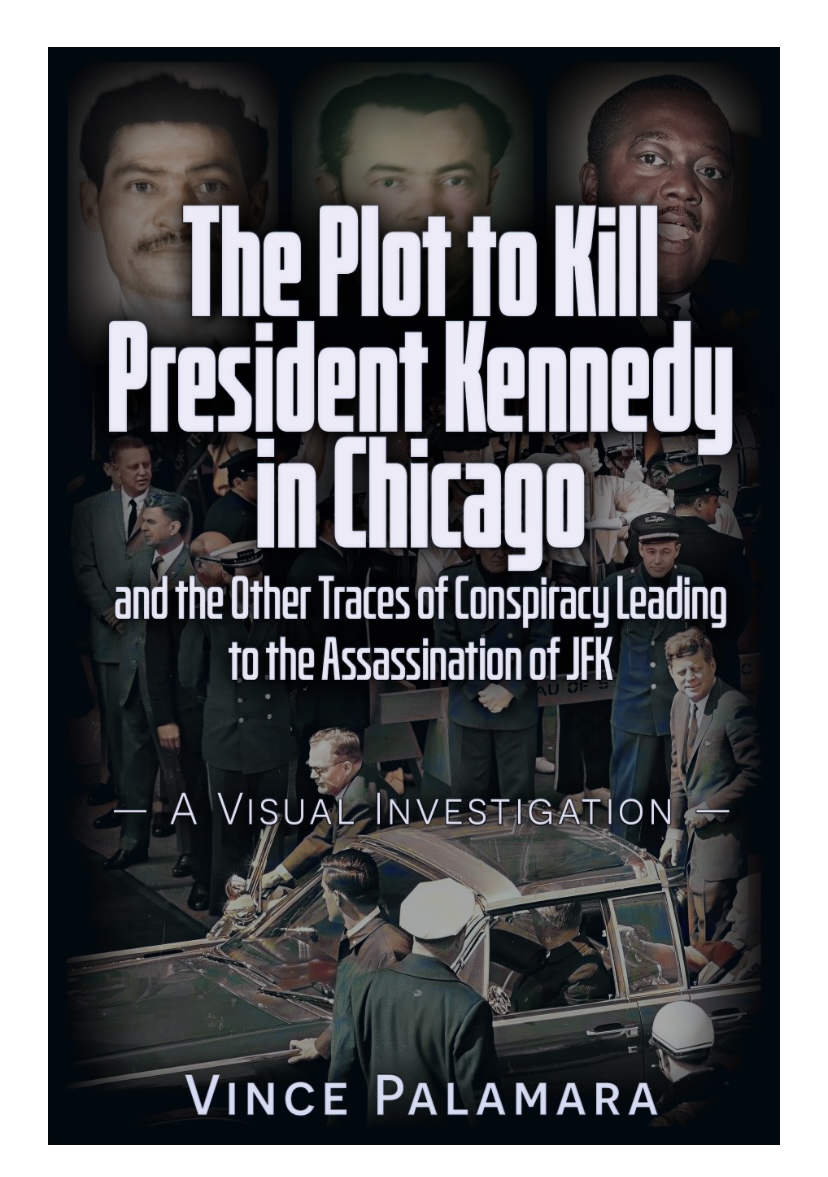


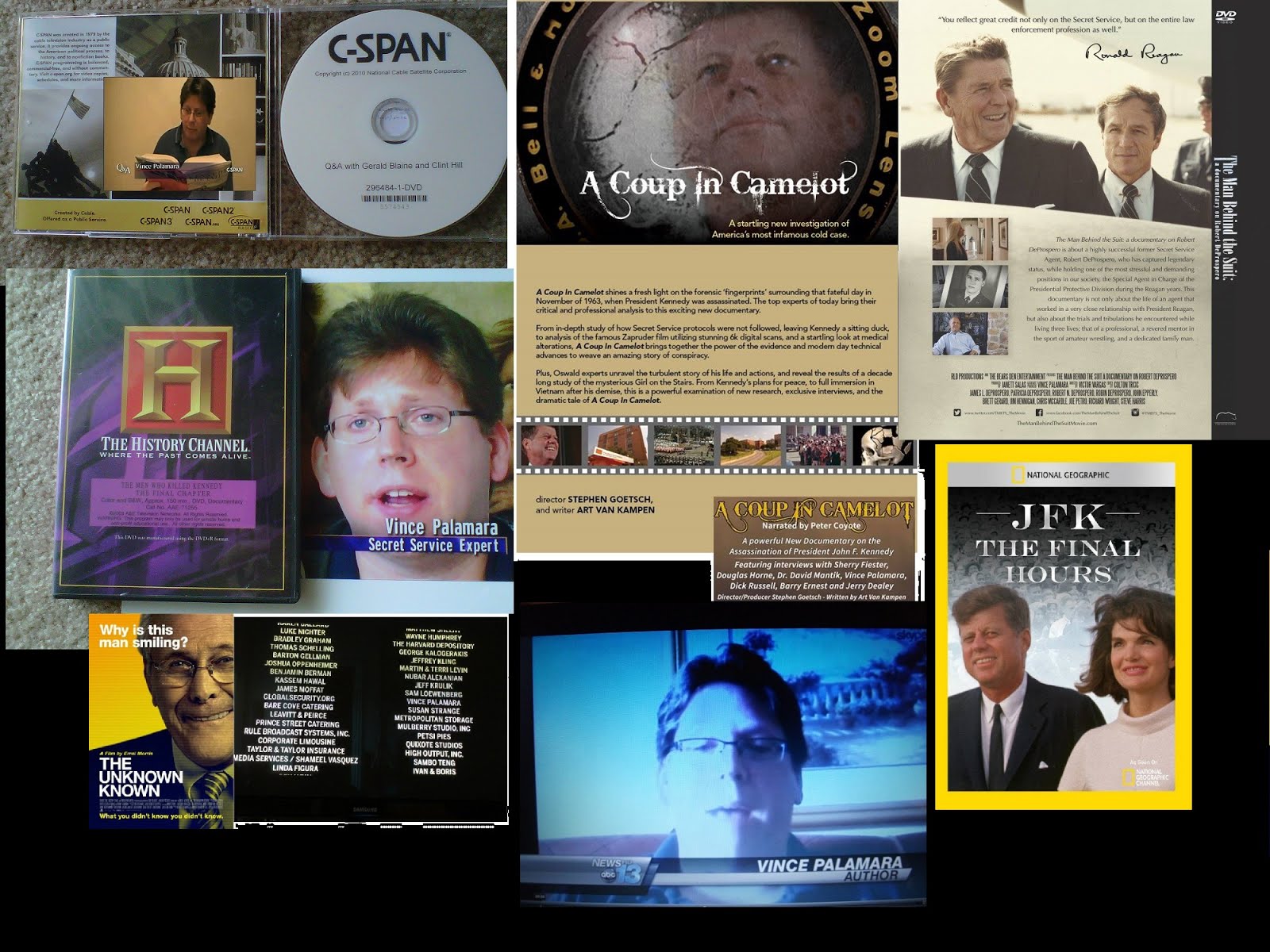

![VINCE PALAMARA [remember to scroll all the way down!]](https://blogger.googleusercontent.com/img/b/R29vZ2xl/AVvXsEjSZ-Z_puqnjl3UgdiJxBenMyIMaFhmBD-PYQUsxCtFS4UF7dJQB6n32rt9a0ZqFRPmuBoukhrMZxv6LOD9GoUGPiaShO3wj_8xL98obRAsUbIf0mXutzbq7jKDrCp8Y-Y0k9rnS5ARjQQ/s1600/11.jpg)


![CHAPTER 8 OF ARRB FINAL REPORT [I AM IN THIS REPORT, AS WELL]...HMMM---THE SECRET SERVICE DESTROYS](https://blogger.googleusercontent.com/img/b/R29vZ2xl/AVvXsEimGbOuG69gW-cgAbsfjd8p8PD-subznIjcsQXUSFq560o_kiXunf9TcH0fkOqmWuK73id6m5TyVMhWcfBrPUEee6JLbvqNZKdIVQa5Drcz568Ue6GZdf_PUtLuLwPDcucv3gOn5KGBZPw/s1600/DSCF0462.JPG)


