


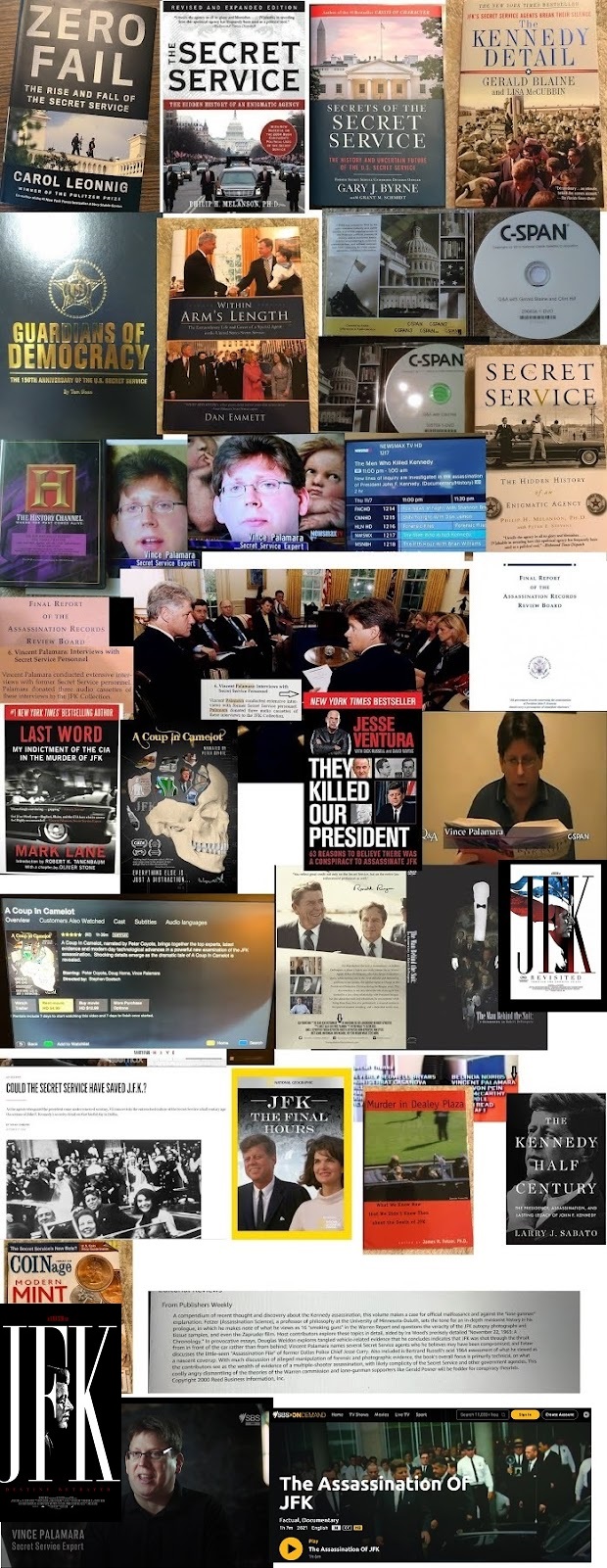

A DAMN good man. Off the top of my head, there are few left from the fateful Dallas motorcade: Win Lawson, Clint Hill, Paul Landis, Tim McIntyre, Jack Ready, Paul Landis, Lem Johns, Woody Taylor, Jim Wright, and a fair amount of press people; that's it
Longtime SE Texas US Rep. Jack Brooks dead at 89
..HOUSTON (AP) — Jack Brooks, who spent 42 years in Congress representing his Southeast Texas district and was in the Dallas motorcade in 1963 when President John F. Kennedy was assassinated, has died. He was 89.
Brooks died Tuesday night at Baptist Hospital of Beaumont after a sudden illness, according to a statement from the Jefferson County Sheriff's Department. Brooks, who would have turned 90 on Dec. 18, was surrounded by family when he died, Deputy Rod Carroll said.
Brooks was among the last links to an era when Democrats dominated Texas politics and was the last of "Mr. Sam's Boys," protégés of fellow Texan and legendary 21-year Democratic House Speaker Sam Rayburn in the state's congressional delegation.
"I'm just like old man Rayburn," Brooks, from Beaumont, once said. "Just a Democrat, no prefix or suffix."
He also was a contemporary and supporter of Lyndon Johnson, who was U.S. Senate majority leader in the 1950s and later president.
Brooks was in the Dallas motorcade Nov. 22, 1963, when President Kennedy was assassinated. He's in the famous photo taken later that day aboard Air Force One at Dallas' Love Field, standing immediately behind the grief-stricken Jacqueline Kennedy as Johnson, his right hand raised, takes the oath of office from U.S. District Judge Sarah Hughes.
Brooks, first elected to the House in his far Southeast Texas district in 1952, was returned to office 20 more times and was on the verge of becoming the dean of the U.S. House when he was ousted in the Republican revolution of 1994.
Rayburn, whose 48 years rivaled Brooks' House tenure, put Brooks on the House Government Operations Committee, a panel Brooks eventually would chair. Brooks gained notoriety as a curmudgeon-like scourge of bureaucrats he grilled for wasting taxpayers' money, peering at witnesses over his glasses as he chewed on a cigar.
"I never thought being a congressman was supposed to be an easy job, and it doesn't bother me a bit to be in a good fight," Brooks once said.
A Brooks-authored law required full and open competition to be the standard for awarding federal contracts. The 1965 Brooks Act set policy for the government's computer acquisition program, requiring competitive bidding and central management. His Inspector General Act established independent Offices of Inspector General in major agencies to prevent fraud and waste.
Other Brooks bills reduced federal paperwork, provided a uniform system of federal procurement, eliminated overlapping audit requirements and established the Department of Education.
"He literally has saved American taxpayers billions of dollars through his actions in improving government efficiency and eliminating waste," former Texas Gov. Dolph Briscoe, a longtime friend who died in 2010, said two years earlier when Brooks donated his congressional papers, photos, correspondence and other items to the Center for American History at the University of Texas.
Brooks also served on the House Judiciary Committee, where he strongly supported President Richard Nixon's impeachment and drafted the articles of impeachment the judiciary panel adopted. Nixon, who resigned Aug. 8, 1974, referred to Brooks as "the executioner." Brooks would rise to committee chairman.
Jack Bascom Brooks was born Dec. 18, 1922, in Crowley, La., and moved to Texas at age 5. While in public schools, he worked as a carhop, grocery clerk, magazine salesman and a reporter for the Beaumont Enterprise. He attended Lamar University in Beaumont, then a two-year school, and earned a degree in journalism from the University of Texas. He served with the Marines in the Pacific in World War II and retired as a colonel from the Marine Corps Reserves in 1972. He received a law degree from the University of Texas and was a two-term Texas state legislator when he was elected to the U.S. House at age 29.
He supported civil rights bills, refused to sign the segregationist "Southern manifesto" in 1956, helped write the historic Civil Rights Act of 1964 that banned racial segregation.
His congressional longevity — figures showed there were 13,858 roll call votes during his tenure — was an issue for him and other long-serving Democrats who were swept from office in 1994. Brooks also had alienated gun owners for supporting a ban on assault weapons and abortion opponents for his support of abortion rights.
Brooks married Charlotte Collins in 1960 and the couple had three children, Jeb Brooks, Kate Brooks Carroll and Kim Brooks, and two grandchildren, Matthew Carroll and Brooke Carroll.
...
Wednesday, December 5, 2012


Q&A ABOUT THE ASSASSINATION OF PRESIDENT KENNEDY: An Attorney’s Evidentiary & Historical Analysis By Michael B. Schweitzer, Attorney at Law (retired)
Q AND A ABOUT THE ASSASSINATION OF PRESIDENT KENNEDY:
An Attorney’s Evidentiary & Historical Analysis
By Michael B. Schweitzer, Attorney at Law (retired)
November 22, 2012
Introductory note: Today marks the 49th anniversary of the coup d’état that changed the United States of America forever: the assassination of President John F. Kennedy, and the assassination of the presidency itself as an office of national leadership. I post today this essay about the assassination in tribute to both the man and the nation lost.
WHO ASSASSINATED PRESIDENT KENNEDY?
THE SHORT ANSWER: The CIA, at the directorate level, assassinated President John F. Kennedy in Dallas, Texas on November 22, 1963, to replace him with CIA-friendly Vice President Lyndon Johnson. Former CIA director Allen Dulles issued the Kill Directive to the Agency’s Deputy Director for Counterintelligence (covert military operations) James J. Angleton, a devoted Dulles assistant from before the CIA existed. Angleton engaged another long-time directorate insider to maintain the cover-up by murdering witnesses, Richard M. Helms, the Deputy Director for Plans (assassinations). And for mission command, Angleton selected Major General Edward G. Lansdale, a hardline militarist employed by both the CIA and Air Force. Lansdale despised Kennedy for denying him the ambassadorship to Vietnam, and was a genius at covert military strategy. Lansdale planned and directed the assassination. He turned to Floyd M. Boring, second in command of the United States Secret Service and a close ally of both himself and Dulles, to prepare the murder scene. Boring deployed Secret Service agents to design a loosely finalized motorcade route to a luncheon and presidential address site chosen by Forrest V. Sorrels, special agent in charge of the Dallas office. After the motorcade began, Boring, in Washington D.C., phoned Emory P. Roberts, special agent in charge of the president’s follow-up car, and ordered the motorcade to alter course to enter a freeway it had no need to use, causing it to make a sharp, slow turn into an open field called Dealey Plaza. There, five or six CIA snipers, augmented by Johnson’s personal assassin Malcolm Wallace, fired thirteen shots, four of which struck the president: in the throat, back, rear head and right temple. The final shot, an exploding projectile, blew his brain out the back of his head.
• NOTES ABOUT ME AND THIS ESSAY
MY BACKGROUND: I am a retired civil liberties attorney who devoted a quarter century to achieving justice for victims of abuse of power. To earn a living, my other clients were attorneys, who engaged my services as a specialist in researching law, preparing pre-trial and appellate briefs, and evaluating evidence. I was eleven years old when President Kennedy was assassinated, and took a renewed interest in 2006 when a friend sent me a videotape that challenged basic assumptions about the assassination.
MY METHODOLOGY: From 2006 to date, I have devoted roughly 5,000 hours to researching the assassination of President Kennedy. Researching the assassination is uniquely difficult because most physical evidence was destroyed or altered, and the marketplace is filled with disinformation and little truth. Yet the truth exists in the public domain, scattered like thousands of dust particles and concealed by their transparency. I developed an analytical model that draws the particles together into a “solid object” that can be viewed three-dimensionally to reveal connections, and applied probability analysis to determine the most likely sequence of events.
MY SOURCES: I turned first to primary sources (statements and images from the time, preserved in various media), particularly contemporaneous eyewitness statements, which statistically are highly reliable. I then reviewed thousands of documents, including the uncensored transcripts of the Warren Commission hearings and executive session meetings, volumes of declassified CIA documents, most notably the “Family Jewels” released in 2007, much of the 40-volume Senate “Church Committee” report on the CIA, completed in 1976 after two years of investigation, that unmasked a chilling history of wrongdoing, and a long-withheld 600-page Justice Department report on CIA-Nazi collaboration entitled “Striving for Accountability in the Aftermath of the Holocaust,” finally coerced into release in 2010 by a Freedom of Information Act lawsuit (National Security Archive v. Dept. of Justice). Finally, I read all of what I consider the most scholarly and credible books about the assassination (none of which mention JFK’s sex life) and, importantly, about the assassination’s historical antecedents: the development of the powerful interests that despised President Kennedy and the life histories of the key “players” connected with the assassination. I believe the key to understanding the assassination is to study what happened before and after, not during.
MY ESSAY: This essay is designed to answer basic questions about the assassination of President Kennedy. For sake of brevity, I do not include footnotes, but every factual statement is sourced. I do not presume to have found all truth. But I am sufficiently confident in my research and analysis to present this essay as a statement of what I believe is true. Finally, this essay is a “final draft” for current purposes, but subject to revision. The CIA continues to withhold thousands of documents, notwithstanding the JFK Records Act of 1992 (Public Law No. 102-526) and President Obama’s Executive Order 13526 (issued December 29, 2009) that shortened the disclosure deadline to December 31, 2013. Whether and when these documents are released depends on ongoing litigation. But I consider the CIA’s refusal to release 49-year-old records irrelevant to national security an admission of guilt.
Turning to specific questions . . .
• BASIC QUESTIONS ABOUT THE ASSASSINATION
WHY WAS PRESIDENT KENNEDY ASSASSINATED? Private profit on an enormous scale. Kennedy grew from president to national leader within his first two years in office. Then came the thunderbolt of the Cuban Missile Crisis of October, 1962, which brought the world to the brink of nuclear war between the United States and the Soviet Union. The crisis radicalized him. John F. Kennedy became the first and only anti-Establishment president in the history of the United States.
Throughout 1963, he called for “peace and freedom” at every opportunity. And he ordered radical changes in the two most fundamental areas of governmental policy, both of which threatened the profits of the nation’s true power-center: the military-industrial-banking complex.
1—ENDING THE COLD WAR: First, he began to end to the Cold War, an enduringly profitable enterprise for the military-industrial-banking complex since the end of World War II. His blows actually struck three times. (1) To seek reconciliation with the Soviet Union, he delivered a “peace speech” on June 10, 1963, as a commencement address at American University. In it, he acknowledged the Soviets’ sacrifice and suffering during the War and called not only for nuclear but total disarmament. The address so impressed Soviet leader Nikita Khrushchev, he told Undersecretary of State Averell Harriman it was “the greatest speech by any American President since Roosevelt,” and allowed the speech to be rebroadcast without censorship in the Soviet Union. (2) As an immediate result, the next month the United States, Soviet Union and Great Britain negotiated the Limited Nuclear Test Ban Treaty, ratified by the U.S. Senate on September 24, 1963. It was the first treaty ever to address nuclear weapons, and banned nuclear weapon tests in the atmosphere, in outer space and under water. He and Khrushchev also began secret disarmament negotiations behind the backs of both their governments, underway at the time Kennedy was assassinated. (3) Then Kennedy threw the strongest and most devastating punch of all. On October 11, 1963, he issued National Security Action Memorandum (NSAM) 263, which ordered the withdrawal of all American military forces from Vietnam by the end of 1965. Waging a war in Vietnam was the highest and most immediate priority of the military-industrial-banking complex, and JFK decreed no war in Vietnam.
2—ENDING THE FEDERAL RESERVE: Secondly, Kennedy created a radical new monetary system to compete with and eventually eliminate the Federal Reserve banks. The Federal Reserve Act of 1913, signed into law by President Wilson but written by the nation’s most powerful bankers led by J.P. Morgan, established a network of 12 regional, privately-owned “central” or “reserve” banks with the monopoly power to create the nation’s currency and loan it to the government at interest. The Fed’s money monopoly profited the bankers enormously, but wreaked havoc with the nation’s economy and federal budget. And although never litigated, the Act on its face violated Article I, Section 8, clause 5 of the U.S. Constitution which grants Congress alone the power of currency creation. On June 4, 1963, Kennedy issued Executive Order 11110 which restored the power of currency-creation to the federal government, specifically the Treasury Department, with instructions “to issue silver certificates against any silver bullion, silver, or standard silver dollars in the Treasury.” Treasury issued $4.3 billion dollars in silver certificates, initiating the process of quashing the Fed and the profits bankers reaped from it. Only Abraham Lincoln among previous presidents had done the same: on February 25, 1862, by signing the Legal Tender Act, which empowered Treasury to issue what became known as “greenbacks.”
WHAT ROLE DID FORMER CIA DIRECTOR ALLEN DULLES PLAY IN THE ASSASSINATION? He ordered it. Allen Dulles was the CEO of the assassination of President Kennedy. He had devoted his entire life to pursuing the imposition of fascism on free people as a means to protect the power elite. Killing an American president was just another project for a man who, as a researcher who once met him told me, “exuded evil.”
WHAT WAS DULLES’ BACKGROUND? Allen Welsh Dulles, born on April 7, 1893, was a corporate lawyer, a spy for the U.S. during both world wars, and CIA director from February 26, 1953, when President Eisenhower appointed him, until November 29, 1961, when he “resigned” after President Kennedy fired him for gross insubordination, including launching two covert military operations in Vietnam against direct presidential orders. Dulles began his spy career in 1916 during World War I when he joined the Diplomatic Corp and worked as an intelligence operative in Switzerland. He began his law career in 1926 when, the day he received his law license, he joined the powerful Wall Street law firm Sullivan & Cromwell. The firm’s managing partner was his older brother, John Foster Dulles (later Eisenhower’s Secretary of State), and its clients were many of the country’s major banking and industrial corporations, and also the wealthiest financiers of European fascists and later Hitler’s Nazis and his régime. Collusion with Hitler was very profitable for the power elite, and the Dulles Brothers promoted and supported the Nazi takeover of Germany.
Dulles resumed his spy career in 1941, a few months before the U.S. entered World War II, when “Wild” Bill Donovan invited him to run the New York branch of the Office of the Coordinator of Information (COI), President Franklin Roosevelt’s new intelligence agency and precursor to the Office of Strategic Services (OSS), his intelligence apparatus during the war. FDR himself had instructed Donovan to hire Dulles because he knew Dulles’ clients included most of the camouflaged financial entities for Nazi-American interests – and by placing Dulles in the COI’s New York office, located in the Rockefeller Center a floor above the British intelligence wiretapping headquarters, FDR could have an operative monitor his Nazi activities by tapping into British wiretaps. When the COI became the OSS in 1942, Dulles was sent to Switzerland, where he served as station chief in Bern from October 1942 to May 1945. Dulles was moved to Switzerland for the purpose of rounding up and importing to the United States German “specialists” (Nazi scientists and arms experts). Three years before the war ended or its fate was decided, the U.S. was already making arrangements for Nazi experts to enter the government – and universities, aerospace industry, and other spheres of technology.
After the war, Dulles resumed his law practice, representing mainly the interests of the Rockefeller oil and banking dynasty. Then in 1951 he returned full-time to his spy career, as Deputy Director of the CIA. Within two years he became the most dangerous and powerful man in the U.S. government.
HOW DID DULLES GAIN SUCH POWER? President Eisenhower, just a month into his presidency in 1953, appointed Dulles as the first civilian director of the CIA, acting on the advice of Ike’s friend and confidant Senator Prescott Bush of Connecticut. Bush, the father of a president and grandfather of another, was one of Hitler’s American bankers during World War II until the FBI shut down the bank, and all records of his Nazi past vanished. President Harry S Truman had created the CIA as the intelligence-gatherer for the president by signing the National Security Act of 1947 on July 26, 1947. The Act created the CIA in a simple 6-word sentence: “There is a Central Intelligence Agency.” (50 U.S.C. § 403–4(a).) And it gave the CIA precisely one power: to “collect intelligence . . . outside the United States.” (50 U.S.C. § 403–4a(d), later re-codified as § 403–4a(c).)
Dulles, who had co-authored the Act and knew he was violating it, gave the CIA a second power: to conduct covert military operations. The military capability existed thanks to a second law, the Central Intelligence Agency Act of 1949 (50 U.S.C. § 403a, et seq.), which gave the CIA, under certain circumstances, full use of all legitimate armed forces resources off the books. All Dulles had to do to invoke the Act was lie about his purpose, and he did so often, his “black ops” consumed more than 80% of the Agency’s budget. And although the 1949 CIA Act shielded the CIA from virtually any accountability, Dulles guaranteed himself zero accountability by re-structuring the Agency horizontally from vertically, so no compartment would know what any other was doing. Consequently, every project involved assembling a specific team without anyone else in the Agency knowing about it – or the president.
HOW DID DULLES USE THE CIA? As CIA director, Dulles specialized in four things: violently overthrowing governments and assassinating their leaders to profit his clients in the military-industrial-banking complex, infiltrating the whole Executive Branch of the federal government to monitor and control activities, infiltrating and manipulating the national news media to perpetually disinform the public, and perfecting and using mind control by sadistically abusing hundreds of victims.
—SERVING THE MILITARY-INDUSTRIAL-BANKING COMPLEX: Allen Dulles transformed the CIA from the president’s personal intelligence apparatus into the enforcement arm of the military-industrial-banking complex. His CIA enriched the most powerful private interests in America: industrialists, bankers, big oil, agribusiness, the Rockefeller oil and banking cartel, and even himself. Dulles had learned to profit from an intelligence post during World War II, when he ran Bern’s OSS office while acting as intermediary for Hitler’s bankers. His covert operations included two bloody coups d’état that turned democracies into dictatorships: Iran in 1953 (Operation TP-AJAX) and Guatemala in 1954 (Operation PBSUCCES). The Iranian coup was America’s first overthrow of a democratically-elected foreign government.
On August 19, 1953, CIA and British forces savagely toppled the progressive government of Prime Minister Mohammad Mosaddegh after it nationalized the British-owned Anglo-Iranian Oil Company (AIOC) which controlled (more accurately, looted) Iran’s oil, the country’s main natural resource. Mosaddegh fled the country, but some 300 people were wounded or killed in street firefights and Mosaddegh’s followers were imprisoned, tortured and even murdered. Iran’s king (“shah” in Persian), Mohammad Reza Pahlavi, replaced Mosaddegh with a puppet deputy, seized total control himself and turned Iran into a drug-dealing dictatorship. After the coup, AIOC became British Petroleum and partnered with U.S. corporations for equal control of Iranian oil.
Next came Guatemala, where in 1953 the democratically elected government of Jacobo Arbenz initiated a land-reform program that re-distributed the country’s arable land to landless peasants, and offered the landowners compensation at the land value they had declared for tax purposes. The offer enraged Rockefeller-controlled United Fruit Company (later United Brands), which owned 80% of the arable land and was being offered a pittance of its true value. To the rescue came Dulles’ CIA. On June 18, 1954, after a prolonged campaign of psychological warfare using pamphleteering, poster campaigns and radio, CIA-backed Guatemalan forces, led by CIA-selected successor Carlos Armas, invaded Guatemala across its Honduran and Salvadoran borders. Armas’ forces failed, but a U.S. Marine Corps amphibious assault force arrived in Honduras, intimidating Arbenz to surrender. The American government (most vocally Vice President Richard Nixon) justified the coup by branding Arbenz a Soviet puppet, notwithstanding Arbenz’ U.N. voting record was nearly identical to that of the U.S. With Guatemala now a military dictatorship, United Fruit recovered its land. And Allen Dulles – who had been a lawyer for United Fruit and, along with his Secretary-of-State brother John Foster, remained a major shareholder – resumed receiving his stock dividends. In his Guatemala invasion, Allen Dulles killed 150,000 people.
—INFILTRATING THE EXECUTIVE BRANCH: To develop a knowledge base and maneuvering capability, Dulles infiltrated the entire Executive Branch of the federal government. He planted infiltration teams in every significant agency, particularly the Secret Service, every branch of the military, and throughout the White House. He also planted wiretaps wherever useful, including people’s bedrooms to monitor pillow talk.
—INFILTRATING AND MANIPULATING THE NEWS MEDIA: The CIA began to infiltrate and manipulate the U.S. news media in 1948, in what came to be known as “Operation Mockingbird.” The operation was launched by the director of the CIA’s Office of Policy Coordination, Frank Wisner, who financed it by siphoning funds intended for the Marshal Plan and recruited Philip Graham, publisher of The Washington Post, to run the project within the industry. The operation was a huge success, employing by the mid-1950s many major media corporations and individual journalists as spies and disseminators of propaganda for the CIA. Dulles took personal charge of the network in 1953 and handed operational control to Cord Meyer, whom he had invited to join the CIA in 1951. Meyer ran Operation Mockingbird at the time of the JFK assassination and was named by long-time CIA insider E. Howard Hunt, in a 2006 audio-taped “deathbed confession” to his son, as a participant in the assassination. Hunt, one of Dulles’ personal assistants in 1961, died on January 23, 2007. According to media reports, both Wisner and Graham died (respectively on October 29, 1965 and August 3, 1963) by committing suicide.
—PERFECTING AND USING MIND CONTROL: Dulles had a deep fixation with controlling the human mind, and more specifically altering people’s personality and programming people to be activated as killers by implanting deep psychological triggers. In one of his first orders as CIA director, at the urging of insider Richard Helms, he created Project MK-ULTRA on April 13,1953. Speculation about the meaning of the acronym differs, but the most accepted is that “MK” stood for “mind control” (as spelled in German, “kontrolle”) and “ULTRA” was the Agency’s highest secrecy classification, withholding information even from the president. Dulles devoted 6% of the Agency’s budget to MK-ULTRA, which consisted of 149 subprojects contracted out to at least 80 institutions, with additional funding provided by the Rockefeller Foundation. To direct the project, he appointed Dr. Sidney Gottlieb, who held a Ph.D. in chemistry and joined the CIA in 1951. As a poisons expert, he headed the chemical division of the Technical Services Staff (TSS) and became known as the “Black Sorcerer” for supervising the preparation of lethal substances. Generally known to the public is the Project’s use of LSD and other hallucinogens in drug experiments, one of which resulted in a suicide. But the true nature of the program, and Dulles himself, is much darker and, without exaggerating, horrific.
In 1973, then-CIA Director Richard Helms, tipped off about forthcoming Senate investigations, ordered all MK-ULTRA project files destroyed. But being an assassin, not a bureaucrat, he forgot the Agency kept accounting as well as project files. In 1977, under a Freedom of Information Act request, a cache of 16,000 pages of MK-ULTRA financial records was discovered, and they were declassified in July, 2001. Of the significant books written about MK-ULTRA since then, I find most compelling A Nation Betrayed, written later in 2001 by Carol Rutz, because she herself was an MK-ULTRA victim from the age of four. The documents describe the use of electroshock equipment to induce grand mal seizures until no more could be elicited, and nightly brutal sexual abuse of children. And Rutz describes her personal experience with a German scientist using the code-name “Dr. Green.” (Color code-names were commonly assigned to Nazi scientists smuggled by Dulles into secret CIA bases in the United States). “Dr. Green,” Rutz discloses, was the most evil of Hitler’s experimenters, Auschwitz’ “Angel of Death” Josef Mengele. Quoting Ms. Rutz, “The insidious part of his work with me was the love thing. He would love me and torture me. One of Mengele’s favorite phrases was, ‘Pain is pleasure, and pleasure is pain, my dear. I am here to make you very happy! You will love me forever!’ I remember being on the floor with him playing piano in nothing but his boots and a tuxedo coat with tails, as he ordered the men working with him to shock me with cattle prods while he played.”
HOW CLOSE WERE DULLES AND JAMES J. ANGLETON? Angleton was Dulles’ assistant in smuggling Nazis out of Germany and returning Nazi money to Hitler’s financiers after World War II. Dulles recruited Angleton and his fascist father Hugh (a business agent for Dulles during the war) as his key links in his network for smuggling German agents and Nazi money through the Vatican and out of Italy. Angleton laundered Nazi money and built a Vatican escape route for the fugitives of the Third Reich. The truth about the CIA’s use of Nazis remained secret for nearly half a century, covered up by the Dulles and others, including a later CIA director and future U.S. president, George H.W. Bush, who gave Angleton access to his files which Angleton destroyed in a fire before his death. When Dulles hired Angleton as his counterintelligence chief in 1954, he did so on the condition Angleton not subject to polygraph tests 60 of Dulles’ closest friends about their dealings with the Nazis (a fact Angleton revealed shortly before his death to author Joseph Trento).
WAS THE ASSASSINATION PLAN ORIGINAL? No. Allen Dulles, who had entered the diplomatic service in 1916 after graduating Princeton University, worked in Switzerland for American intelligence during World War I. He knew well how the war started. On June 28, 1914, in the Bosnian capital, Sarajevo, the motorcade vehicle of Austrian Archduke Franz Ferdinand made a wrong turn into a street where waiting gunmen shot him dead. Worked in Sarajevo. Worked in Dallas.
WHAT ROLE DID VICE PRESIDENT LYNDON JOHNSON PLAY IN THE ASSASSINATION? Far less than expected. Johnson had planned to kill Kennedy himself, using his personal assassin Malcolm Wallace, making the decision no later than May, 1960, before the start of the Democratic National Convention when he realized JFK would win the nomination, and perhaps as early as 1958. But higher powers intervened and superceded him and his role in the assassination became limited to contributing his personal assassin, Malcolm Wallace, to the sniper teams, then waiting in the wings to command the cover-up. (Wallace’s fingerprint was found in the sixth floor of the Texas Schoolbook Depository Building, where accused assassin Lee Harvey Oswald supposedly alone shot the president.) Johnson may also have helped secure the financing from his Texas oil backers – H.L. Hunt, John Mecom, John De Menil, Sid W. Richardson, D. Harold Byrd (who owned the Texas Schoolbook Depository Building at the time of the assassination), and especially Clint Murchison (pronounced "Murkison"), all of them enraged at Kennedy for proposing to eliminate a massive tax break for oilmen – but Dulles had stronger ties to oilmen than Johnson, having long protected oil interests as an attorney then as CIA director.
WHAT WAS JOHNSON’S BACKGROUND? Johnson began his political career as a congressman (from 1937 to 1949), then won a disputed election for the U.S. Senate in 1949. Four years later, he became the Democrats’ minority leader, then their majority leader in 1955 after they won control of the Senate in the 1954 general election.
HOW CAN JOHNSON BEST BE DESCRIBED? Lyndon Baines Johnson was a power-obsessed, violently emotional psychopath from Texas with a maniacal drive to become President of the United States. He was a serial killer with a personal assassin, Mac Wallace, who killed eight people on Johnson’s orders, according to a letter to the Justice Department from the attorney for Billy Sol Estes, a close LBJ associate and convicted swindler, dated August 9, 1984. He seized the most powerful position among Democrats in the U.S. Senate – minority then majority leader – through bribery and blackmail. In my opinion, no more dangerous madman ever held the American presidency.
HOW DID LYNDON JOHNSON BECOME VICE PRESIDENT? Blackmail. After Kennedy won the presidential nomination at the 1960 Democratic National Convention in Los Angeles, he unexpectedly offered Johnson the vice presidential nomination. And, to the astonishment of nearly everyone, Johnson accepted it. Journalists and historians long theorized Kennedy offered Johnson the nomination as a courtesy, expecting him to turn it down, and was shocked when he accepted. But Johnson’s acceptance they could not fathom. Having attained so much power in the U.S. Senate – controlling all legislation and committee assignments – he would not conceivably cast it aside. But he did, and for the vice presidency: a powerless office except to vote to break a tie in the Senate. No one had cause to grasp the significance of the constitutional fact it placed him next in line for the presidency. Years later, the truth came out, disclosed by Evelyn Lincoln in a videotaped interview in the early 1990s. Ms. Lincoln was John Kennedy’s secretary both before and during his presidency, and the only observer of a private meeting between him and his brother and campaign manager Robert in a suite at the Biltmore Hotel where, after a lengthy, agonizing discussion, they agreed they had to go with Johnson: Johnson had blackmailed John Kennedy into nominating him for vice president by using evidence of his womanizing provided by Johnson’s close friend, neighbor and FBI Director J. Edgar Hoover.
WHAT DID JOHNSON DO AS VICE PRESIDENT? He did not spend his 1,000 days as vice president idly. He repeatedly undermined Kennedy’s domestic and foreign policy initiatives to save them for his own legacy. He could have used his skill to achieve passage of Kennedy’s stalled legislation, but instead worked behind the scenes to block it.
WHAT DID JOHNSON FIRST DO AS PRESIDENT RELATING TO THE ASSASSINATION? Three things:
—He immediately launched the cover-up by ordering Texas Congressman Henry Gonzalez to steal the clothing of Texas Governor John Connally from Parkland Hospital, where both Kennedy and Connally were taken after the shooting. Connally suffered three wounds of his own as a passenger in the presidential limousine: a shattered rib from a bullet that entered his back and existed through his chest, a shattered right wrist, and a bullet lodged in his thigh that remained there the rest of the day because, as his doctors told a televised press conference, they did not consider it life-threatening. Rep. Gonzales smuggled Connally’s articles of clothing out of the hospital in a sack and brought them back to Washington D.C., where they hung in his closet for at least a week. When they were given back to Connally’s wife Nellie, she laundered them, so when FBI agents finally asked her for them, they were useless to test for gunfire residue.
—As described by Evelyn Lincoln in her early 1990s interview, the day LBJ took over the Oval office, he ordered her to remove all of Kennedy’s personal possessions from the Oval Office, her office and the Cabinet room within half an hour
—He squelched the real threat to the cover-up – independent investigations – by creating a seven-member, blue-ribbon committee, the Warren Commission, to investigate the assassination. Before Kennedy was even buried, both Senate and House committees announced their intention to investigate the assassination and the Texas attorney general, having criminal jurisdiction, was about to begin his own investigation. The Warren Commission successfully preempted them.
WHAT ROLE DID THE UNITED STATES SECRET SERVICE PLAY IN THE ASSASSINATION? The Secret Service was the “but for” of the assassination. But for the direct participation of Secret Service leaders and agents, there would have been no murder scene and no murder. Leaders and agents of the one federal agency sworn to protect the president (18 U.S.C. § 3056) committed conspiracy, obstruction of justice, treason and murder. They withdrew all protection from the president’s motorcade in Dallas. They ordered his bodyguards and police escort away from his limousine. They placed his limousine first in line instead of sheltered in the middle. They forced his motorcade, against their own rules, to made a slow 120-degree turn into an open field and made him a sitting duck for gunfire from all directions (as it turned out, three). Then they destroyed all records of the motorcade, all evidence of physical damage to the limo and the corpse, and the original autopsy notes. The limousine itself was sent to Ford Motors in Detroit, where chairman Lee Iacocca rebuilt it to destroy all evidence of bullet hits, except for replacing the windshield that contained a through-and-through frontal bullet hole perfectly positioned for a shot to Kennedy’s throat with one that bore a scratch in a different location.
WHO WAS LEE HARVEY OSWALD? This is by far the most difficult question to answer, because his life is shrouded in mystery, and there may actually have been two of him: a Lee Oswald and a Harvey Oswald. For an extraordinarily detailed exploration of the “two-Oswald” phenomenon, I recommend John Armstrong’s 2003 book (which includes a CD-ROM of documents) Harvey & Lee: How the CIA Framed Oswald. For purposes of this essay, I will assume a lone Oswald.
This much is known: Oswald accomplished much in his brief 24 years. He worked as a contact agent for both the FBI and CIA. When the CIA continued operating its anti-Castro training camps after October, 1962, it breached the Kennedy-Khrushchev settlement agreement that ended the Cuban Missile Crisis. Khruschev told Kennedy to put a stop to it. J. Edgar Hoover sent Oswald to Florida to infiltrate the camps and the government shut them down. For its part, the CIA groomed Oswald for four years as the perfect patsy in a presidential assassination, beginning in 1959, when James Angleton’s inner-circle “Special Investigations Group” arranged Oswald’s three-year defection to the Soviet Union. The Agency even added an assassination attempt to his resumé. In a charade played out with Dallas resident, ultra-right-wing spokesman, willing participant and retired Army General Edwin A. Walker on April 10, 1963, Oswald fired a rifle shot at Walker that missed and Walker went home.
WHAT ROLE DID OSWALD PLAY IN THE ASSASSINATION OF PRESIDENT KENNEDY? None by direct action. He had been set up and used as a patsy. And brilliant strategist that he was, Ed Lansdale probably planted a second, fall-back patsy elsewhere in Dealey Plaza in case something went terribly awry and the shots could not possibly be made to appear to have been fired from “Oswald’s sniper nest.”
WHAT ROLE DID THE U.S. MILITARY PLAY IN THE ASSASSINATION? None identified. The coup was an act of espionage, native to CIA capability and foreign to military capability. That said, Ed Lansdale was an Air Force Major General, but working as a CIA employee.
WHAT ROLE DID THE MAFIA PLAY IN THE ASSASSINATION? None identified. Lansdale had no need for mobsters. He had more than the resources he needed inside the federal government. No mobster had any capability to use any of those resources. After-the-fact braggadocio by New Orleans Mafia don Carlos Marcello and nothing more.
HOW DID THE ASSASSINATION AFFECT PRESIDENT KENNEDY’S NEW MONETARY POLICY? It ended it. Treasury Secretary C. Douglas Dillon halted the redemption of silver certificates on March 25, 1964. Executive Order 11110 remained on the books, unused, until President Reagan revoked it on September 9, 1987 (along with many other executive orders) by issuing Executive Order 12608.
HOW DID THE ASSASSINATION AFFECT THE COLD WAR? It kept it going unabated. The loss of America’s “peace president” compelled the Soviet Union to counter-move eleven months later by replacing peace-favoring Khrushchev with hardliner Leonid Brezhnev. Dulles no doubt anticipated the domino effect, because he knew better than anyone outside the Kremlin that killing Kennedy would topple Khrushchev as well. The Cold War, about to end in Kennedy's second term, continued for another profitable quarter of a century. And one must admit Dulles was clever. He overthrew the two most powerful governments on earth by killing just one man.
HOW DID THE ASSASSINATION AFFECT THE WAR IN VIETNAM? It made the war happen. Just four days into his presidency, Johnson issued National Security Action Memorandum (NSAM) 273, reversing Kennedy's NSAM 263 that ordered all American military personnel withdrawn from Vietnam by the end of 1965. NSAM 273 appears to endorse no change in Vietnam policy, but contains a slipped-in authorization to invade North Vietnam, effectively reversing course entirely and guaranteeing tremendous enrichment for war profiteers. McGeorge Bundy, Dulles’ highest-ranking infiltrator in the Kennedy Administration – the national security adviser – drafted NSAM 273 the day before the assassination, an indicator of two things: (1) the need to reverse JFK’s barrier to war in Vietnam was imperative, and (2) the government was already in transition before the assassination.
WHO TOLD THE TRUTH? Ironically, the only players who told the truth were the two supposed “killers”: Oswald and Jack Ruby, the man seen shooting him in the stomach during his basement-garage transfer from Dallas city to county jail. In city jail corridors, Oswald told reporters, “I didn't shoot anybody” and “I’m just a patsy.” And in a corridor two years later, Ruby told reporters, “About Adlai Stevenson, if he was vice president, there would never have been an assassination of our beloved President Kennedy.” Asked “Would you explain again?” he replied, “Well, the answer is the man in office now.” My interpretation: Ruby understood Kennedy was assassinated to make Johnson president, to cause changes in policies Stevenson would not have changed.
HOW CERTAIN CAN WE BE THE CIA ASSASSINATED PRESIDENT KENNEDY? Certain beyond a reasonable doubt, in my opinion. My reasoning: Only the CIA had the capability to carry out every aspect the assassination the way it happened. No other entity, inside or outside the government, controlled every resource needed and utilized for what I term “Assassination Weekend”: the 48-hour period commencing early afternoon on Friday, November 22nd when the president was assassinated and ending early afternoon on Sunday, November 24th when his supposed assassin was assassinated. Closure Sunday, and the next business day, Monday, a new president in the Oval Office. The entire sequence of events displays the distinctive, brilliant hallmarks of Dulles/Lansdale strategy, as identifiable as an artist’s brushstrokes on a painting.
• EXAMPLES OF THE CIA’S USE OF ITS CAPABILITIES
—USING THE SECRET SERVICE: Lansdale exploited his close ties to second-in-command of the Secret Service (and probable Dulles infiltrator) Floyd Boring to send a presidential motorcade past a building where a CIA asset, Lee Oswald, groomed for four years to be a perfect patsy for a presidential assassination, had been planted weeks earlier by a CIA handler as a temporary employee.
—USING OPERATION MOCKINGBIRD: I do not believe it was a coincidence that Oswald was shot during a 46-second appearance on live television. If I were Ed Lansdale, I would have staged it, using Cord Meyer and his supreme command of media manipulation to choreograph a mini-television show. Here is my reasoning:
• NECESSITY FOR A “CASE CLOSER”: Legitimizing the Johnson presidency made it essential to end the assassination story at once. If Oswald lived beyond “assassination weekend,” he would have gone to trial and public attention would have stayed focused on the late President Kennedy instead of shifting to the new President Johnson. And worse, the public would have had time to think about what happened and start considering possibilities other than Oswald. The coup required two assassinations: the president and his alleged assassin.
• PRE-EVENT PUBLICITY: Dallas Police Chief Jesse Curry heavily promoted the date and time of Oswald’s basement transfer from city to county jail, effectively maximizing television viewership. Precisely the opposite should have occurred in a maximum security situation where Oswald would pass briefly through an open environment. No one outside the Dallas Police Department should have known about the time of transfer.
• PRE-EVENT BRIEFING: Oswald had been visited in jail by his landlady of a house where he never lived, Ruth Paine. Paine belonged to his small network of CIA handlers. What she told him is known only to the Dallas policemen who listened to them, but his behavior demonstrated he had been told his “escape route.”
• PRE-EVENT COSTUMING: Oswald asked to wear a dark sweater before the transfer. A dark sweater would conceal the lack of blood on black-and-white TV if someone fired a blank at him. Apparently Oswald expected this scenario after he met with Ruth Paine. Someone would pretend to shoot him dead, an ambulance would take him away, and he would be dropped off somewhere free to go anywhere. It was his ticket to freedom, so he readily participated in the game.
• THE PRACTICAL NECESSITY OF FIRING A BLANK: The “someone” who shot Oswald turned out to be Jack Ruby, a Dallas strip-club owner and small-time mobster. Planners likely selected Ruby so the second killing, like the first, could be pinned on a “lone nut” gunman. But the setting limited Ruby to a single shot and had no guarantee it would be fatal. Ruby had to lunge at Oswald through a throng of police, reporters, television cameras and photographers – a multiplicity of variables to hinder him. If Ruby failed to fire with fatal precision, someone else would have had to complete the job, and there would have been a second “magic bullet” to explain: a single shot by Ruby causing two wounds to Oswald.
• THE MADE-FOR-TELEVISION PERFORMANCE: Oswald entered the basement garage. Ruby lunged through the crowd and fired once into his stomach. Oswald groaned twice and dropped straight to the ground, without even a hint of body movement from a bullet impact.
• THE EVIDENCE RUBY DID NOT FIRE A REAL BULLET: (1) Photographer Bob Jackson, who took the Pulitzer Prize-winning photograph of the shooting, said later in a radio interview there was "not a speck of blood anywhere" on the body or at the crime scene. (2) The two "stretcher photos" of Oswald being carried to the ambulance show not only no blood on his sweater, but no damage to a single fiber. (3) A shot by Ruby would have passed straight through Oswald’s stomach, but the trajectory of the bullet that killed him was upward. Dallas police later claimed Oswald was hemorrhaging blood. I acknowledge it may well be Oswald and Ruby both expected Ruby would fire a blank and Ruby was double-crossed and fired a real bullet. But I find that proposition difficult to reconcile with a statement by a photojournalist a few feet away who saw no “speck of blood” at all. More likely, in my opinion, is the CIA double-crossed Oswald in the ambulance and shot him for real.
• THE RUBY “RECOLLECTION BLANK”: In a curious echo of Dulles’ memory control experiments, Ruby, recounting the “incident” (his words) in an interview three weeks before his death on January 3, 1967, said: “I can't recall what had happened from the time I came to the bottom of the ramp until the police officers had me on the ground.” His mind was blank about everything he said and did during his encounter with Oswald, as if MK-ULTRA programmed to auto-erase.
• PROBABILITY ANALYSIS: I realize my suggestion Ruby fired a blank may seem implausible. But whether he fired a bullet or a blank, I do not question the event was staged. For those who doubt that proposition, please consider: in a plot that required two assassinations, what is the probability the first occurred by conspiracy and the second by chance?
—THE MISSING CABINET: Six of the ten members of Kennedy’s Cabinet were sent out of the country before the assassination, on a flight to Japan that only one of them had to make, Secretary of State Dean Rusk. Who made the flight arrangements is unknown, but the White House staff routinely handles all scheduling, and the scheduling office surely had its own allocation of Dulles infiltrators. Flying with them, for no reason, was Kennedy's press secretary, Pierre Salinger – an expert on motorcade security. Only two important Cabinet members were in Washington, D.C. when Lyndon Johnson became the President of the United States: Secretary of Defense Robert McNamara and the Attorney General, Kennedy's brother Robert. Everyone else with authority to run a Department of the federal government was stranded over the Pacific Ocean in a presidential aircraft – with the code book to communicate with the White House missing! They learned about the assassination from an old-fashioned telex – and with no code book, only Johnson could run their Departments. Meanwhile, McNamara, attending a budget meeting at the Pentagon, was never told by anyone there that Kennedy died. He only learned about it 90 minutes later, when he received a personal phone call from Robert Kennedy. Someone cleared a path for Johnson to run almost the entire federal government himself, without any impediment, for the first 24 hours after the assassination.
—THE MISSING JCS LINK TO CIA COVERT OPERATIONS: Also absent from the country during the assassination was the Joint Chief of Staff's intermediary with CIA covert operations, Air Force Col. L. Fletcher Prouty. (Prouty authored the 1996 book JFK, revised in 2009, and served as Oliver Stone’s advisor for his 1991 film JFK.) Prouty was suddenly sent on a pointless mission to the South Pole! Who gave the order that broke the link between the JCS and CIA black ops during the assassination? Precisely in that position was a superior officer with whom Prouty had intimately worked for a decade, dual-capacity CIA strategist and Air Force Major General Edward Lansdale.
—ELECTRICITY AND TELEPHONE SHUT-DOWN: Immediately after the Dealey Plaza shooting, all electrical power and telephone service in the Texas Schoolbook Depository Building shut down. Whoever accomplished this task is unknown, but it strains credibility to credit a rogue operation. The government could cause it.
—PREDICTION BY PRESIDENT KENNEDY: Journalist Richard Starnes was one of few reporters of unquestionable integrity at the time of the assassination. He had no CIA hooks in him at all. On October 2, 1963 – 51 days before the assassination – the Washington Daily News published an article on page 3 of its newspaper, written by Starnes in Saigon, entitled, “’SPOOKS’ MAKE LIFE MISERABLE FOR AMBASSADOR LODGE: ‘Arrogant’ CIA Disobeys Orders in Viet Nam.”
The Starnes article is astonishing for two reasons. First, it criticized the CIA – a radical act at the height of Operation Mockingbird control of the news media. The story began by expressing the outrage of the State Department at CIA defiance, stating: “The story of the Central Intelligence Agency’s role in South Viet Nam is a dismal chronicle or bureaucratic arrogance, obstinate disregard of orders, and unrestrained thirst for power. Twice the CIA flatly refused to carry out instructions from Ambassador Henry Cabot Lodge, according to a high United States source here.”
Secondly, it expressed the outrage of someone else: “Other American agencies here are incredibly bitter about the CIA. ‘If the United States ever experiences a “Seven Days in May” it will come from the CIA, and not from the Pentagon,” one U.S. official commented caustically. (‘Seven Days in May’ is a fictional account of an attempted military coup to take over the U.S. Government.)”
An anonymous source had predicted the CIA would lead any coup attempt against the U.S. government. The source has never, to my knowledge, been identified. But the reference to “Seven Days In May” is a tip-off it was President Kennedy. John Kennedy so strongly supported the production of a motion picture version of the novel in 1962, he personally helped the producers. He flew to the family estate in Hyannisport, Massachusetts for a weekend vacation so director John Frankenheimer could film a protest-turned-riot sequence on the sidewalk in front of the White House, which could only be allowed if the president were not there. President Kennedy wanted the public to understand the dangerous environment in which his Administration operated, even though he realized the story pointed the finger in the wrong direction, at the military establishment instead of the CIA.
WHY DOES THE ASSASSINATION OF PRESIDENT KENNEDY STILL MATTER? The assassination of President Kennedy altered the American form of government into the foreseeable future. It had the effect of a constitutional amendment. It eliminated the presidency as an office of national leadership.
WHO WAS THE POWER BEHIND THE ASSASSINATION?
Thus far, this essay has addressed what may be characterized as the “second level” question: Who assassinated President Kennedy? That is a planning and operational question.
More difficult to answer is the “first level” question: Who above the operational level initiated the assassination? Who told Dulles "Kill the President"? This question is more difficult to answer because no tangible evidence exists. No paper trail, just spoken words. But still the answer can be ascertained, at least to a high degree of probability, by using a different methodology: deduction.
First I will address the prevailing theories, then present my list of candidates, then state my conclusion identifying the culprit.
• THE PREVAILING THEORIES
Different authors and researchers have deduced different masterminds. I perceive three main schools of thought, which I will present first. Then I will state my own conclusion.
1—LYNDON JOHNSON: Many people, including Jacqueline and Robert Kennedy, believed the mastermind was Lyndon Johnson, who coveted the presidency and blackmailed JFK into making him next in line. Author Phillip F. Nelson espouses this belief in his well-researched but regrettably prurience-tainted book, LBJ: The Mastermind of the JFK Assassination (2011 revised edition).
• FOOTNOTE: OTHER LBJ PROJECTS: Covering up the JFK assassination was only one of Lyndon Johnson's dirty projects as president. He was also the only president who forced a Supreme Court Justice to resign: Kennedy nominee Arthur Goldberg. Goldberg had worked in U.S. intelligence during WWII and was the operative for President Roosevelt who tapped into British wiretaps in Rockefeller Center to monitor Allen Dulles’ Nazi activities. The cover story for Justice Goldberg's resignation from the Court was that Johnson urged him to replace the late Adlai Stevenson as Ambassador to the United Nations. Disclosed by an apparent leak from the Church Committee in 1975 or 1976, and reported for one day by a few alternative media outlets then never repeated, is the way Stevenson died. During a brief stop in London on July 14, 1965, he suddenly fell to the ground dead on the steps of the U.S. Embassy, shot in the neck by a CIA ice dart. LBJ had ordered the first combat troops into Vietnam just three months earlier, on March 8, 1965 – an escalation Stevenson (like JFK) opposed. So down at the same time went a key Johnson and a key Dulles irritant.
2—THE CIA: Others believe the CIA itself initiated the assassination at a very high level because Kennedy was determined to reform it, stripping it of all but its intelligence-gathering functions. As long-time researcher Mark Lane posits in his Last Word: My Indictment of the CIA in the Murder of JFK (2011), “in an act that the CIA likely considered self-defense, the agency . . . assassinated President Kennedy before he could take action against it.” Lane specifically fingers Richard Helms as the mastermind, and also explains how the CIA made Oswald a “patsy”: Oswald's friend “CIA operative George De Mohrenschildt . . . found a job for Oswald at the book depository located directly on the route selected for the presidential motorcade.”
3—HIGHER POWERS THAN THE CIA OR LBJ: Author/theologian James W. Douglass, in his highly regarded JFK and the Unspeakable (2008), blames neither the CIA nor LBJ, but powers higher than the government, yet he characterizes them only as “the Unspeakable.” Douglass acknowledges possible CIA involvement, but proposes at most “CIA Deputy Director for Plans Richard Helms and Counter-intelligence head James Angleton knew [about the assassination] beforehand.”
• MY LIST OF CANDIDATES
I concur with Mr. Douglas that “higher powers” ordered the assassination. But I do not accept the vague description of them as “unspeakable.” The “powers” have names. They had purposes. They can be identified.
RULING OUT THE UNLIKELY
1—LYNDON JOHNSON: I consider LBJ an unlikely candidate for “mastermind.” He was a terrific, cut-throat political operator. He logically would have known about the assassination in advance, because planning a cover-up is part of planning the event to be concealed. And the positively identified fingerprint of his personal assassin, Mac Wallace, in the sixth floor of the Texas Schoolbook Depository Building demonstrates he at least contributed a sniper to the killing. But I do not find credible his having the capability to utilize all the resources the plot required and only the CIA possessed. Nor do I find credible the CIA deploying all of those resources to assassinate the President of the United States just to serve Lyndon Johnson's personal ambitions. I believe the “Johnson Mastermind” theory considerably exaggerates his role in the assassination, and by doing so, however inadvertently, perpetuates the cover-up by diverting attention away from the CIA.
2—THE CIA ACTING ALONE: I also dismiss the proposition the conspiracy originated within the CIA. The CIA’s mission was to serve clients in the private sector: the global geopolitical profit interests of the most towering industrial and financial enterprises in the nation. Self-indulgence like killing an American president out of personal spite would have contradicted the very reason for its existence. Allen Dulles had molded the CIA to enforce the will of those private enterprises, who were his clients – and remained so after he was sacked. Their power exceeded Dulles' (just as Dulles' exceeded the president's), and Kennedy had initiated policies that imminently threatened their livelihoods. I believe Dulles issued the kill order to the directorate level of the CIA. But he was not the mastermind, either. His life story is one of serving private sector clients for a living, both as a lawyer and blood-splattered spy.
RULING IN THE LIKELY
Among the higher powers, I perceive three distinct candidates – each a highest-tier power in politics and finance with a history of pro-Nazi activism and a truly intimate relationship with Allen Dulles:
1—AVERELL HARRIMAN: Harriman was lawyer for the power elite, political power broker, one-time governor of New York, oft-times presidential advisor with his own agenda, and one of his businesses was Brown Bros., Harriman & Co., one of the country’s leading private banking institutions. He was fully capable of masterminding the ultimate power grab. He wormed his way into the Kennedy Administration as undersecretary of state for political affairs. Harriman strongly favored war in Vietnam. Without presidential approval and behind Kennedy’s back while he was vacationing at Hyannisport, Harriman cabled Kennedy’s pro-war ambassador to Vietnam, Henry Cabot Lodge, Jr., and ordered the November 2, 1963 assassination of South Vietnam's President Ngo Dinh Diem. Harriman, a power behind the throne, was a presidential assassin.
2—JOHN J. McCLOY: McCloy controlled so many private and public institutions, journalist Richard Rovere dubbed him “Chairman of the American Establishment.” McCloy had close relations with Nazis and Hitler himself. During World War II, he served as Assistant Secretary of the War Department and kept sea lanes open for Standard Oil tankers supplying fuel for the Nazi war machine, prevented the bombing of Nazi concentration camps, and refused Jewish refugees entry to the U.S. After the war, he blocked the executions of Nazi war criminals and hid a number of major war criminals, including the “butcher of Lyons” Klaus Barbie, at the 370th Counter Intelligence Corps at Obergamergau. One of their handlers was Army Private Henry Kissinger, who later entered Harvard University as a McCloy protégé. McCloy returned to Germany in 1949 as American High Commissioner, where he commuted the death sentences of a number of Nazi war criminals and gave others early releases. One was Hitler’s financial genius, Dr. Hjalmar Schacht, who subsequently went on the payroll of Aristotle Onassis (ironically, the future husband of JFK’s widow Jacqueline). In 1952, McCloy left Germany to resume work in the private sector and became the president of Chase Manhattan Bank, director of a dozen blue chip corporations, and legal counsel to the “Seven Sisters” of American oil. In an irony unto itself, he acquired as a client the Nobel oil firm, whose interests in Czarist Russia had been managed by the father of Lee and Marina Oswald’s “best friend” in Dallas, George de Mohrenschildt, one of Oswald’s CIA handlers.
3—DAVID S. ROCKEFELLER, SR. (WITH A CAVEAT): Rockefeller is (at age 97) the godfather of the only trillionaire family in America. The family’s net worth, never disclosed and concealed behind a web of foundations, is about $18 trillion dollars. The only wealthier family on earth are the Rothschilds (the “red shield” in German), worth nearly $200 trillion. (Although condemned by Anti-Semites as a “Zionist dynasty,” in truth the Rothschilds converted to Catholicism generations ago.) The Rockefellers at the time of the Kennedy assassination, adjusted for inflation, were worth about $9 trillion, derived from a massive global oil, industrial, chemical, agribusiness and banking empire. The Rockefellers funded Hitler’s eugenics program and partnered with German industrialists throughout World War II, as arranged by their lawyers Allen Dulles and his brother John Foster Dulles. From the start of the 1940s until Allen Dulles’ death on January 29, 1969, David Rockefeller and Allen Dulles were best friends.
WEEDING DOWN THE LIST
I rule out Harriman because he gained no enrichment from the assassination. I rule out McCloy because he was a Rockefeller subordinate, running Rockefeller’s Chase-Manhattan bank.
• MY CHOICE OF CULPRIT: DAVID S. ROCKEFELLER, SR. (but acting on another’s advice)
David Rockefeller is the man who profited the most from the assassination. Kennedy’s death, in the long run, was worth trillions of dollars to him. And for a quarter of a century, he was Allen Dulles’ primary client, served by Dulles both as an attorney and as CIA director. They were so close that Dulles had Rockefeller regularly briefed on CIA activities. And Rockefeller despised Kennedy more than anyone else despised him.
KENNEDY’S DOUBLE PUNCH AT ROCKEFELLER
In 1963, Kennedy slammed Rockefeller in the pocket-book twice, by slicing deeply into this two main sources of income.
1—BANKING: Kennedy’s restoration of the power of currency-creation to the Treasury Department by issuing Executive Order 11110 on June 4, 1963 hit Rockefeller harder than any other American. Rockefeller’s Chase-Manhattan Bank owned by far the largest share of stock of any U.S. institution in the Federal Reserve banks.
2—OIL: Kennedy’s NSAM 263 of October 11, 1963, ordering the complete American military personnel from Vietnam by the end of 1965, deprived Rockefeller of the greatest prize of a war, a secret known only to him and his geologists. In 1958, one of the world’s greatest oil fields was discovered off the south coast of Vietnam, and was coveted by Rockefeller’s Shell Oil Company.
Kennedy’s decision to go to Dallas was not made until November 4, 1963, giving Rockefeller ample time to tell Dulles to issue a kill directive.
A LITTLE PERSONAL DIRT
Having been the man who ordered the issuance of the kill directive, Rockefeller deserves at least a measure of public humiliation.
Many years ago, an elderly friend of mine met an intoxicated “Bo Bo” Rockefeller (wife of Winthrop, one of David’s brothers and the first Republican governor of Arkansas) aboard the cruise ship Rafaello on a trip to Italy. Bo Bo told my friend—and this is a direct quote: “The most dangerous family in America are the Rockefellers.” Those words are from a member of the Rockefeller family.
And Bo Bo told my friend something else, a closely guarded family secret. David’s brother Winthrop was gay. To bear him a child, Winthrop ordered Bo Bo to have sex with his chauffeur. She did, and he got his child.
Now, turning to the “caveat” – the “other” person, who advised, indeed urged, David Rockefeller to have Kennedy killed.
THE “HEINZ” FACTOR
—HISTORICAL BACKGROUND
Enter Henry “Heinz” Kissinger, the world’s most brilliant geopolitical strategist. In an astonishing career, he rose from a 15-year-old Jewish refuge who fled to the United States from Nazi Germany in 1938, to an interpreter and intelligence officer for the U.S. Army Counter-Intelligence Corps (CIC) in Europe (from 1943 to 1949), to a CIC commandant of portions of occupied Germany which he ruled with an iron fist starting in June of 1945, to an inner-circle member of the David Rockefeller-controlled exclusive club of Wall Street power elite, the Council of Foreign Relations (CFR), in 1956 (whose members included banker John McCloy and CIA Director Allen Dulles, both appointed to the Warren Commission), to President Nixon’s national security advisor in 1969 and Secretary of State in 1973.
Kissinger also took on another assignment in the late 1940s, according to author/attorney John Loftus, a former prosecutor with the Justice Department’s Nazi-hunting unit: Kissinger screened the Nazi scientists entering the United States to serve the government under President Truman’s Operation Paperclip. When he detected war criminals, barred from entry by Truman’s order, instead of having them prosecuted, he routed them to the CIA. And when Dulles became CIA director in 1953, the number of Nazis joining the CIA doubled.
Kissinger and Dulles first met in 1947, during a Dulles visit to Germany, where Kissinger served as his German interpreter. Kissinger returned to the United States in 1949 and earned three degrees from Harvard University: B.A. summa cum laude in political science in 1950, M.A. in 1952, and Ph.D. in 1954. “Dr. Kissinger” and Rockefeller first met in 1954, when Kissinger served as an advisor to a CFR “study group” evaluating nuclear weapons. The relationship developed to the point that Kissinger was invited to sit on the board of trustees of the Rockefeller Brothers Fund.
By the mid-1950s, the trio of Rockefeller, Dulles and Kissinger were a power-team unto themselves, with Dulles and Kissinger both serving Rockefeller family interests, Dulles as CIA director and Kissinger as master advisor in geopolitical manipulation for profit.
—FROM THEORY TO PRACTICE
From the moment Kissinger acquired a position of power inside the government in 1969 as Nixon’s national security director, he relentlessly accumulated control over American foreign policy, achieving total control within a year, and his control continued for decades (with lapses under Presidents Carter and Clinton).
Kissinger promptly utilized every tool at his disposal to achieve his foreign policy objectives, which generally coincided with Rockefeller interests. And his tools were the same at Hitler’s: genocide, mass murder, and assassination. He adopted genocide as a tool for policy implementation in Bangladesh for Pakistan in 1971, East Timor for Indonesia in 1975, and against the Kurds in northern Iraq in for Iraqi dictator Saddam Hussein in 1975. In cities and towns in Vietnam and throughout Southeast Asia, he slaughtered entire civilian populations in waves of massive bombings between 1969 and 1973. He overthrew three democratic governments, assassinated their leaders and replaced them with mass-murdering dictators: in Cambodia in 1975 (Prince Norodom Sihanouk killed and replaced with Pol Pot), Chile in 1973 (President Salvador Allende killed and replaced with Augusto Pinochet, and East Timor (invaded by Indonesia in 1975 but former leader Nicolau dos Reis Lobato, who fled, belatedly killed in 1978). The year Kissinger killed Allende, he ended President Kennedy’s Alliance for Progress, a joint U.S.-Latin American effort to improve economic conditions on the continent without regard to a country’s form of government. Ultimately, he became the last of the four great mass murderers of the 20th Century, responsible for millions of deaths. In order of magnitude: Mao (58 million), Stalin (49 million), Hitler (42 million), and Kissinger (roughly 16 million, but no official body count yet).
—MASTERMIND OF THE JFK ASSASSINATION
By October 11, 1963, when Kennedy issued the order separating Rockefeller from his Vietnamese oil, Kissinger realized Rockefeller needed a regime change. Kennedy placed Rockefeller’s wealth-building on hold. One can almost hear Kissinger's voice, in its grave Germanic accent, speaking the words to Rockefeller, "Kennedy has to go." Needing no further prompting, Rockefeller called Dulles and Dulles issued the kill directive.
If this scenario is correct – and none seem more realistic to me given the historical antecedents – then David Rockefeller, Sr. set the machinery of the assassination in motion. But the power behind the throne – the true mastermind of the assassination of President John F. Kennedy – was Kissinger. In short: Henry Kissinger, the world’s only serial presidential assassin, was the man responsible for the assassination of President Kennedy.
SUMMARY OF ESSAY: MY EVIDENTIARY AND HISTORICAL ANALYSIS OF THE ASSASSINATION OF PRESIDENT JOHN F. KENNEDY
The CIA assassinated President John F. Kennedy at the directorate level, pursuant to a kill directive issued by former director Allen Dulles. Dulles issued the directive as a service to a client and endorsed it personally. The client was his best friend and the “emperor” of the U.S. power elite, David S. Rockefeller, Sr. But Rockefeller’s decision was made by his advisor, Professor of geopolitics Henry Kissinger. Henry Kissinger is the man responsible for the assassination of President Kennedy.
EPILOGUE
The irony is that President Kennedy alone survives the assassination. His voice of inspiration still speaks to us and lights a path, through our current darkness, to a future that should be our present.
Copyright © 2012 by Michael B. Schweitzer
All rights reserved
Publication in any medium authorized except for profit
http://mikiestar.com/qa-about-the-assassination-of-President-kennedy-2/
An Attorney’s Evidentiary & Historical Analysis
By Michael B. Schweitzer, Attorney at Law (retired)
November 22, 2012
Introductory note: Today marks the 49th anniversary of the coup d’état that changed the United States of America forever: the assassination of President John F. Kennedy, and the assassination of the presidency itself as an office of national leadership. I post today this essay about the assassination in tribute to both the man and the nation lost.
WHO ASSASSINATED PRESIDENT KENNEDY?
THE SHORT ANSWER: The CIA, at the directorate level, assassinated President John F. Kennedy in Dallas, Texas on November 22, 1963, to replace him with CIA-friendly Vice President Lyndon Johnson. Former CIA director Allen Dulles issued the Kill Directive to the Agency’s Deputy Director for Counterintelligence (covert military operations) James J. Angleton, a devoted Dulles assistant from before the CIA existed. Angleton engaged another long-time directorate insider to maintain the cover-up by murdering witnesses, Richard M. Helms, the Deputy Director for Plans (assassinations). And for mission command, Angleton selected Major General Edward G. Lansdale, a hardline militarist employed by both the CIA and Air Force. Lansdale despised Kennedy for denying him the ambassadorship to Vietnam, and was a genius at covert military strategy. Lansdale planned and directed the assassination. He turned to Floyd M. Boring, second in command of the United States Secret Service and a close ally of both himself and Dulles, to prepare the murder scene. Boring deployed Secret Service agents to design a loosely finalized motorcade route to a luncheon and presidential address site chosen by Forrest V. Sorrels, special agent in charge of the Dallas office. After the motorcade began, Boring, in Washington D.C., phoned Emory P. Roberts, special agent in charge of the president’s follow-up car, and ordered the motorcade to alter course to enter a freeway it had no need to use, causing it to make a sharp, slow turn into an open field called Dealey Plaza. There, five or six CIA snipers, augmented by Johnson’s personal assassin Malcolm Wallace, fired thirteen shots, four of which struck the president: in the throat, back, rear head and right temple. The final shot, an exploding projectile, blew his brain out the back of his head.
• NOTES ABOUT ME AND THIS ESSAY
MY BACKGROUND: I am a retired civil liberties attorney who devoted a quarter century to achieving justice for victims of abuse of power. To earn a living, my other clients were attorneys, who engaged my services as a specialist in researching law, preparing pre-trial and appellate briefs, and evaluating evidence. I was eleven years old when President Kennedy was assassinated, and took a renewed interest in 2006 when a friend sent me a videotape that challenged basic assumptions about the assassination.
MY METHODOLOGY: From 2006 to date, I have devoted roughly 5,000 hours to researching the assassination of President Kennedy. Researching the assassination is uniquely difficult because most physical evidence was destroyed or altered, and the marketplace is filled with disinformation and little truth. Yet the truth exists in the public domain, scattered like thousands of dust particles and concealed by their transparency. I developed an analytical model that draws the particles together into a “solid object” that can be viewed three-dimensionally to reveal connections, and applied probability analysis to determine the most likely sequence of events.
MY SOURCES: I turned first to primary sources (statements and images from the time, preserved in various media), particularly contemporaneous eyewitness statements, which statistically are highly reliable. I then reviewed thousands of documents, including the uncensored transcripts of the Warren Commission hearings and executive session meetings, volumes of declassified CIA documents, most notably the “Family Jewels” released in 2007, much of the 40-volume Senate “Church Committee” report on the CIA, completed in 1976 after two years of investigation, that unmasked a chilling history of wrongdoing, and a long-withheld 600-page Justice Department report on CIA-Nazi collaboration entitled “Striving for Accountability in the Aftermath of the Holocaust,” finally coerced into release in 2010 by a Freedom of Information Act lawsuit (National Security Archive v. Dept. of Justice). Finally, I read all of what I consider the most scholarly and credible books about the assassination (none of which mention JFK’s sex life) and, importantly, about the assassination’s historical antecedents: the development of the powerful interests that despised President Kennedy and the life histories of the key “players” connected with the assassination. I believe the key to understanding the assassination is to study what happened before and after, not during.
MY ESSAY: This essay is designed to answer basic questions about the assassination of President Kennedy. For sake of brevity, I do not include footnotes, but every factual statement is sourced. I do not presume to have found all truth. But I am sufficiently confident in my research and analysis to present this essay as a statement of what I believe is true. Finally, this essay is a “final draft” for current purposes, but subject to revision. The CIA continues to withhold thousands of documents, notwithstanding the JFK Records Act of 1992 (Public Law No. 102-526) and President Obama’s Executive Order 13526 (issued December 29, 2009) that shortened the disclosure deadline to December 31, 2013. Whether and when these documents are released depends on ongoing litigation. But I consider the CIA’s refusal to release 49-year-old records irrelevant to national security an admission of guilt.
Turning to specific questions . . .
• BASIC QUESTIONS ABOUT THE ASSASSINATION
WHY WAS PRESIDENT KENNEDY ASSASSINATED? Private profit on an enormous scale. Kennedy grew from president to national leader within his first two years in office. Then came the thunderbolt of the Cuban Missile Crisis of October, 1962, which brought the world to the brink of nuclear war between the United States and the Soviet Union. The crisis radicalized him. John F. Kennedy became the first and only anti-Establishment president in the history of the United States.
Throughout 1963, he called for “peace and freedom” at every opportunity. And he ordered radical changes in the two most fundamental areas of governmental policy, both of which threatened the profits of the nation’s true power-center: the military-industrial-banking complex.
1—ENDING THE COLD WAR: First, he began to end to the Cold War, an enduringly profitable enterprise for the military-industrial-banking complex since the end of World War II. His blows actually struck three times. (1) To seek reconciliation with the Soviet Union, he delivered a “peace speech” on June 10, 1963, as a commencement address at American University. In it, he acknowledged the Soviets’ sacrifice and suffering during the War and called not only for nuclear but total disarmament. The address so impressed Soviet leader Nikita Khrushchev, he told Undersecretary of State Averell Harriman it was “the greatest speech by any American President since Roosevelt,” and allowed the speech to be rebroadcast without censorship in the Soviet Union. (2) As an immediate result, the next month the United States, Soviet Union and Great Britain negotiated the Limited Nuclear Test Ban Treaty, ratified by the U.S. Senate on September 24, 1963. It was the first treaty ever to address nuclear weapons, and banned nuclear weapon tests in the atmosphere, in outer space and under water. He and Khrushchev also began secret disarmament negotiations behind the backs of both their governments, underway at the time Kennedy was assassinated. (3) Then Kennedy threw the strongest and most devastating punch of all. On October 11, 1963, he issued National Security Action Memorandum (NSAM) 263, which ordered the withdrawal of all American military forces from Vietnam by the end of 1965. Waging a war in Vietnam was the highest and most immediate priority of the military-industrial-banking complex, and JFK decreed no war in Vietnam.
2—ENDING THE FEDERAL RESERVE: Secondly, Kennedy created a radical new monetary system to compete with and eventually eliminate the Federal Reserve banks. The Federal Reserve Act of 1913, signed into law by President Wilson but written by the nation’s most powerful bankers led by J.P. Morgan, established a network of 12 regional, privately-owned “central” or “reserve” banks with the monopoly power to create the nation’s currency and loan it to the government at interest. The Fed’s money monopoly profited the bankers enormously, but wreaked havoc with the nation’s economy and federal budget. And although never litigated, the Act on its face violated Article I, Section 8, clause 5 of the U.S. Constitution which grants Congress alone the power of currency creation. On June 4, 1963, Kennedy issued Executive Order 11110 which restored the power of currency-creation to the federal government, specifically the Treasury Department, with instructions “to issue silver certificates against any silver bullion, silver, or standard silver dollars in the Treasury.” Treasury issued $4.3 billion dollars in silver certificates, initiating the process of quashing the Fed and the profits bankers reaped from it. Only Abraham Lincoln among previous presidents had done the same: on February 25, 1862, by signing the Legal Tender Act, which empowered Treasury to issue what became known as “greenbacks.”
WHAT ROLE DID FORMER CIA DIRECTOR ALLEN DULLES PLAY IN THE ASSASSINATION? He ordered it. Allen Dulles was the CEO of the assassination of President Kennedy. He had devoted his entire life to pursuing the imposition of fascism on free people as a means to protect the power elite. Killing an American president was just another project for a man who, as a researcher who once met him told me, “exuded evil.”
WHAT WAS DULLES’ BACKGROUND? Allen Welsh Dulles, born on April 7, 1893, was a corporate lawyer, a spy for the U.S. during both world wars, and CIA director from February 26, 1953, when President Eisenhower appointed him, until November 29, 1961, when he “resigned” after President Kennedy fired him for gross insubordination, including launching two covert military operations in Vietnam against direct presidential orders. Dulles began his spy career in 1916 during World War I when he joined the Diplomatic Corp and worked as an intelligence operative in Switzerland. He began his law career in 1926 when, the day he received his law license, he joined the powerful Wall Street law firm Sullivan & Cromwell. The firm’s managing partner was his older brother, John Foster Dulles (later Eisenhower’s Secretary of State), and its clients were many of the country’s major banking and industrial corporations, and also the wealthiest financiers of European fascists and later Hitler’s Nazis and his régime. Collusion with Hitler was very profitable for the power elite, and the Dulles Brothers promoted and supported the Nazi takeover of Germany.
Dulles resumed his spy career in 1941, a few months before the U.S. entered World War II, when “Wild” Bill Donovan invited him to run the New York branch of the Office of the Coordinator of Information (COI), President Franklin Roosevelt’s new intelligence agency and precursor to the Office of Strategic Services (OSS), his intelligence apparatus during the war. FDR himself had instructed Donovan to hire Dulles because he knew Dulles’ clients included most of the camouflaged financial entities for Nazi-American interests – and by placing Dulles in the COI’s New York office, located in the Rockefeller Center a floor above the British intelligence wiretapping headquarters, FDR could have an operative monitor his Nazi activities by tapping into British wiretaps. When the COI became the OSS in 1942, Dulles was sent to Switzerland, where he served as station chief in Bern from October 1942 to May 1945. Dulles was moved to Switzerland for the purpose of rounding up and importing to the United States German “specialists” (Nazi scientists and arms experts). Three years before the war ended or its fate was decided, the U.S. was already making arrangements for Nazi experts to enter the government – and universities, aerospace industry, and other spheres of technology.
After the war, Dulles resumed his law practice, representing mainly the interests of the Rockefeller oil and banking dynasty. Then in 1951 he returned full-time to his spy career, as Deputy Director of the CIA. Within two years he became the most dangerous and powerful man in the U.S. government.
HOW DID DULLES GAIN SUCH POWER? President Eisenhower, just a month into his presidency in 1953, appointed Dulles as the first civilian director of the CIA, acting on the advice of Ike’s friend and confidant Senator Prescott Bush of Connecticut. Bush, the father of a president and grandfather of another, was one of Hitler’s American bankers during World War II until the FBI shut down the bank, and all records of his Nazi past vanished. President Harry S Truman had created the CIA as the intelligence-gatherer for the president by signing the National Security Act of 1947 on July 26, 1947. The Act created the CIA in a simple 6-word sentence: “There is a Central Intelligence Agency.” (50 U.S.C. § 403–4(a).) And it gave the CIA precisely one power: to “collect intelligence . . . outside the United States.” (50 U.S.C. § 403–4a(d), later re-codified as § 403–4a(c).)
Dulles, who had co-authored the Act and knew he was violating it, gave the CIA a second power: to conduct covert military operations. The military capability existed thanks to a second law, the Central Intelligence Agency Act of 1949 (50 U.S.C. § 403a, et seq.), which gave the CIA, under certain circumstances, full use of all legitimate armed forces resources off the books. All Dulles had to do to invoke the Act was lie about his purpose, and he did so often, his “black ops” consumed more than 80% of the Agency’s budget. And although the 1949 CIA Act shielded the CIA from virtually any accountability, Dulles guaranteed himself zero accountability by re-structuring the Agency horizontally from vertically, so no compartment would know what any other was doing. Consequently, every project involved assembling a specific team without anyone else in the Agency knowing about it – or the president.
HOW DID DULLES USE THE CIA? As CIA director, Dulles specialized in four things: violently overthrowing governments and assassinating their leaders to profit his clients in the military-industrial-banking complex, infiltrating the whole Executive Branch of the federal government to monitor and control activities, infiltrating and manipulating the national news media to perpetually disinform the public, and perfecting and using mind control by sadistically abusing hundreds of victims.
—SERVING THE MILITARY-INDUSTRIAL-BANKING COMPLEX: Allen Dulles transformed the CIA from the president’s personal intelligence apparatus into the enforcement arm of the military-industrial-banking complex. His CIA enriched the most powerful private interests in America: industrialists, bankers, big oil, agribusiness, the Rockefeller oil and banking cartel, and even himself. Dulles had learned to profit from an intelligence post during World War II, when he ran Bern’s OSS office while acting as intermediary for Hitler’s bankers. His covert operations included two bloody coups d’état that turned democracies into dictatorships: Iran in 1953 (Operation TP-AJAX) and Guatemala in 1954 (Operation PBSUCCES). The Iranian coup was America’s first overthrow of a democratically-elected foreign government.
On August 19, 1953, CIA and British forces savagely toppled the progressive government of Prime Minister Mohammad Mosaddegh after it nationalized the British-owned Anglo-Iranian Oil Company (AIOC) which controlled (more accurately, looted) Iran’s oil, the country’s main natural resource. Mosaddegh fled the country, but some 300 people were wounded or killed in street firefights and Mosaddegh’s followers were imprisoned, tortured and even murdered. Iran’s king (“shah” in Persian), Mohammad Reza Pahlavi, replaced Mosaddegh with a puppet deputy, seized total control himself and turned Iran into a drug-dealing dictatorship. After the coup, AIOC became British Petroleum and partnered with U.S. corporations for equal control of Iranian oil.
Next came Guatemala, where in 1953 the democratically elected government of Jacobo Arbenz initiated a land-reform program that re-distributed the country’s arable land to landless peasants, and offered the landowners compensation at the land value they had declared for tax purposes. The offer enraged Rockefeller-controlled United Fruit Company (later United Brands), which owned 80% of the arable land and was being offered a pittance of its true value. To the rescue came Dulles’ CIA. On June 18, 1954, after a prolonged campaign of psychological warfare using pamphleteering, poster campaigns and radio, CIA-backed Guatemalan forces, led by CIA-selected successor Carlos Armas, invaded Guatemala across its Honduran and Salvadoran borders. Armas’ forces failed, but a U.S. Marine Corps amphibious assault force arrived in Honduras, intimidating Arbenz to surrender. The American government (most vocally Vice President Richard Nixon) justified the coup by branding Arbenz a Soviet puppet, notwithstanding Arbenz’ U.N. voting record was nearly identical to that of the U.S. With Guatemala now a military dictatorship, United Fruit recovered its land. And Allen Dulles – who had been a lawyer for United Fruit and, along with his Secretary-of-State brother John Foster, remained a major shareholder – resumed receiving his stock dividends. In his Guatemala invasion, Allen Dulles killed 150,000 people.
—INFILTRATING THE EXECUTIVE BRANCH: To develop a knowledge base and maneuvering capability, Dulles infiltrated the entire Executive Branch of the federal government. He planted infiltration teams in every significant agency, particularly the Secret Service, every branch of the military, and throughout the White House. He also planted wiretaps wherever useful, including people’s bedrooms to monitor pillow talk.
—INFILTRATING AND MANIPULATING THE NEWS MEDIA: The CIA began to infiltrate and manipulate the U.S. news media in 1948, in what came to be known as “Operation Mockingbird.” The operation was launched by the director of the CIA’s Office of Policy Coordination, Frank Wisner, who financed it by siphoning funds intended for the Marshal Plan and recruited Philip Graham, publisher of The Washington Post, to run the project within the industry. The operation was a huge success, employing by the mid-1950s many major media corporations and individual journalists as spies and disseminators of propaganda for the CIA. Dulles took personal charge of the network in 1953 and handed operational control to Cord Meyer, whom he had invited to join the CIA in 1951. Meyer ran Operation Mockingbird at the time of the JFK assassination and was named by long-time CIA insider E. Howard Hunt, in a 2006 audio-taped “deathbed confession” to his son, as a participant in the assassination. Hunt, one of Dulles’ personal assistants in 1961, died on January 23, 2007. According to media reports, both Wisner and Graham died (respectively on October 29, 1965 and August 3, 1963) by committing suicide.
—PERFECTING AND USING MIND CONTROL: Dulles had a deep fixation with controlling the human mind, and more specifically altering people’s personality and programming people to be activated as killers by implanting deep psychological triggers. In one of his first orders as CIA director, at the urging of insider Richard Helms, he created Project MK-ULTRA on April 13,1953. Speculation about the meaning of the acronym differs, but the most accepted is that “MK” stood for “mind control” (as spelled in German, “kontrolle”) and “ULTRA” was the Agency’s highest secrecy classification, withholding information even from the president. Dulles devoted 6% of the Agency’s budget to MK-ULTRA, which consisted of 149 subprojects contracted out to at least 80 institutions, with additional funding provided by the Rockefeller Foundation. To direct the project, he appointed Dr. Sidney Gottlieb, who held a Ph.D. in chemistry and joined the CIA in 1951. As a poisons expert, he headed the chemical division of the Technical Services Staff (TSS) and became known as the “Black Sorcerer” for supervising the preparation of lethal substances. Generally known to the public is the Project’s use of LSD and other hallucinogens in drug experiments, one of which resulted in a suicide. But the true nature of the program, and Dulles himself, is much darker and, without exaggerating, horrific.
In 1973, then-CIA Director Richard Helms, tipped off about forthcoming Senate investigations, ordered all MK-ULTRA project files destroyed. But being an assassin, not a bureaucrat, he forgot the Agency kept accounting as well as project files. In 1977, under a Freedom of Information Act request, a cache of 16,000 pages of MK-ULTRA financial records was discovered, and they were declassified in July, 2001. Of the significant books written about MK-ULTRA since then, I find most compelling A Nation Betrayed, written later in 2001 by Carol Rutz, because she herself was an MK-ULTRA victim from the age of four. The documents describe the use of electroshock equipment to induce grand mal seizures until no more could be elicited, and nightly brutal sexual abuse of children. And Rutz describes her personal experience with a German scientist using the code-name “Dr. Green.” (Color code-names were commonly assigned to Nazi scientists smuggled by Dulles into secret CIA bases in the United States). “Dr. Green,” Rutz discloses, was the most evil of Hitler’s experimenters, Auschwitz’ “Angel of Death” Josef Mengele. Quoting Ms. Rutz, “The insidious part of his work with me was the love thing. He would love me and torture me. One of Mengele’s favorite phrases was, ‘Pain is pleasure, and pleasure is pain, my dear. I am here to make you very happy! You will love me forever!’ I remember being on the floor with him playing piano in nothing but his boots and a tuxedo coat with tails, as he ordered the men working with him to shock me with cattle prods while he played.”
HOW CLOSE WERE DULLES AND JAMES J. ANGLETON? Angleton was Dulles’ assistant in smuggling Nazis out of Germany and returning Nazi money to Hitler’s financiers after World War II. Dulles recruited Angleton and his fascist father Hugh (a business agent for Dulles during the war) as his key links in his network for smuggling German agents and Nazi money through the Vatican and out of Italy. Angleton laundered Nazi money and built a Vatican escape route for the fugitives of the Third Reich. The truth about the CIA’s use of Nazis remained secret for nearly half a century, covered up by the Dulles and others, including a later CIA director and future U.S. president, George H.W. Bush, who gave Angleton access to his files which Angleton destroyed in a fire before his death. When Dulles hired Angleton as his counterintelligence chief in 1954, he did so on the condition Angleton not subject to polygraph tests 60 of Dulles’ closest friends about their dealings with the Nazis (a fact Angleton revealed shortly before his death to author Joseph Trento).
WAS THE ASSASSINATION PLAN ORIGINAL? No. Allen Dulles, who had entered the diplomatic service in 1916 after graduating Princeton University, worked in Switzerland for American intelligence during World War I. He knew well how the war started. On June 28, 1914, in the Bosnian capital, Sarajevo, the motorcade vehicle of Austrian Archduke Franz Ferdinand made a wrong turn into a street where waiting gunmen shot him dead. Worked in Sarajevo. Worked in Dallas.
WHAT ROLE DID VICE PRESIDENT LYNDON JOHNSON PLAY IN THE ASSASSINATION? Far less than expected. Johnson had planned to kill Kennedy himself, using his personal assassin Malcolm Wallace, making the decision no later than May, 1960, before the start of the Democratic National Convention when he realized JFK would win the nomination, and perhaps as early as 1958. But higher powers intervened and superceded him and his role in the assassination became limited to contributing his personal assassin, Malcolm Wallace, to the sniper teams, then waiting in the wings to command the cover-up. (Wallace’s fingerprint was found in the sixth floor of the Texas Schoolbook Depository Building, where accused assassin Lee Harvey Oswald supposedly alone shot the president.) Johnson may also have helped secure the financing from his Texas oil backers – H.L. Hunt, John Mecom, John De Menil, Sid W. Richardson, D. Harold Byrd (who owned the Texas Schoolbook Depository Building at the time of the assassination), and especially Clint Murchison (pronounced "Murkison"), all of them enraged at Kennedy for proposing to eliminate a massive tax break for oilmen – but Dulles had stronger ties to oilmen than Johnson, having long protected oil interests as an attorney then as CIA director.
WHAT WAS JOHNSON’S BACKGROUND? Johnson began his political career as a congressman (from 1937 to 1949), then won a disputed election for the U.S. Senate in 1949. Four years later, he became the Democrats’ minority leader, then their majority leader in 1955 after they won control of the Senate in the 1954 general election.
HOW CAN JOHNSON BEST BE DESCRIBED? Lyndon Baines Johnson was a power-obsessed, violently emotional psychopath from Texas with a maniacal drive to become President of the United States. He was a serial killer with a personal assassin, Mac Wallace, who killed eight people on Johnson’s orders, according to a letter to the Justice Department from the attorney for Billy Sol Estes, a close LBJ associate and convicted swindler, dated August 9, 1984. He seized the most powerful position among Democrats in the U.S. Senate – minority then majority leader – through bribery and blackmail. In my opinion, no more dangerous madman ever held the American presidency.
HOW DID LYNDON JOHNSON BECOME VICE PRESIDENT? Blackmail. After Kennedy won the presidential nomination at the 1960 Democratic National Convention in Los Angeles, he unexpectedly offered Johnson the vice presidential nomination. And, to the astonishment of nearly everyone, Johnson accepted it. Journalists and historians long theorized Kennedy offered Johnson the nomination as a courtesy, expecting him to turn it down, and was shocked when he accepted. But Johnson’s acceptance they could not fathom. Having attained so much power in the U.S. Senate – controlling all legislation and committee assignments – he would not conceivably cast it aside. But he did, and for the vice presidency: a powerless office except to vote to break a tie in the Senate. No one had cause to grasp the significance of the constitutional fact it placed him next in line for the presidency. Years later, the truth came out, disclosed by Evelyn Lincoln in a videotaped interview in the early 1990s. Ms. Lincoln was John Kennedy’s secretary both before and during his presidency, and the only observer of a private meeting between him and his brother and campaign manager Robert in a suite at the Biltmore Hotel where, after a lengthy, agonizing discussion, they agreed they had to go with Johnson: Johnson had blackmailed John Kennedy into nominating him for vice president by using evidence of his womanizing provided by Johnson’s close friend, neighbor and FBI Director J. Edgar Hoover.
WHAT DID JOHNSON DO AS VICE PRESIDENT? He did not spend his 1,000 days as vice president idly. He repeatedly undermined Kennedy’s domestic and foreign policy initiatives to save them for his own legacy. He could have used his skill to achieve passage of Kennedy’s stalled legislation, but instead worked behind the scenes to block it.
WHAT DID JOHNSON FIRST DO AS PRESIDENT RELATING TO THE ASSASSINATION? Three things:
—He immediately launched the cover-up by ordering Texas Congressman Henry Gonzalez to steal the clothing of Texas Governor John Connally from Parkland Hospital, where both Kennedy and Connally were taken after the shooting. Connally suffered three wounds of his own as a passenger in the presidential limousine: a shattered rib from a bullet that entered his back and existed through his chest, a shattered right wrist, and a bullet lodged in his thigh that remained there the rest of the day because, as his doctors told a televised press conference, they did not consider it life-threatening. Rep. Gonzales smuggled Connally’s articles of clothing out of the hospital in a sack and brought them back to Washington D.C., where they hung in his closet for at least a week. When they were given back to Connally’s wife Nellie, she laundered them, so when FBI agents finally asked her for them, they were useless to test for gunfire residue.
—As described by Evelyn Lincoln in her early 1990s interview, the day LBJ took over the Oval office, he ordered her to remove all of Kennedy’s personal possessions from the Oval Office, her office and the Cabinet room within half an hour
—He squelched the real threat to the cover-up – independent investigations – by creating a seven-member, blue-ribbon committee, the Warren Commission, to investigate the assassination. Before Kennedy was even buried, both Senate and House committees announced their intention to investigate the assassination and the Texas attorney general, having criminal jurisdiction, was about to begin his own investigation. The Warren Commission successfully preempted them.
WHAT ROLE DID THE UNITED STATES SECRET SERVICE PLAY IN THE ASSASSINATION? The Secret Service was the “but for” of the assassination. But for the direct participation of Secret Service leaders and agents, there would have been no murder scene and no murder. Leaders and agents of the one federal agency sworn to protect the president (18 U.S.C. § 3056) committed conspiracy, obstruction of justice, treason and murder. They withdrew all protection from the president’s motorcade in Dallas. They ordered his bodyguards and police escort away from his limousine. They placed his limousine first in line instead of sheltered in the middle. They forced his motorcade, against their own rules, to made a slow 120-degree turn into an open field and made him a sitting duck for gunfire from all directions (as it turned out, three). Then they destroyed all records of the motorcade, all evidence of physical damage to the limo and the corpse, and the original autopsy notes. The limousine itself was sent to Ford Motors in Detroit, where chairman Lee Iacocca rebuilt it to destroy all evidence of bullet hits, except for replacing the windshield that contained a through-and-through frontal bullet hole perfectly positioned for a shot to Kennedy’s throat with one that bore a scratch in a different location.
WHO WAS LEE HARVEY OSWALD? This is by far the most difficult question to answer, because his life is shrouded in mystery, and there may actually have been two of him: a Lee Oswald and a Harvey Oswald. For an extraordinarily detailed exploration of the “two-Oswald” phenomenon, I recommend John Armstrong’s 2003 book (which includes a CD-ROM of documents) Harvey & Lee: How the CIA Framed Oswald. For purposes of this essay, I will assume a lone Oswald.
This much is known: Oswald accomplished much in his brief 24 years. He worked as a contact agent for both the FBI and CIA. When the CIA continued operating its anti-Castro training camps after October, 1962, it breached the Kennedy-Khrushchev settlement agreement that ended the Cuban Missile Crisis. Khruschev told Kennedy to put a stop to it. J. Edgar Hoover sent Oswald to Florida to infiltrate the camps and the government shut them down. For its part, the CIA groomed Oswald for four years as the perfect patsy in a presidential assassination, beginning in 1959, when James Angleton’s inner-circle “Special Investigations Group” arranged Oswald’s three-year defection to the Soviet Union. The Agency even added an assassination attempt to his resumé. In a charade played out with Dallas resident, ultra-right-wing spokesman, willing participant and retired Army General Edwin A. Walker on April 10, 1963, Oswald fired a rifle shot at Walker that missed and Walker went home.
WHAT ROLE DID OSWALD PLAY IN THE ASSASSINATION OF PRESIDENT KENNEDY? None by direct action. He had been set up and used as a patsy. And brilliant strategist that he was, Ed Lansdale probably planted a second, fall-back patsy elsewhere in Dealey Plaza in case something went terribly awry and the shots could not possibly be made to appear to have been fired from “Oswald’s sniper nest.”
WHAT ROLE DID THE U.S. MILITARY PLAY IN THE ASSASSINATION? None identified. The coup was an act of espionage, native to CIA capability and foreign to military capability. That said, Ed Lansdale was an Air Force Major General, but working as a CIA employee.
WHAT ROLE DID THE MAFIA PLAY IN THE ASSASSINATION? None identified. Lansdale had no need for mobsters. He had more than the resources he needed inside the federal government. No mobster had any capability to use any of those resources. After-the-fact braggadocio by New Orleans Mafia don Carlos Marcello and nothing more.
HOW DID THE ASSASSINATION AFFECT PRESIDENT KENNEDY’S NEW MONETARY POLICY? It ended it. Treasury Secretary C. Douglas Dillon halted the redemption of silver certificates on March 25, 1964. Executive Order 11110 remained on the books, unused, until President Reagan revoked it on September 9, 1987 (along with many other executive orders) by issuing Executive Order 12608.
HOW DID THE ASSASSINATION AFFECT THE COLD WAR? It kept it going unabated. The loss of America’s “peace president” compelled the Soviet Union to counter-move eleven months later by replacing peace-favoring Khrushchev with hardliner Leonid Brezhnev. Dulles no doubt anticipated the domino effect, because he knew better than anyone outside the Kremlin that killing Kennedy would topple Khrushchev as well. The Cold War, about to end in Kennedy's second term, continued for another profitable quarter of a century. And one must admit Dulles was clever. He overthrew the two most powerful governments on earth by killing just one man.
HOW DID THE ASSASSINATION AFFECT THE WAR IN VIETNAM? It made the war happen. Just four days into his presidency, Johnson issued National Security Action Memorandum (NSAM) 273, reversing Kennedy's NSAM 263 that ordered all American military personnel withdrawn from Vietnam by the end of 1965. NSAM 273 appears to endorse no change in Vietnam policy, but contains a slipped-in authorization to invade North Vietnam, effectively reversing course entirely and guaranteeing tremendous enrichment for war profiteers. McGeorge Bundy, Dulles’ highest-ranking infiltrator in the Kennedy Administration – the national security adviser – drafted NSAM 273 the day before the assassination, an indicator of two things: (1) the need to reverse JFK’s barrier to war in Vietnam was imperative, and (2) the government was already in transition before the assassination.
WHO TOLD THE TRUTH? Ironically, the only players who told the truth were the two supposed “killers”: Oswald and Jack Ruby, the man seen shooting him in the stomach during his basement-garage transfer from Dallas city to county jail. In city jail corridors, Oswald told reporters, “I didn't shoot anybody” and “I’m just a patsy.” And in a corridor two years later, Ruby told reporters, “About Adlai Stevenson, if he was vice president, there would never have been an assassination of our beloved President Kennedy.” Asked “Would you explain again?” he replied, “Well, the answer is the man in office now.” My interpretation: Ruby understood Kennedy was assassinated to make Johnson president, to cause changes in policies Stevenson would not have changed.
HOW CERTAIN CAN WE BE THE CIA ASSASSINATED PRESIDENT KENNEDY? Certain beyond a reasonable doubt, in my opinion. My reasoning: Only the CIA had the capability to carry out every aspect the assassination the way it happened. No other entity, inside or outside the government, controlled every resource needed and utilized for what I term “Assassination Weekend”: the 48-hour period commencing early afternoon on Friday, November 22nd when the president was assassinated and ending early afternoon on Sunday, November 24th when his supposed assassin was assassinated. Closure Sunday, and the next business day, Monday, a new president in the Oval Office. The entire sequence of events displays the distinctive, brilliant hallmarks of Dulles/Lansdale strategy, as identifiable as an artist’s brushstrokes on a painting.
• EXAMPLES OF THE CIA’S USE OF ITS CAPABILITIES
—USING THE SECRET SERVICE: Lansdale exploited his close ties to second-in-command of the Secret Service (and probable Dulles infiltrator) Floyd Boring to send a presidential motorcade past a building where a CIA asset, Lee Oswald, groomed for four years to be a perfect patsy for a presidential assassination, had been planted weeks earlier by a CIA handler as a temporary employee.
—USING OPERATION MOCKINGBIRD: I do not believe it was a coincidence that Oswald was shot during a 46-second appearance on live television. If I were Ed Lansdale, I would have staged it, using Cord Meyer and his supreme command of media manipulation to choreograph a mini-television show. Here is my reasoning:
• NECESSITY FOR A “CASE CLOSER”: Legitimizing the Johnson presidency made it essential to end the assassination story at once. If Oswald lived beyond “assassination weekend,” he would have gone to trial and public attention would have stayed focused on the late President Kennedy instead of shifting to the new President Johnson. And worse, the public would have had time to think about what happened and start considering possibilities other than Oswald. The coup required two assassinations: the president and his alleged assassin.
• PRE-EVENT PUBLICITY: Dallas Police Chief Jesse Curry heavily promoted the date and time of Oswald’s basement transfer from city to county jail, effectively maximizing television viewership. Precisely the opposite should have occurred in a maximum security situation where Oswald would pass briefly through an open environment. No one outside the Dallas Police Department should have known about the time of transfer.
• PRE-EVENT BRIEFING: Oswald had been visited in jail by his landlady of a house where he never lived, Ruth Paine. Paine belonged to his small network of CIA handlers. What she told him is known only to the Dallas policemen who listened to them, but his behavior demonstrated he had been told his “escape route.”
• PRE-EVENT COSTUMING: Oswald asked to wear a dark sweater before the transfer. A dark sweater would conceal the lack of blood on black-and-white TV if someone fired a blank at him. Apparently Oswald expected this scenario after he met with Ruth Paine. Someone would pretend to shoot him dead, an ambulance would take him away, and he would be dropped off somewhere free to go anywhere. It was his ticket to freedom, so he readily participated in the game.
• THE PRACTICAL NECESSITY OF FIRING A BLANK: The “someone” who shot Oswald turned out to be Jack Ruby, a Dallas strip-club owner and small-time mobster. Planners likely selected Ruby so the second killing, like the first, could be pinned on a “lone nut” gunman. But the setting limited Ruby to a single shot and had no guarantee it would be fatal. Ruby had to lunge at Oswald through a throng of police, reporters, television cameras and photographers – a multiplicity of variables to hinder him. If Ruby failed to fire with fatal precision, someone else would have had to complete the job, and there would have been a second “magic bullet” to explain: a single shot by Ruby causing two wounds to Oswald.
• THE MADE-FOR-TELEVISION PERFORMANCE: Oswald entered the basement garage. Ruby lunged through the crowd and fired once into his stomach. Oswald groaned twice and dropped straight to the ground, without even a hint of body movement from a bullet impact.
• THE EVIDENCE RUBY DID NOT FIRE A REAL BULLET: (1) Photographer Bob Jackson, who took the Pulitzer Prize-winning photograph of the shooting, said later in a radio interview there was "not a speck of blood anywhere" on the body or at the crime scene. (2) The two "stretcher photos" of Oswald being carried to the ambulance show not only no blood on his sweater, but no damage to a single fiber. (3) A shot by Ruby would have passed straight through Oswald’s stomach, but the trajectory of the bullet that killed him was upward. Dallas police later claimed Oswald was hemorrhaging blood. I acknowledge it may well be Oswald and Ruby both expected Ruby would fire a blank and Ruby was double-crossed and fired a real bullet. But I find that proposition difficult to reconcile with a statement by a photojournalist a few feet away who saw no “speck of blood” at all. More likely, in my opinion, is the CIA double-crossed Oswald in the ambulance and shot him for real.
• THE RUBY “RECOLLECTION BLANK”: In a curious echo of Dulles’ memory control experiments, Ruby, recounting the “incident” (his words) in an interview three weeks before his death on January 3, 1967, said: “I can't recall what had happened from the time I came to the bottom of the ramp until the police officers had me on the ground.” His mind was blank about everything he said and did during his encounter with Oswald, as if MK-ULTRA programmed to auto-erase.
• PROBABILITY ANALYSIS: I realize my suggestion Ruby fired a blank may seem implausible. But whether he fired a bullet or a blank, I do not question the event was staged. For those who doubt that proposition, please consider: in a plot that required two assassinations, what is the probability the first occurred by conspiracy and the second by chance?
—THE MISSING CABINET: Six of the ten members of Kennedy’s Cabinet were sent out of the country before the assassination, on a flight to Japan that only one of them had to make, Secretary of State Dean Rusk. Who made the flight arrangements is unknown, but the White House staff routinely handles all scheduling, and the scheduling office surely had its own allocation of Dulles infiltrators. Flying with them, for no reason, was Kennedy's press secretary, Pierre Salinger – an expert on motorcade security. Only two important Cabinet members were in Washington, D.C. when Lyndon Johnson became the President of the United States: Secretary of Defense Robert McNamara and the Attorney General, Kennedy's brother Robert. Everyone else with authority to run a Department of the federal government was stranded over the Pacific Ocean in a presidential aircraft – with the code book to communicate with the White House missing! They learned about the assassination from an old-fashioned telex – and with no code book, only Johnson could run their Departments. Meanwhile, McNamara, attending a budget meeting at the Pentagon, was never told by anyone there that Kennedy died. He only learned about it 90 minutes later, when he received a personal phone call from Robert Kennedy. Someone cleared a path for Johnson to run almost the entire federal government himself, without any impediment, for the first 24 hours after the assassination.
—THE MISSING JCS LINK TO CIA COVERT OPERATIONS: Also absent from the country during the assassination was the Joint Chief of Staff's intermediary with CIA covert operations, Air Force Col. L. Fletcher Prouty. (Prouty authored the 1996 book JFK, revised in 2009, and served as Oliver Stone’s advisor for his 1991 film JFK.) Prouty was suddenly sent on a pointless mission to the South Pole! Who gave the order that broke the link between the JCS and CIA black ops during the assassination? Precisely in that position was a superior officer with whom Prouty had intimately worked for a decade, dual-capacity CIA strategist and Air Force Major General Edward Lansdale.
—ELECTRICITY AND TELEPHONE SHUT-DOWN: Immediately after the Dealey Plaza shooting, all electrical power and telephone service in the Texas Schoolbook Depository Building shut down. Whoever accomplished this task is unknown, but it strains credibility to credit a rogue operation. The government could cause it.
—PREDICTION BY PRESIDENT KENNEDY: Journalist Richard Starnes was one of few reporters of unquestionable integrity at the time of the assassination. He had no CIA hooks in him at all. On October 2, 1963 – 51 days before the assassination – the Washington Daily News published an article on page 3 of its newspaper, written by Starnes in Saigon, entitled, “’SPOOKS’ MAKE LIFE MISERABLE FOR AMBASSADOR LODGE: ‘Arrogant’ CIA Disobeys Orders in Viet Nam.”
The Starnes article is astonishing for two reasons. First, it criticized the CIA – a radical act at the height of Operation Mockingbird control of the news media. The story began by expressing the outrage of the State Department at CIA defiance, stating: “The story of the Central Intelligence Agency’s role in South Viet Nam is a dismal chronicle or bureaucratic arrogance, obstinate disregard of orders, and unrestrained thirst for power. Twice the CIA flatly refused to carry out instructions from Ambassador Henry Cabot Lodge, according to a high United States source here.”
Secondly, it expressed the outrage of someone else: “Other American agencies here are incredibly bitter about the CIA. ‘If the United States ever experiences a “Seven Days in May” it will come from the CIA, and not from the Pentagon,” one U.S. official commented caustically. (‘Seven Days in May’ is a fictional account of an attempted military coup to take over the U.S. Government.)”
An anonymous source had predicted the CIA would lead any coup attempt against the U.S. government. The source has never, to my knowledge, been identified. But the reference to “Seven Days In May” is a tip-off it was President Kennedy. John Kennedy so strongly supported the production of a motion picture version of the novel in 1962, he personally helped the producers. He flew to the family estate in Hyannisport, Massachusetts for a weekend vacation so director John Frankenheimer could film a protest-turned-riot sequence on the sidewalk in front of the White House, which could only be allowed if the president were not there. President Kennedy wanted the public to understand the dangerous environment in which his Administration operated, even though he realized the story pointed the finger in the wrong direction, at the military establishment instead of the CIA.
WHY DOES THE ASSASSINATION OF PRESIDENT KENNEDY STILL MATTER? The assassination of President Kennedy altered the American form of government into the foreseeable future. It had the effect of a constitutional amendment. It eliminated the presidency as an office of national leadership.
WHO WAS THE POWER BEHIND THE ASSASSINATION?
Thus far, this essay has addressed what may be characterized as the “second level” question: Who assassinated President Kennedy? That is a planning and operational question.
More difficult to answer is the “first level” question: Who above the operational level initiated the assassination? Who told Dulles "Kill the President"? This question is more difficult to answer because no tangible evidence exists. No paper trail, just spoken words. But still the answer can be ascertained, at least to a high degree of probability, by using a different methodology: deduction.
First I will address the prevailing theories, then present my list of candidates, then state my conclusion identifying the culprit.
• THE PREVAILING THEORIES
Different authors and researchers have deduced different masterminds. I perceive three main schools of thought, which I will present first. Then I will state my own conclusion.
1—LYNDON JOHNSON: Many people, including Jacqueline and Robert Kennedy, believed the mastermind was Lyndon Johnson, who coveted the presidency and blackmailed JFK into making him next in line. Author Phillip F. Nelson espouses this belief in his well-researched but regrettably prurience-tainted book, LBJ: The Mastermind of the JFK Assassination (2011 revised edition).
• FOOTNOTE: OTHER LBJ PROJECTS: Covering up the JFK assassination was only one of Lyndon Johnson's dirty projects as president. He was also the only president who forced a Supreme Court Justice to resign: Kennedy nominee Arthur Goldberg. Goldberg had worked in U.S. intelligence during WWII and was the operative for President Roosevelt who tapped into British wiretaps in Rockefeller Center to monitor Allen Dulles’ Nazi activities. The cover story for Justice Goldberg's resignation from the Court was that Johnson urged him to replace the late Adlai Stevenson as Ambassador to the United Nations. Disclosed by an apparent leak from the Church Committee in 1975 or 1976, and reported for one day by a few alternative media outlets then never repeated, is the way Stevenson died. During a brief stop in London on July 14, 1965, he suddenly fell to the ground dead on the steps of the U.S. Embassy, shot in the neck by a CIA ice dart. LBJ had ordered the first combat troops into Vietnam just three months earlier, on March 8, 1965 – an escalation Stevenson (like JFK) opposed. So down at the same time went a key Johnson and a key Dulles irritant.
2—THE CIA: Others believe the CIA itself initiated the assassination at a very high level because Kennedy was determined to reform it, stripping it of all but its intelligence-gathering functions. As long-time researcher Mark Lane posits in his Last Word: My Indictment of the CIA in the Murder of JFK (2011), “in an act that the CIA likely considered self-defense, the agency . . . assassinated President Kennedy before he could take action against it.” Lane specifically fingers Richard Helms as the mastermind, and also explains how the CIA made Oswald a “patsy”: Oswald's friend “CIA operative George De Mohrenschildt . . . found a job for Oswald at the book depository located directly on the route selected for the presidential motorcade.”
3—HIGHER POWERS THAN THE CIA OR LBJ: Author/theologian James W. Douglass, in his highly regarded JFK and the Unspeakable (2008), blames neither the CIA nor LBJ, but powers higher than the government, yet he characterizes them only as “the Unspeakable.” Douglass acknowledges possible CIA involvement, but proposes at most “CIA Deputy Director for Plans Richard Helms and Counter-intelligence head James Angleton knew [about the assassination] beforehand.”
• MY LIST OF CANDIDATES
I concur with Mr. Douglas that “higher powers” ordered the assassination. But I do not accept the vague description of them as “unspeakable.” The “powers” have names. They had purposes. They can be identified.
RULING OUT THE UNLIKELY
1—LYNDON JOHNSON: I consider LBJ an unlikely candidate for “mastermind.” He was a terrific, cut-throat political operator. He logically would have known about the assassination in advance, because planning a cover-up is part of planning the event to be concealed. And the positively identified fingerprint of his personal assassin, Mac Wallace, in the sixth floor of the Texas Schoolbook Depository Building demonstrates he at least contributed a sniper to the killing. But I do not find credible his having the capability to utilize all the resources the plot required and only the CIA possessed. Nor do I find credible the CIA deploying all of those resources to assassinate the President of the United States just to serve Lyndon Johnson's personal ambitions. I believe the “Johnson Mastermind” theory considerably exaggerates his role in the assassination, and by doing so, however inadvertently, perpetuates the cover-up by diverting attention away from the CIA.
2—THE CIA ACTING ALONE: I also dismiss the proposition the conspiracy originated within the CIA. The CIA’s mission was to serve clients in the private sector: the global geopolitical profit interests of the most towering industrial and financial enterprises in the nation. Self-indulgence like killing an American president out of personal spite would have contradicted the very reason for its existence. Allen Dulles had molded the CIA to enforce the will of those private enterprises, who were his clients – and remained so after he was sacked. Their power exceeded Dulles' (just as Dulles' exceeded the president's), and Kennedy had initiated policies that imminently threatened their livelihoods. I believe Dulles issued the kill order to the directorate level of the CIA. But he was not the mastermind, either. His life story is one of serving private sector clients for a living, both as a lawyer and blood-splattered spy.
RULING IN THE LIKELY
Among the higher powers, I perceive three distinct candidates – each a highest-tier power in politics and finance with a history of pro-Nazi activism and a truly intimate relationship with Allen Dulles:
1—AVERELL HARRIMAN: Harriman was lawyer for the power elite, political power broker, one-time governor of New York, oft-times presidential advisor with his own agenda, and one of his businesses was Brown Bros., Harriman & Co., one of the country’s leading private banking institutions. He was fully capable of masterminding the ultimate power grab. He wormed his way into the Kennedy Administration as undersecretary of state for political affairs. Harriman strongly favored war in Vietnam. Without presidential approval and behind Kennedy’s back while he was vacationing at Hyannisport, Harriman cabled Kennedy’s pro-war ambassador to Vietnam, Henry Cabot Lodge, Jr., and ordered the November 2, 1963 assassination of South Vietnam's President Ngo Dinh Diem. Harriman, a power behind the throne, was a presidential assassin.
2—JOHN J. McCLOY: McCloy controlled so many private and public institutions, journalist Richard Rovere dubbed him “Chairman of the American Establishment.” McCloy had close relations with Nazis and Hitler himself. During World War II, he served as Assistant Secretary of the War Department and kept sea lanes open for Standard Oil tankers supplying fuel for the Nazi war machine, prevented the bombing of Nazi concentration camps, and refused Jewish refugees entry to the U.S. After the war, he blocked the executions of Nazi war criminals and hid a number of major war criminals, including the “butcher of Lyons” Klaus Barbie, at the 370th Counter Intelligence Corps at Obergamergau. One of their handlers was Army Private Henry Kissinger, who later entered Harvard University as a McCloy protégé. McCloy returned to Germany in 1949 as American High Commissioner, where he commuted the death sentences of a number of Nazi war criminals and gave others early releases. One was Hitler’s financial genius, Dr. Hjalmar Schacht, who subsequently went on the payroll of Aristotle Onassis (ironically, the future husband of JFK’s widow Jacqueline). In 1952, McCloy left Germany to resume work in the private sector and became the president of Chase Manhattan Bank, director of a dozen blue chip corporations, and legal counsel to the “Seven Sisters” of American oil. In an irony unto itself, he acquired as a client the Nobel oil firm, whose interests in Czarist Russia had been managed by the father of Lee and Marina Oswald’s “best friend” in Dallas, George de Mohrenschildt, one of Oswald’s CIA handlers.
3—DAVID S. ROCKEFELLER, SR. (WITH A CAVEAT): Rockefeller is (at age 97) the godfather of the only trillionaire family in America. The family’s net worth, never disclosed and concealed behind a web of foundations, is about $18 trillion dollars. The only wealthier family on earth are the Rothschilds (the “red shield” in German), worth nearly $200 trillion. (Although condemned by Anti-Semites as a “Zionist dynasty,” in truth the Rothschilds converted to Catholicism generations ago.) The Rockefellers at the time of the Kennedy assassination, adjusted for inflation, were worth about $9 trillion, derived from a massive global oil, industrial, chemical, agribusiness and banking empire. The Rockefellers funded Hitler’s eugenics program and partnered with German industrialists throughout World War II, as arranged by their lawyers Allen Dulles and his brother John Foster Dulles. From the start of the 1940s until Allen Dulles’ death on January 29, 1969, David Rockefeller and Allen Dulles were best friends.
WEEDING DOWN THE LIST
I rule out Harriman because he gained no enrichment from the assassination. I rule out McCloy because he was a Rockefeller subordinate, running Rockefeller’s Chase-Manhattan bank.
• MY CHOICE OF CULPRIT: DAVID S. ROCKEFELLER, SR. (but acting on another’s advice)
David Rockefeller is the man who profited the most from the assassination. Kennedy’s death, in the long run, was worth trillions of dollars to him. And for a quarter of a century, he was Allen Dulles’ primary client, served by Dulles both as an attorney and as CIA director. They were so close that Dulles had Rockefeller regularly briefed on CIA activities. And Rockefeller despised Kennedy more than anyone else despised him.
KENNEDY’S DOUBLE PUNCH AT ROCKEFELLER
In 1963, Kennedy slammed Rockefeller in the pocket-book twice, by slicing deeply into this two main sources of income.
1—BANKING: Kennedy’s restoration of the power of currency-creation to the Treasury Department by issuing Executive Order 11110 on June 4, 1963 hit Rockefeller harder than any other American. Rockefeller’s Chase-Manhattan Bank owned by far the largest share of stock of any U.S. institution in the Federal Reserve banks.
2—OIL: Kennedy’s NSAM 263 of October 11, 1963, ordering the complete American military personnel from Vietnam by the end of 1965, deprived Rockefeller of the greatest prize of a war, a secret known only to him and his geologists. In 1958, one of the world’s greatest oil fields was discovered off the south coast of Vietnam, and was coveted by Rockefeller’s Shell Oil Company.
Kennedy’s decision to go to Dallas was not made until November 4, 1963, giving Rockefeller ample time to tell Dulles to issue a kill directive.
A LITTLE PERSONAL DIRT
Having been the man who ordered the issuance of the kill directive, Rockefeller deserves at least a measure of public humiliation.
Many years ago, an elderly friend of mine met an intoxicated “Bo Bo” Rockefeller (wife of Winthrop, one of David’s brothers and the first Republican governor of Arkansas) aboard the cruise ship Rafaello on a trip to Italy. Bo Bo told my friend—and this is a direct quote: “The most dangerous family in America are the Rockefellers.” Those words are from a member of the Rockefeller family.
And Bo Bo told my friend something else, a closely guarded family secret. David’s brother Winthrop was gay. To bear him a child, Winthrop ordered Bo Bo to have sex with his chauffeur. She did, and he got his child.
Now, turning to the “caveat” – the “other” person, who advised, indeed urged, David Rockefeller to have Kennedy killed.
THE “HEINZ” FACTOR
—HISTORICAL BACKGROUND
Enter Henry “Heinz” Kissinger, the world’s most brilliant geopolitical strategist. In an astonishing career, he rose from a 15-year-old Jewish refuge who fled to the United States from Nazi Germany in 1938, to an interpreter and intelligence officer for the U.S. Army Counter-Intelligence Corps (CIC) in Europe (from 1943 to 1949), to a CIC commandant of portions of occupied Germany which he ruled with an iron fist starting in June of 1945, to an inner-circle member of the David Rockefeller-controlled exclusive club of Wall Street power elite, the Council of Foreign Relations (CFR), in 1956 (whose members included banker John McCloy and CIA Director Allen Dulles, both appointed to the Warren Commission), to President Nixon’s national security advisor in 1969 and Secretary of State in 1973.
Kissinger also took on another assignment in the late 1940s, according to author/attorney John Loftus, a former prosecutor with the Justice Department’s Nazi-hunting unit: Kissinger screened the Nazi scientists entering the United States to serve the government under President Truman’s Operation Paperclip. When he detected war criminals, barred from entry by Truman’s order, instead of having them prosecuted, he routed them to the CIA. And when Dulles became CIA director in 1953, the number of Nazis joining the CIA doubled.
Kissinger and Dulles first met in 1947, during a Dulles visit to Germany, where Kissinger served as his German interpreter. Kissinger returned to the United States in 1949 and earned three degrees from Harvard University: B.A. summa cum laude in political science in 1950, M.A. in 1952, and Ph.D. in 1954. “Dr. Kissinger” and Rockefeller first met in 1954, when Kissinger served as an advisor to a CFR “study group” evaluating nuclear weapons. The relationship developed to the point that Kissinger was invited to sit on the board of trustees of the Rockefeller Brothers Fund.
By the mid-1950s, the trio of Rockefeller, Dulles and Kissinger were a power-team unto themselves, with Dulles and Kissinger both serving Rockefeller family interests, Dulles as CIA director and Kissinger as master advisor in geopolitical manipulation for profit.
—FROM THEORY TO PRACTICE
From the moment Kissinger acquired a position of power inside the government in 1969 as Nixon’s national security director, he relentlessly accumulated control over American foreign policy, achieving total control within a year, and his control continued for decades (with lapses under Presidents Carter and Clinton).
Kissinger promptly utilized every tool at his disposal to achieve his foreign policy objectives, which generally coincided with Rockefeller interests. And his tools were the same at Hitler’s: genocide, mass murder, and assassination. He adopted genocide as a tool for policy implementation in Bangladesh for Pakistan in 1971, East Timor for Indonesia in 1975, and against the Kurds in northern Iraq in for Iraqi dictator Saddam Hussein in 1975. In cities and towns in Vietnam and throughout Southeast Asia, he slaughtered entire civilian populations in waves of massive bombings between 1969 and 1973. He overthrew three democratic governments, assassinated their leaders and replaced them with mass-murdering dictators: in Cambodia in 1975 (Prince Norodom Sihanouk killed and replaced with Pol Pot), Chile in 1973 (President Salvador Allende killed and replaced with Augusto Pinochet, and East Timor (invaded by Indonesia in 1975 but former leader Nicolau dos Reis Lobato, who fled, belatedly killed in 1978). The year Kissinger killed Allende, he ended President Kennedy’s Alliance for Progress, a joint U.S.-Latin American effort to improve economic conditions on the continent without regard to a country’s form of government. Ultimately, he became the last of the four great mass murderers of the 20th Century, responsible for millions of deaths. In order of magnitude: Mao (58 million), Stalin (49 million), Hitler (42 million), and Kissinger (roughly 16 million, but no official body count yet).
—MASTERMIND OF THE JFK ASSASSINATION
By October 11, 1963, when Kennedy issued the order separating Rockefeller from his Vietnamese oil, Kissinger realized Rockefeller needed a regime change. Kennedy placed Rockefeller’s wealth-building on hold. One can almost hear Kissinger's voice, in its grave Germanic accent, speaking the words to Rockefeller, "Kennedy has to go." Needing no further prompting, Rockefeller called Dulles and Dulles issued the kill directive.
If this scenario is correct – and none seem more realistic to me given the historical antecedents – then David Rockefeller, Sr. set the machinery of the assassination in motion. But the power behind the throne – the true mastermind of the assassination of President John F. Kennedy – was Kissinger. In short: Henry Kissinger, the world’s only serial presidential assassin, was the man responsible for the assassination of President Kennedy.
SUMMARY OF ESSAY: MY EVIDENTIARY AND HISTORICAL ANALYSIS OF THE ASSASSINATION OF PRESIDENT JOHN F. KENNEDY
The CIA assassinated President John F. Kennedy at the directorate level, pursuant to a kill directive issued by former director Allen Dulles. Dulles issued the directive as a service to a client and endorsed it personally. The client was his best friend and the “emperor” of the U.S. power elite, David S. Rockefeller, Sr. But Rockefeller’s decision was made by his advisor, Professor of geopolitics Henry Kissinger. Henry Kissinger is the man responsible for the assassination of President Kennedy.
EPILOGUE
The irony is that President Kennedy alone survives the assassination. His voice of inspiration still speaks to us and lights a path, through our current darkness, to a future that should be our present.
Copyright © 2012 by Michael B. Schweitzer
All rights reserved
Publication in any medium authorized except for profit
http://mikiestar.com/qa-about-the-assassination-of-President-kennedy-2/
Thursday, November 29, 2012
Wow- not EVERYONE likes Clint Hill's book...
1.0 out of 5 stars A SAD WASTE OF TIME, November 28, 2012
By M. Tomory (illinois) - See all my reviews
(REAL NAME) Amazon Verified Purchase(What's this?)
This review is from: Mrs. Kennedy and Me (Paperback)
This is a poor excuse for a book. Mr. Hill has unwittedly revealed the very selfish nature of rich people in the form of Mrs. Kennedy. He also has shown himself a poor example of a husband and a father. He writes he had nothing to live for after the assassination forgetting that he had two sons and a wife. How his wife put up with him not being home 95% of the time is a mystery. The book has a mind numbing redundancy to it as Hill recounts similar incidents over and over. A huge disappointment in reading this book.
Being an assassination buff I am curious why Hill took the assassination so personally. From all accounts Hill could not have prevented the killing...or could he have? His severe reaction indicates a guilty conscience. Posted on Jun 4, 2012 7:19:46 PM PDT
C. Moen says:
I think the author is using this book as part of his therapy, his effort to sort through and deal with the guilt and burdens he has carried for so long.
I seem to remember from an interview I heard that he and his wife are divorced. I think part of the problem was that his wife was not comfortable with the relationship (however innocent it may have been) her husband had with Jackie.
4 of 11 people found the following review helpful
1.0 out of 5 stars Talk about sugar coating the past!, August 25, 2012
By nana (Manahawkin, Nj) - See all my reviewsAmazon Verified Purchase(What's this?)
This review is from: Mrs. Kennedy and Me (Kindle Edition)
I am having a hard time even getting through this one. It is like a schoolboy crush!
Its very hard to believe she said some of the things to him that are quoted in the book and he makes the Kennedys out to be the perfect family!
Also, I have never heard a man describe her outfits like this guy does..."Mrs Kennedy took off her coat to reveal a formfitting dress with cap sleeves..."
REALLY! How many secret service agents know what a cap sleeve is, or would describe a dress as 'formfitting'?!
I am sorry I got this book. 3 of 11 people found the following review helpful
1.0 out of 5 stars Fluff, September 7, 2012
By Readmorebooks - See all my reviewsAmazon Verified Purchase(What's this?)
This review is from: Mrs. Kennedy and Me (Kindle Edition)
Clearly, Clint Hill fell in love with Jackie. Not an objective examination of his time protecting her. However, I feel that even writing the book is a breach of his former profession. Kind of takes the secret out of "Secret Service" Hill contradicts his own Warren Commission testimony, May 5, 2012
By Steven Kossor - See all my reviewsThis review is from: Mrs. Kennedy and Me: An Intimate Memoir (Hardcover)
In his new book, Mrs. Kennedy and Me, Clint Hill describes his visit to the Bethesda morgue to view President Kennedy's body: "...Then gently rolling the president over to one side, he pointed out a wound in the upper back, at the neckline quite small."
In his testimony before the Warren Commission in 1964, Clint Hill testified as follows: Representative BOGGS. "Did you see any other wound other than the head wound?" Mr. HILL. "Yes, sir; I saw an opening in the back, about 6 inches below the neckline to the right-hand side of the spinal column."
Clint moved the entrance wound on the back UP six inches in his new book. That's where the Warren Commission wanted it to be, because if it really WAS six inches lower, the bullet couldn't possibly have exited from Kennedy's neck (that would make "the single bullet theory" even more preposterous).
Memories nearer to the event are always more accurate than memories 50 years later! Did Clint need to lie to get a chance to promote his book? Sure looks like it.
Wednesday, November 28, 2012
Another terrific Jefferson Morley article
Another terrific Jefferson Morley article
I highly recommend everyone take a look at this fine article by the great Jefferson Morley:
http://www.huffingtonpost.com/jefferson-morley/jfk-assassination_b_2175898.html?utm_hp_ref=politics
Vince Palamara
Thursday, November 22, 2012
RARE 11/18/63 Tampa, FL JFK motorcade pic

NEW photo discovered- a Tampa resident sent me this pic of the returning 11/18/63 JFK motorcade in Tampa- Agents Charles Zboril (shown) and Don Lawton (not shown) STILL on rear of limo while Kennedy, George Smathers, and Sam Gibbons share a laugh. ASAIC Boring, Godfrey McHugh, and SA Bill Greer in front seat. JFK did NOT order the agents off his limo, as both Boring and Gibbons told me. And, as someone else mentioned, with his bad back, HOW could JFK even turn around to see the agents?? Agents on or near the rear of the limo 11/22/63- JFK lives
Wednesday, November 21, 2012
It's time to demand accountability from the officials who failed to protect the president -- and then spent decades covering up their mistakes.
What Can We Do About JFK's Murder?
By Jefferson Morley
Nov 21 2012
It's time to demand accountability from the officials who failed to protect the president -- and then spent decades covering up their mistakes.
As November 22 comes around again, the memory of John F. Kennedy's assassination seems to be fading in America's collective consciousness, save among aging Baby Boomers like myself. Few people younger than me (I'm 54) have any memory of the day it actually happened. 9/11 has replaced 11/22 as the date stamp of catastrophic angst.
Yet that doesn't mean people have stopped looking for answers. The buzz surrounding the release of Jackie Kennedy's private conversations and Tom Hanks' upcoming Dallas movie shows that the public is still seeking new theories and clues. Two years ago on this site, I tried to answer the question "What Do We Really Know About JFK?" With the 50th anniversary of JFK's assassination approaching next year, the time for conspiracy theories has passed and the time for accountability is coming. Now is the time to ask, "What can we do about JFK's assassination?"
For one thing, we can use the Internet. The World Wide Web has birthed many conspiracy theories (most of them easily debunked), but it has also made the historical record of JFK's murder available to millions of people outside of Washington and the federal government for the first time. I have to believe this diffusion of historical knowledge will slowly clarify the JFK story for everybody.
For now, though, many American cultural elites continue to ignore the widely available facts. Earlier this year, in an exchange with sports columnist Bill Simmons, Malcolm Gladwell endorsed baseball statistician Bill James' theory that the fatal shot was fired by one of Kennedy's own Secret Service men. "When you have lots of trigger-happy people and lots of guns and lots of excitement all situated in the same place at the same time," Gladwell wrote, unburdened by evidence, "sometimes stupid and tragic accidents happen."
We can likewise treat with skepticism the CIA's latest interpretation of Kennedy's murder, proposed by Brian Latell, a former Cuba specialist at the Agency. In a new book, Latell has updated and modified the unconvincing "Fidel Castro did it" theory that was that was first put forward by the CIA within hours of JFK's death and is still believed by some.
Latell now argues that Castro knew (via his DGI intelligence service) that Oswald posed a threat to JFK, but he did nothing. The heartless Cuban communist, he says, played a "passive but knowing" role in JFK's murder. As I reported in Salon last spring, the most basic corroboration for these claims is lacking, as even an otherwise approving reviewer had to acknowledge in the CIA's Studies in Intelligence publication.
Latell is on firmer ground when he suggests that the media's obsession with "conspiracy" obscures other more nuanced explanations of JFK's death. But his allegations advertently highlight a truth that the CIA and my friends in the Washington press corps prefer not to acknowledge: There is a lot more evidence of CIA negligence in JFK's assassination than Cuban complicity.
The record available online confirms that Oswald was well known to the CIA shortly before JFK was killed -- so well known, in fact, that a group of senior officials collaborated on a security review of him in October 1963. And these officials assured colleagues and the FBI that Oswald, far from being a dangerous Castroite, was actually "maturing" and thus becoming less of a threat.
Read this CIA cable (not declassified until 1993) from beginning to end. You will see that Oswald's travels, politics, intentions, and state of mind were known to six senior CIA officers as of October 10, 1963. At that date, JFK and Jackie were just beginning to think about their upcoming political trip to Dallas.
Because the CIA is so often caricatured in JFK discussions, some background is helpful in understanding who wrote this document and why.
In the fall of 1963, Oswald, a 23-year old ex-Marine, traveled from his hometown of New Orleans to Mexico City. There he contacted the Cuban and Soviet Embassies, seeking a visa to travel to both countries. A CIA wiretap picked up his telephone calls, which indicated he had been referred to a Soviet consular officer suspected of being a KGB assassination specialist. Win Scott, the respected chief of the CIA station in Mexico, was concerned. He sent a query to headquarters: Who is this guy Oswald?
Scott's question was referred to the agency's counterintelligence (CI) staff. The CI staff was responsible for detecting threats to the secrecy of agency operations. Its senior members had been closely monitoring Oswald ever since he had defected to the Soviet Union in October 1959. Oswald had lived there two years, married a Russian woman, and then returned to the United States in June 1962.
Jane Roman a senior member of the CI staff retrieved the agency's fat file on Oswald. It included some three dozen documents, including family correspondence, State Department cables, and a recent FBI report stating said Oswald was an active pro-Castro leftist who had recently been arrested for fighting with anti-Castro exiles in New Orleans.
Roman and the CI staff drafted a response to the Mexico City station, which said, in effect, Don't worry. Ignoring the FBI report, the cable stated the "latest HQS info" on Oswald was a 16-month old message from a diplomat in Moscow concluding that Oswald's marriage and two year residence in the Soviet Union had a "maturing effect" on him. This inaccurate and optimistic message was reviewed and endorsed by five senior CIA officers, identified on the last page of the cable.
The CIA would kept the names of these highly-regarded officers -- Tom Karamessines, Bill Hood, John Whitten ("John Scelso"), Jane Roman, and Betty Egeter -- secret for thirty years. Why? Because the officers most knowledgeable about Oswald reported to two of the most powerful men in the CIA: Deputy Director Richard Helms and Counterintelligence Chief James Angleton.
These high-level aides could have -- and should have -- flagged Oswald for special attention. All five were anti-communists, well-versed in running covert operations and experienced in detecting threats to U.S. national security.
Karamessines, a trusted deputy to Helms, was a former beat cop who had served as a prosecutor in New York City before joining the CIA and becoming Athens station chief. Bill Hood was a former Berlin hand who oversaw all covert operations in the Western Hemisphere (and would later co-author Dick Helms' posthumous memoir). John Whitten, dogged and curmudgeonly, had built a reputation in the agency with his pioneering use of the polygraph.
Their complacent assessment of Oswald had real-world consequences.
In Mexico City, Win Scott never learned about Oswald's recent arrest or the fact that he gone public with his support for Castro. He stopped investigating Oswald. In Washington, a senior FBI official, Marvin Gheesling, responded to the CIA's benign assessment by taking Oswald off an "alert" list of people of special interest to the Bureau. When it came to the erratic and provocative Oswald, the CIA and the FBI were standing down.
Conspiracy or not, the CIA blew it. Oswald had been calling attention to himself. He had clashed with anti-Castro students in New Orleans, then contacted a suspected KGB operative to arrange an illegal trip to Cuba. By standard agency procedures of the day, he should have gotten closer attention. Instead, he got a pass from Helms and Angleton's staffers. Oswald returned from Mexico to Dallas where he rented a room in a boarding house under an assumed name.
Six weeks later JFK was shot dead, and the allegedly "maturing" Oswald was arrested.
After the assassination, Helms and Angleton stayed mum about their failure to identify Oswald as a threat. So did the agency hands who had vetted the accused assassin. The honorable exception was John Whitten, one of the few CIA operatives in the JFK assassination story who acted admirably. In 1963, Whitten served as chief of the Mexico Desk. He was a "good spy," specializing in counterespionage investigations to determine a suspect's ultimate allegiances. That was exactly the kind of information the U.S. government needed about Oswald after JFK was killed.
Whitten tried to mount an internal investigation of the accused assassin, drawing particularly on his contacts with pro-and anti-Castro Cubans in New Orleans and Miami. As Whitten later recounted in secret testimony to Congress, he was blocked by Angleton and then effectively fired by Helms.
His career over, Whitten retired and moved to Europe, telling his story only to those who had been cleared to hear it. He died in a Pennsylvania nursing home in 2001, his efforts to pursue the truth about Oswald concealed by his employer and forgotten by his country.
What did Helms and Angleton want to hide in 1963? Probably the same thing that the CIA and "Castro did it" conspiracy theorists hope to obscure today: U.S. intelligence failures contributed to JFK's wrongful death.
Neither Richard Helms or James Angleton was ever held accountable for their staff's faulty handling of intelligence about Oswald, and it is easy to see why. Both men were hard-line skeptics of JFK's liberal foreign policy who found President Lyndon Johnson a much more capable commander in chief. Both had friends and allies in high places. (Angleton was close to J. Edgar Hoover; Helms was lionized by syndicated columnist Stewart Alsop.) .Both used official secrecy to prevent the Warren Commission from asking too many questions. After the Warren Report came out, they kept their jobs and enjoyed the respect of the Washington press corps, at least for a while.
President Lyndon Johnson named Helms to be CIA director in 1966 and he served until 1973, gaining a well-deserved reputation as The Man Who Kept the Secrets. Helms played an inscrutable role in the Watergate scandal that brought down President Richard Nixon and later pled guilty to lying to Congress. The "gentlemanly planner of assassinations," as one journalist dubbed him, died in 2002. His widow, Cynthia Helms, has just published a memoir defending his good name.
Jim Angleton remained chief of the Counterintelligence Staff until 1974, when he was disgraced by the revelation he had overseen a massive illegal spying program on Americans. He died in 1988. His espionage exploits have inspired many book and several Hollywood movies (most recently The Good Shepherd, starring Matt Damon). Angleton's close monitoring of Lee Harvey Oswald from October 1959 to October 1963 was first documented in historian John Newman's groundbreaking book, Oswald and the CIA.
So those Americans still seeking to understand the meaning of November 22, 1963, in American history, would do well to consider the legal culpability of two titans in the annals of the CIA, Richard Helms and James Angleton. Their negligence could spawn any number of new conspiracy theories: Were they (or other national security mandarins) using Oswald in a sinister maneuver against JFK? Or did their staffs use Oswald in service of a legitimate secret operation, only to realize too late that he was a lone psychopath?
Ultimately, what matters most is that these decorated CIA men were criminally negligent -- or, at the very least, clueless about a clever assassin. If we honor the memory of JFK, they should be held responsible. Their complacent and inaccurate reporting on Oswald before JFK's assassination, and their evasion of responsibility afterwards, are central to the confusion that sadly still clouds the case of the murdered president.
That much we know. Some day, we may also have access to deeper information - for instance, the records of George Joannides, a decorated Miami-based undercover officer (now deceased) who knew about Oswald's Cuban contacts and who reported to Dick Helms in 1963. (In 2003 I filed a Freedom of Information Action Act lawsuit for his files in 1963. Nine years later, my case is still pending.)
We can't do much about the JFK tragedy at this late date, but we can acknowledge that CIA negligence led directly to the president's death. The officers who obscured information about Oswald should be stripped of any medals or commendations they received for their job performance in 1963. Fifty years later, it's time for accountability.
Jefferson Morley - Jefferson Morley is a former editor at The Washington Post and the author of Our Man in Mexico: Winston Scott and the Hidden History of the CIA. He writes about JFK's assassination at JFKfacts.org.
By Jefferson Morley
Nov 21 2012
It's time to demand accountability from the officials who failed to protect the president -- and then spent decades covering up their mistakes.
As November 22 comes around again, the memory of John F. Kennedy's assassination seems to be fading in America's collective consciousness, save among aging Baby Boomers like myself. Few people younger than me (I'm 54) have any memory of the day it actually happened. 9/11 has replaced 11/22 as the date stamp of catastrophic angst.
Yet that doesn't mean people have stopped looking for answers. The buzz surrounding the release of Jackie Kennedy's private conversations and Tom Hanks' upcoming Dallas movie shows that the public is still seeking new theories and clues. Two years ago on this site, I tried to answer the question "What Do We Really Know About JFK?" With the 50th anniversary of JFK's assassination approaching next year, the time for conspiracy theories has passed and the time for accountability is coming. Now is the time to ask, "What can we do about JFK's assassination?"
For one thing, we can use the Internet. The World Wide Web has birthed many conspiracy theories (most of them easily debunked), but it has also made the historical record of JFK's murder available to millions of people outside of Washington and the federal government for the first time. I have to believe this diffusion of historical knowledge will slowly clarify the JFK story for everybody.
For now, though, many American cultural elites continue to ignore the widely available facts. Earlier this year, in an exchange with sports columnist Bill Simmons, Malcolm Gladwell endorsed baseball statistician Bill James' theory that the fatal shot was fired by one of Kennedy's own Secret Service men. "When you have lots of trigger-happy people and lots of guns and lots of excitement all situated in the same place at the same time," Gladwell wrote, unburdened by evidence, "sometimes stupid and tragic accidents happen."
We can likewise treat with skepticism the CIA's latest interpretation of Kennedy's murder, proposed by Brian Latell, a former Cuba specialist at the Agency. In a new book, Latell has updated and modified the unconvincing "Fidel Castro did it" theory that was that was first put forward by the CIA within hours of JFK's death and is still believed by some.
Latell now argues that Castro knew (via his DGI intelligence service) that Oswald posed a threat to JFK, but he did nothing. The heartless Cuban communist, he says, played a "passive but knowing" role in JFK's murder. As I reported in Salon last spring, the most basic corroboration for these claims is lacking, as even an otherwise approving reviewer had to acknowledge in the CIA's Studies in Intelligence publication.
Latell is on firmer ground when he suggests that the media's obsession with "conspiracy" obscures other more nuanced explanations of JFK's death. But his allegations advertently highlight a truth that the CIA and my friends in the Washington press corps prefer not to acknowledge: There is a lot more evidence of CIA negligence in JFK's assassination than Cuban complicity.
The record available online confirms that Oswald was well known to the CIA shortly before JFK was killed -- so well known, in fact, that a group of senior officials collaborated on a security review of him in October 1963. And these officials assured colleagues and the FBI that Oswald, far from being a dangerous Castroite, was actually "maturing" and thus becoming less of a threat.
Read this CIA cable (not declassified until 1993) from beginning to end. You will see that Oswald's travels, politics, intentions, and state of mind were known to six senior CIA officers as of October 10, 1963. At that date, JFK and Jackie were just beginning to think about their upcoming political trip to Dallas.
Because the CIA is so often caricatured in JFK discussions, some background is helpful in understanding who wrote this document and why.
In the fall of 1963, Oswald, a 23-year old ex-Marine, traveled from his hometown of New Orleans to Mexico City. There he contacted the Cuban and Soviet Embassies, seeking a visa to travel to both countries. A CIA wiretap picked up his telephone calls, which indicated he had been referred to a Soviet consular officer suspected of being a KGB assassination specialist. Win Scott, the respected chief of the CIA station in Mexico, was concerned. He sent a query to headquarters: Who is this guy Oswald?
Scott's question was referred to the agency's counterintelligence (CI) staff. The CI staff was responsible for detecting threats to the secrecy of agency operations. Its senior members had been closely monitoring Oswald ever since he had defected to the Soviet Union in October 1959. Oswald had lived there two years, married a Russian woman, and then returned to the United States in June 1962.
Jane Roman a senior member of the CI staff retrieved the agency's fat file on Oswald. It included some three dozen documents, including family correspondence, State Department cables, and a recent FBI report stating said Oswald was an active pro-Castro leftist who had recently been arrested for fighting with anti-Castro exiles in New Orleans.
Roman and the CI staff drafted a response to the Mexico City station, which said, in effect, Don't worry. Ignoring the FBI report, the cable stated the "latest HQS info" on Oswald was a 16-month old message from a diplomat in Moscow concluding that Oswald's marriage and two year residence in the Soviet Union had a "maturing effect" on him. This inaccurate and optimistic message was reviewed and endorsed by five senior CIA officers, identified on the last page of the cable.
The CIA would kept the names of these highly-regarded officers -- Tom Karamessines, Bill Hood, John Whitten ("John Scelso"), Jane Roman, and Betty Egeter -- secret for thirty years. Why? Because the officers most knowledgeable about Oswald reported to two of the most powerful men in the CIA: Deputy Director Richard Helms and Counterintelligence Chief James Angleton.
These high-level aides could have -- and should have -- flagged Oswald for special attention. All five were anti-communists, well-versed in running covert operations and experienced in detecting threats to U.S. national security.
Karamessines, a trusted deputy to Helms, was a former beat cop who had served as a prosecutor in New York City before joining the CIA and becoming Athens station chief. Bill Hood was a former Berlin hand who oversaw all covert operations in the Western Hemisphere (and would later co-author Dick Helms' posthumous memoir). John Whitten, dogged and curmudgeonly, had built a reputation in the agency with his pioneering use of the polygraph.
Their complacent assessment of Oswald had real-world consequences.
In Mexico City, Win Scott never learned about Oswald's recent arrest or the fact that he gone public with his support for Castro. He stopped investigating Oswald. In Washington, a senior FBI official, Marvin Gheesling, responded to the CIA's benign assessment by taking Oswald off an "alert" list of people of special interest to the Bureau. When it came to the erratic and provocative Oswald, the CIA and the FBI were standing down.
Conspiracy or not, the CIA blew it. Oswald had been calling attention to himself. He had clashed with anti-Castro students in New Orleans, then contacted a suspected KGB operative to arrange an illegal trip to Cuba. By standard agency procedures of the day, he should have gotten closer attention. Instead, he got a pass from Helms and Angleton's staffers. Oswald returned from Mexico to Dallas where he rented a room in a boarding house under an assumed name.
Six weeks later JFK was shot dead, and the allegedly "maturing" Oswald was arrested.
After the assassination, Helms and Angleton stayed mum about their failure to identify Oswald as a threat. So did the agency hands who had vetted the accused assassin. The honorable exception was John Whitten, one of the few CIA operatives in the JFK assassination story who acted admirably. In 1963, Whitten served as chief of the Mexico Desk. He was a "good spy," specializing in counterespionage investigations to determine a suspect's ultimate allegiances. That was exactly the kind of information the U.S. government needed about Oswald after JFK was killed.
Whitten tried to mount an internal investigation of the accused assassin, drawing particularly on his contacts with pro-and anti-Castro Cubans in New Orleans and Miami. As Whitten later recounted in secret testimony to Congress, he was blocked by Angleton and then effectively fired by Helms.
His career over, Whitten retired and moved to Europe, telling his story only to those who had been cleared to hear it. He died in a Pennsylvania nursing home in 2001, his efforts to pursue the truth about Oswald concealed by his employer and forgotten by his country.
What did Helms and Angleton want to hide in 1963? Probably the same thing that the CIA and "Castro did it" conspiracy theorists hope to obscure today: U.S. intelligence failures contributed to JFK's wrongful death.
Neither Richard Helms or James Angleton was ever held accountable for their staff's faulty handling of intelligence about Oswald, and it is easy to see why. Both men were hard-line skeptics of JFK's liberal foreign policy who found President Lyndon Johnson a much more capable commander in chief. Both had friends and allies in high places. (Angleton was close to J. Edgar Hoover; Helms was lionized by syndicated columnist Stewart Alsop.) .Both used official secrecy to prevent the Warren Commission from asking too many questions. After the Warren Report came out, they kept their jobs and enjoyed the respect of the Washington press corps, at least for a while.
President Lyndon Johnson named Helms to be CIA director in 1966 and he served until 1973, gaining a well-deserved reputation as The Man Who Kept the Secrets. Helms played an inscrutable role in the Watergate scandal that brought down President Richard Nixon and later pled guilty to lying to Congress. The "gentlemanly planner of assassinations," as one journalist dubbed him, died in 2002. His widow, Cynthia Helms, has just published a memoir defending his good name.
Jim Angleton remained chief of the Counterintelligence Staff until 1974, when he was disgraced by the revelation he had overseen a massive illegal spying program on Americans. He died in 1988. His espionage exploits have inspired many book and several Hollywood movies (most recently The Good Shepherd, starring Matt Damon). Angleton's close monitoring of Lee Harvey Oswald from October 1959 to October 1963 was first documented in historian John Newman's groundbreaking book, Oswald and the CIA.
So those Americans still seeking to understand the meaning of November 22, 1963, in American history, would do well to consider the legal culpability of two titans in the annals of the CIA, Richard Helms and James Angleton. Their negligence could spawn any number of new conspiracy theories: Were they (or other national security mandarins) using Oswald in a sinister maneuver against JFK? Or did their staffs use Oswald in service of a legitimate secret operation, only to realize too late that he was a lone psychopath?
Ultimately, what matters most is that these decorated CIA men were criminally negligent -- or, at the very least, clueless about a clever assassin. If we honor the memory of JFK, they should be held responsible. Their complacent and inaccurate reporting on Oswald before JFK's assassination, and their evasion of responsibility afterwards, are central to the confusion that sadly still clouds the case of the murdered president.
That much we know. Some day, we may also have access to deeper information - for instance, the records of George Joannides, a decorated Miami-based undercover officer (now deceased) who knew about Oswald's Cuban contacts and who reported to Dick Helms in 1963. (In 2003 I filed a Freedom of Information Action Act lawsuit for his files in 1963. Nine years later, my case is still pending.)
We can't do much about the JFK tragedy at this late date, but we can acknowledge that CIA negligence led directly to the president's death. The officers who obscured information about Oswald should be stripped of any medals or commendations they received for their job performance in 1963. Fifty years later, it's time for accountability.
Jefferson Morley - Jefferson Morley is a former editor at The Washington Post and the author of Our Man in Mexico: Winston Scott and the Hidden History of the CIA. He writes about JFK's assassination at JFKfacts.org.
UPDATE: David McCullough To Headline Dallas' JFK Tribute
UPDATE: David McCullough To Headline Dallas' JFK Tribute
BY KERA STAFF
Five stories that have North Texas talking: JFK 50, Walmart walk-offs, Museum Tower shines on and more.
Updated, 2:58 p.m.: Dallas will mark the 50th anniversary next year of one of its darkest moments, the assassination of John F. Kennedy, with a solemn ceremony narrated by historian David McCullough.
Mayor Mike Rawlings unveiled plans for the commemoration, which he described as "understated , serious, with dignity and honor,” at a news conference Tuesday afternoon.
McCullough, at age 79 one of the country's most recognized historians, has been a stalwart voice of public television as the narrator of The Civil War and American Experience.
During the Nov. 22, 2013, ceremony -- dubbed The 50th: Honoring the Memory of President John F. Kennedy -- the two-time Pulitzer Prize winner will read excerpts from Kennedy's speeches and share recollections of the slain president. The 45-minute ceremony will include a nationwide moment of silence at 12:30 p.m., music by the U.S. Naval Academy Men's Glee Club and a concluding military flyover.
Our original post continues: If there’s anything to celebrate here, its the distance from that day. Just ask former Secret Service agent Clint Hill, the last surviving person who rode in the car to Parkland hospital with Kennedy after the shooting. I heard him speak at the Sixth Floor Museum in April. He answered gruesome questions about whose foot was where in the convertible with dutiful grace; it was obvious Hill much preferred to speak about Camelot’s first couple as they were before that day.
When one journalist asked about his hopes for next year’s ceremony in Dallas, here’s what Hill said:
Well I’m sure it’ll be remembered very seriously, but you know, with memories of President and Mrs. Kennedy as they were prior to that moment. They were a wonderful, loving couple; and they were very well-received when they came to Dallas that day. Large crowds. If you ever look at the photographs of downtown Main Street, we could barely get through there with cars, it was so packed. But that’s the way they should be remembered.
BY KERA STAFF
Five stories that have North Texas talking: JFK 50, Walmart walk-offs, Museum Tower shines on and more.
Updated, 2:58 p.m.: Dallas will mark the 50th anniversary next year of one of its darkest moments, the assassination of John F. Kennedy, with a solemn ceremony narrated by historian David McCullough.
Mayor Mike Rawlings unveiled plans for the commemoration, which he described as "understated , serious, with dignity and honor,” at a news conference Tuesday afternoon.
McCullough, at age 79 one of the country's most recognized historians, has been a stalwart voice of public television as the narrator of The Civil War and American Experience.
During the Nov. 22, 2013, ceremony -- dubbed The 50th: Honoring the Memory of President John F. Kennedy -- the two-time Pulitzer Prize winner will read excerpts from Kennedy's speeches and share recollections of the slain president. The 45-minute ceremony will include a nationwide moment of silence at 12:30 p.m., music by the U.S. Naval Academy Men's Glee Club and a concluding military flyover.
Our original post continues: If there’s anything to celebrate here, its the distance from that day. Just ask former Secret Service agent Clint Hill, the last surviving person who rode in the car to Parkland hospital with Kennedy after the shooting. I heard him speak at the Sixth Floor Museum in April. He answered gruesome questions about whose foot was where in the convertible with dutiful grace; it was obvious Hill much preferred to speak about Camelot’s first couple as they were before that day.
When one journalist asked about his hopes for next year’s ceremony in Dallas, here’s what Hill said:
Well I’m sure it’ll be remembered very seriously, but you know, with memories of President and Mrs. Kennedy as they were prior to that moment. They were a wonderful, loving couple; and they were very well-received when they came to Dallas that day. Large crowds. If you ever look at the photographs of downtown Main Street, we could barely get through there with cars, it was so packed. But that’s the way they should be remembered.
Subscribe to:
Posts (Atom)






![VINCE PALAMARA [remember to scroll all the way down!]](https://blogger.googleusercontent.com/img/b/R29vZ2xl/AVvXsEjSZ-Z_puqnjl3UgdiJxBenMyIMaFhmBD-PYQUsxCtFS4UF7dJQB6n32rt9a0ZqFRPmuBoukhrMZxv6LOD9GoUGPiaShO3wj_8xL98obRAsUbIf0mXutzbq7jKDrCp8Y-Y0k9rnS5ARjQQ/s1600/11.jpg)


![CHAPTER 8 OF ARRB FINAL REPORT [I AM IN THIS REPORT, AS WELL]...HMMM---THE SECRET SERVICE DESTROYS](https://blogger.googleusercontent.com/img/b/R29vZ2xl/AVvXsEimGbOuG69gW-cgAbsfjd8p8PD-subznIjcsQXUSFq560o_kiXunf9TcH0fkOqmWuK73id6m5TyVMhWcfBrPUEee6JLbvqNZKdIVQa5Drcz568Ue6GZdf_PUtLuLwPDcucv3gOn5KGBZPw/s1600/DSCF0462.JPG)


